

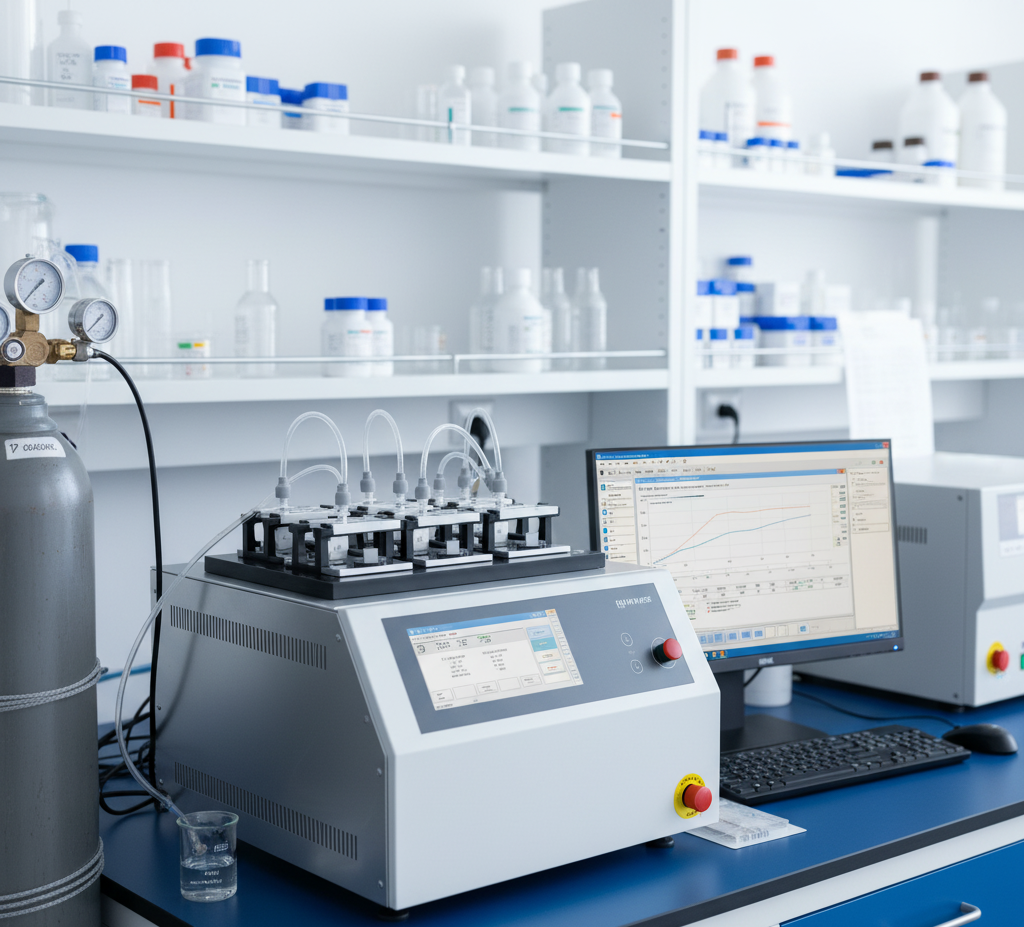
ASTM F1249 specifies the standard test method for determining the water vapor transmission rate of flexible barrier materials using an IR sensor detection technique.
This test measures the rate of water vapor transmitted through a film or sheet material during a given period under controlled temperature and humidity conditions. The procedure is ordinarily applicable to flexible packaging films, laminates, and coatings, offering an essential measure of their moisture barrier performance.
WVTR data helps determine the suitability of materials used to package products susceptible to moisture, such as foodstuffs, pharmaceuticals, electrical, and medical equipment.
Controlling moisture transmission is crucial for maintaining product quality, shelf life, and optimal performance. Excessive moisture ingress can cause spoilage, corrosion, or degradation of packaged goods.
ASTM F1249 testing helps:
The test is recognized globally as a reliable, standardized method for determining WVTR in flexible materials.
ASTM F1249 applies to a wide range of flexible barrier materials, including:
The materials can be tested in sheet or film form, typically with thicknesses up to 3 mm, depending on the permeability and instrument capabilities.
The test provides quantitative data on a material’s permeability to water vapor.
| Parameter | Unit | Description |
| Water Vapor Transmission Rate (WVTR) | g/m²/day | Amount of water vapor transmitted through a unit area of material in 24 hours |
| Test Temperature | °C | The temperature at which the test is conducted |
| Relative Humidity | % RH | Humidity gradient across the specimen |
| Film Thickness | µm or mm | Measured thickness of the test sample |
These results are critical for comparing materials or verifying conformance to performance specifications.
ASTM F1249 is widely used in industries where moisture control and barrier integrity are vital, such as:
This test supports product safety, quality assurance, and compliance with moisture barrier specifications.
The ASTM F1249 method utilizes a modulated infrared (IR) sensor-based instrument, commonly referred to as a MOCON Permatran-W system or its equivalent.
Typical equipment includes:
Step-by-Step Procedure:
| Parameter | Typical Condition |
| Temperature | 37.8°C ± 1°C |
| Relative Humidity | 90% RH on one side, dry nitrogen on the other |
| Pressure | Ambient |
| Sample Area | Typically 50 cm² |
| Test Duration | Until steady-state transmission is achieved (commonly 8–24 hours) |
Maintaining consistent temperature and humidity conditions is essential for accurate and reproducible WVTR measurements.
ASTM F1249 measures a material’s water vapor permeability, specifically:
These properties provide valuable insight into how a packaging material will perform in real-world environments where moisture exposure is critical.
ASTM F1249 enables the accurate measurement of the water vapor transmission rate of flexible barrier materials using infrared detection in a highly reproducible manner.
By precisely measuring the amount of moisture that permeates the packaging films, this test allows manufacturers to validate product performance in terms of extended shelf life and quality maintenance in moisture-sensitive applications.
It explains that ASTM F1249 is a crucial tool in packaging development, quality assurance, and regulatory compliance, supporting industries where barrier reliability directly impacts product integrity.
Infinita Lab offers comprehensive ASTM F1249 testing services, a Comprehensive lab network, project management, confidentiality, and rapid turnaround. Trust Infinita Lab for your material testing needs, Faster test results, cost savings, and reduced administrative workload.
Looking for a trusted partner to achieve your research goals? Schedule a meeting with us, send us a request, or call us at (888) 878-3090 to learn more about our services and how we can support you. Request a Quote
ASTM F1249 measures the Water Vapor Transmission Rate (WVTR) of flexible barrier materials such as films, coatings, and laminates. It determines how much water vapor passes through a material over a specific period, under controlled temperature and humidity.
WVTR testing is crucial for assessing the barrier performance of packaging materials. It helps ensure that products—especially food, pharmaceuticals, and electronics—are protected from moisture, which can cause spoilage, degradation, or reduced shelf life.
The method uses an infrared sensor (modulated infrared detection) to measure the amount of water vapor permeating through the specimen. One side of the film is exposed to high humidity, while the other side is kept dry. The water vapor diffuses through the material and is detected by the instrument.

Liquid Chromatography-Mass Spectroscopy Liquid Chromatography-Mass Spectroscopy (LC-MS) is an analytical technique that allows the separation, identification, and quantification of the...
Read Article ➙
Highly Accelerated Stress Test - HAST Testing Services A highly accelerated stress test (HAST) is an essential part of environmental...
Read Article ➙
Introduction Accelerated aging in product testing is a methodology that simulates the long-term effects of environmental factors on a product...
Read Article ➙In-depth examination of genuine material testing solutions

EELS analysis of gate and channel is performed on fin field-effect transistors (finFETs). Scanning transmission electron...
Read Case Study
Introduction PVC is the polymer primarily used to make pipes for plumbing, drainage, and electrical conduits....
Read Case Study
Nano-scale surface roughness is a critical parameter in fabricated thin-films that are used in optics, solar...
Read Case StudySubmit your contact info and we’ll get back to you within 24 hours


