
Residual Gas Analysis (RGA)
Residual Gas analysis (RGA) is commonly done for hermetically sealed microelectronic devices, to detect moisture and other damaging volatile or gaseous compounds in the device cavity. The residual gases released upon controlled heating of a pierced hermetic device are analyzed by mass spectrometry.


Introduction:
Residual Gas analysis (RGA) is commonly performed on hermetically sealed microelectronic devices to detect moisture and other damaging volatile or gaseous compounds in the device cavity. We analyze the residual gases released upon controlled heating of a pierced hermetic device using residual gas analysis mass spectrometry.
Scope of Residual Gas Analysis (RGA)
Engineers use Residual Gas Analysis (RGA) testing to ensure high reliability in microelectronic devices used in critical military, aerospace, medical, telecommunications, and industrial automation applications. For example, RGA measures the moisture content inside a metal or ceramic hermetically sealed microelectronic device using Method 1018.2 of MIL-STD-883D. Moisture can occur inside hermetic devices due to hydrogen evolving in the presence of nickel used in device packaging, reacting with reducible metal oxides to form water. In addition to moisture, using epoxies and other adhesives or polymeric materials in microelectronic devices can cause outgassing of volatile species due to insufficient curing.
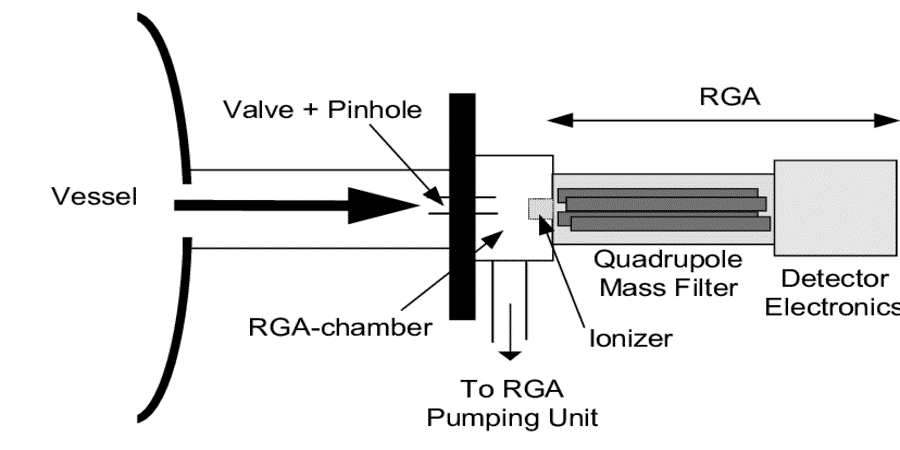
RGA, or Residual gas analysis mass spectrometry, is also used in the process industry, as well as research equipment for vacuum leak testing in ultra-high vacuum systems. It allows us to directly determine the partial pressure of gaseous components from the measured gas composition.
The standard RGA test for hermetically sealed microelectronic devices involves placing the sample in a vacuum chamber connected by a transfer passage to a suitably calibrated mass spectrometer. We heat the chamber transfer passage and maintain it at specified temperatures. Then, we pierce the sample with a sharp piercing tool outside the vacuum chamber. The tool must be capable of piercing metallic and ceramic packages. The specimen’s internal gases, which are released, are then conveyed to the mass spectrometer for analysis. Most Mass spectrometers used in RGA utilize Quadrupole-type mass analyzers with a wide dynamic range of measurement.
Common Uses of Residual Gas Analysis (RGA)
- It can perform moisture and gaseous component analysis of hermetically sealed microelectronic devices.
- It can also perform vacuum leak and residual gas analysis testing on ultra-high vacuum equipment.
Advantages and Industrial Applications of Residual Gas Analysis (RGA)
The following are some of the advantages and applications associated with RGA:
| Advantages | Industrial Applications |
| Sensitive down to parts per billion | Microelectronic device quality control |
| Ability to analyze the outgassing problem | Vacuum process control |
| Can determine the partial pressure of gaseous component at low pressures | Sealing quality control |
Limitations of Residual Gas Analysis (RGA)
- The analysis by mass spectrometer requires three spectral data covering background, calibration, and sample spectra.
- Small devices may have only traces of moisture, which can mask external moisture leakage into the vacuum system.
Conclusion:
RGA is an essential test technique for reliability and quality in hermetically sealed microelectronic devices, especially within strategic applications, including aerospace, military, and biomedical applications. The moisture test and other volatile species by mass spectrometry within the RGA prevent device failures caused by internal contamination. It is a destructive test, and its preparation is compassionate; it requires meticulous calibration. Furthermore, the ability of the test to detect deficient concentrations of gases makes this test very important in quality control and vacuum process management. Infinita Lab brings extensive experience in RGA testing and guarantees the accuracy and reliability of results to support the highest standards of product performance and safety.
FAQs:
RGA, or Residual Gas analysis, testing is commonly performed on hermetically sealed microelectronic devices to detect moisture and other damaging volatile or gaseous compounds in the device cavity.
The common uses of RGA are: It can perform moisture and gaseous component analysis of hermetically sealed microelectronic devices, It can also perform vacuum leak testing and residual gas analysis on ultra-high vacuum equipment.
Mass spectrometry analyzes the gaseous components released from the device in RGA. It also measures the mass-to-charge ratio of ions to identify and quantify different gases present in the sample.
It is a method used to detect leaks in sealed packages.
Moisture trapped in hermetically sealed microelectronic devices leads to corrosion, electrical shorts, and other forms of degradation that eventually result in device failure. RGAs capable of detecting and quantifying moisture provide the device's reliability and performance.
 Metrology Testing Service

- Inductively Coupled Plasma Atomic Emission Spectroscopy
- Thermal Resistance Testing and Measurement Services
- Flow Calibration
- Air-Jet Sieve for Particle Size Analysis
- Fourier Transform Infrared Spectroscopy – FTIR
- Vacuum Calibration: Methods, Standards, and Industrial Applications
- Focused Ion Beam SEM (FIB-SEM)
- High-Resolution Mass Spectrometry (HRMS) for Industrial Advancement
- View All


3 Easy Steps to Start Testing


Case Studies
In-depth examination of genuine material testing solutions
Dopant and Ultra-Low Concentration Elemental Analysis Using STEM…

Dopant and Ultra-Low Concentration Elemental Analysis Using STEM…
Introduction to STEM-EELS for Elemental Analysis Scanning Transmission Electron Microscopy (STEM) combined with Electron Energy Loss...
Read Case StudyAnalysis of PVC Pipe Degradation Using FTIR Spectroscopy

Analysis of PVC Pipe Degradation Using FTIR Spectroscopy
PVC Pipe in Infrastructure — and Why Degradation Matters Polyvinyl chloride (PVC) pressure pipe is one...
Read Case StudyNano-scale roughness measurement of Si-wafers by Atomic Force…

Nano-scale roughness measurement of Si-wafers by Atomic Force…
Nano-scale surface roughness is a critical parameter in fabricated thin-films that are used in optics, solar...
Read Case StudyTalk to Our Experts Today!
Submit your contact info and we’ll get back to you within 24 hours


