
ASTM D2095 Tensile Strength of Adhesives by Means of Bar and Rod Specimens
The ASTM D2095 test technique is used to determine the relative tensile strength of adhesives using bar-and rod-shaped butt-joined specimens under specific preparation, conditioning, and testing conditions. Tension tests are a good way to find out how strong an adhesive is in terms of tensile strength.
TRUSTED BY


Precision-driven testing for dimensional accuracy and compliance
- Overview
- Scope, Applications, and Benefits
- Test Process
- Specifications
- Instrumentation
- Results and Deliverables
Overview
ASTM D2095 describes a standard test method for determining the tensile strength of adhesives bonded between metal rods or bars. This test determines the maximum stress an adhesive joint can withstand under uniaxial tensile loading before failure occurs. This test method is widely used to qualify structural and engineering adhesives for cylindrical bonding applications. By simulating service conditions where tensile loads predominate, ASTM D2095 yields critical performance data valuable for material selection, quality control, and product development.
It provides valuable information on adhesive strength, joint durability, and expected service behavior, helping manufacturers and engineers to establish performance criteria that ensure product reliability.

Scope, Applications, and Benefits
Scope
ASTM D2095 outlines procedures for determining the tensile strength of rigid and semi-rigid adhesives used to bond machined metal rods or bars.
It evaluates:
- Maximum tensile stress at bond failure
- Adhesive joint durability
- Failure behavior under controlled loading
- Effect of curing and surface preparation
- Bond integrity under axial tension
The method applies primarily to structural adhesives used in load-bearing joints.
Applications
- Aerospace structural bonding
- Automotive assembly
- Industrial equipment manufacturing
- Metal fabrication and joining
- Mechanical component bonding
- Product qualification and validation testing
Benefits
- Provides accurate tensile strength measurement
- Enables comparison between adhesive systems
- Supports quality control programs
- Helps optimize surface preparation and curing processes
- Predicts service performance under tensile loads
- Improves product safety and reliability
Test Process
Specimen Preparation
Metal rods or bars are machined to specified dimensions. Bonding surfaces are cleaned and treated mechanically or chemically. Adhesive is applied uniformly, and specimens are aligned concentrically before curing.
1Conditioning of Specimens
Bonded samples are conditioned at controlled laboratory temperature and humidity to stabilize material behavior.
2Tensile Loading Test
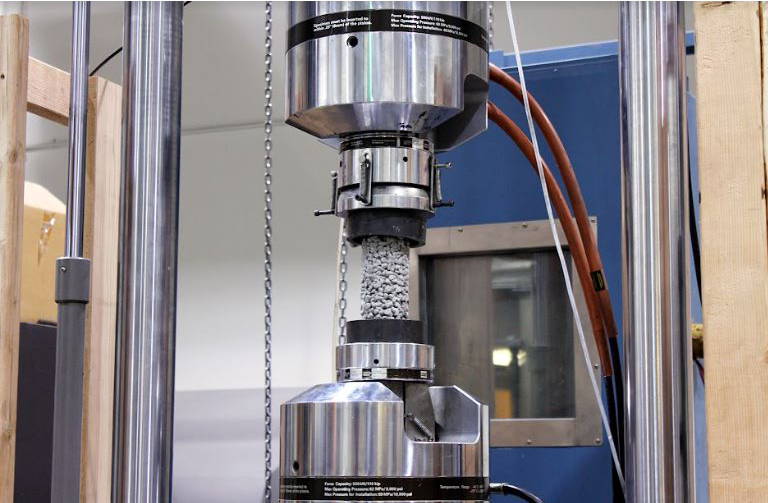
Specimens are mounted in a universal testing machine using self-aligning grips. A controlled axial tensile load is applied until bond failure occurs.
3Failure Recording & Analysis
Maximum load at failure is recorded and converted to tensile strength. Failure mode (adhesive, cohesive, or substrate) is visually examined.
4Technical Specifications
| Parameter | Details |
|---|---|
| Applicable Materials | Rigid and semi-rigid structural adhesives |
| Specimen Type | Bonded metal rods or bars |
| Bond Area | Precisely machined circular cross-section |
| Loading Rate | As specified by the test standard |
| Conditioning Environment | Controlled temperature and humidity |
| Output Units | MPa or psi |
Instrumentation Used for Testing
- Universal testing machine (UTM)
- Self-aligning tensile grips
- Precision alignment fixtures
- Load cell with digital data acquisition
- Environmental conditioning chamber (if required)
- Measurement and analysis software
Results and Deliverables
- Tensile strength values (MPa or psi)
- Peak failure load data
- Identification of failure mode (adhesive, cohesive, substrate)
- Comparative performance evaluation of adhesives
- Data for material qualification and certification
- Documentation for quality control and compliance
Frequently Asked Questions
ASTM D2095 is used to determine the tensile strength of adhesives by applying a uniaxial tensile load to bonded bar or rod specimens until failure occurs.
This method applies to many structural and engineering adhesives such as epoxies, acrylics, polyurethane, and anaerobic adhesives.
Tensile strength is calculated by dividing the maximum load at failure by the cross-sectional area of the bonded surface.
Case Studies
In-depth examination of genuine material testing solutions
Dopant and ultra-low concentration elemental analysis using Scanning…

Dopant and ultra-low concentration elemental analysis using Scanning…
EELS analysis of gate and channel is performed on fin field-effect transistors (finFETs). Scanning transmission electron...
Read Case StudyAnalysis of degradation of PVC pipe using Fourier…

Analysis of degradation of PVC pipe using Fourier…
Introduction PVC is the polymer primarily used to make pipes for plumbing, drainage, and electrical conduits....
Read Case StudyNano-scale roughness measurement of Si-wafers by Atomic Force…

Nano-scale roughness measurement of Si-wafers by Atomic Force…
Nano-scale surface roughness is a critical parameter in fabricated thin-films that are used in optics, solar...
Read Case Study
Request a Quote
Submit your material details and receive testing procedures, pricing, and turnaround time within 24 hours.
 Quick Turnaround and Hasslefree process
 Confidentiality Guarantee
 Free, No-obligation Consultation
 100% Customer Satisfaction
