
ASTM E110-14 Test for Rockwell and Brinell Hardness of Metallic Materials by Portable Hardness Testers
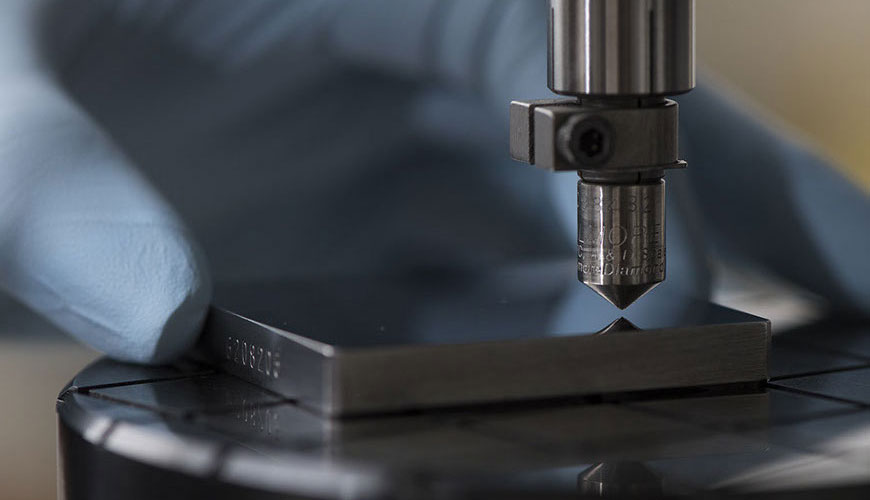
ASTM E110 test method is used to determine a metal’s Rockwell and Brinell hardness by using portable hardness testers. Portable hardness testers test metals that cannot be tested by fixed instruments because of the metal's size, location, or other requirements.
TRUSTED BY


Precision-driven testing for dimensional accuracy and compliance
- Overview
- Scope, Applications, and Benefits
- Test Process
- Specifications
- Instrumentation
- Results and Deliverables
Overview
ASTM E110-14 is a Standard Test Method for Rockwell and Brinell hardness of metallic materials. This test method is applicable to defining procedures for using portable devices to measure Rockwell and Brinell hardness of large, immovable objects or in-situ metals when lab testing isn’t feasible or reliable, while ensuring field results align with fixed-tester results.
ASTM E110-14 is the revision of the ASTM E110 standard. Included herein are the modifications and improvements made to the original version. ASTM E110-14 refers to the fact that this edition was published in 2014. Updates to standards might relate to the following:

Scope, Applications, and Benefits
Scope
The ASTM E110-14 standard test method is used to determine Rockwell and Brinell hardness of metallic materials using a portable hardness tester. The test is essential when samples are too bulky or heavy to be assessed by traditional, immobile instruments. This standard provides procedures for testing hardness in configurations where standard lab configurations cannot be used. This will ensure that hardness test results are obtained with reasonable accuracy and reliability, even under non-standard laboratory conditions. This standard addresses the requirements for test equipment, specimen preparation, and data interpretation.
Applications
- Architectural glazing and building glass.
- Automotive glass components.
- Heat-resistant and safety glass evaluation.
- Glass is used in appliances and industrial equipment.
- Research and development of new glass compositions.
Benefits
- Provides a standardized method for determining the thermal shock resistance of glass.
- Helps predict glass performance under sudden temperature changes.
- Improves the safety and reliability assessment of glass products.
- Supports quality control during glass manufacturing.
- Assists in material selection for thermally demanding environments.
Testing Process
Portable Hardness Tester
Used for Rockwell and Brinell hardness testing
1Indenters
Carbide balls or diamond cones for indentation.
2Calibration Blocks
Hardness Calibration Material for Instrument Verification.
3Microscope/Optical Device
To measure the diameter of the indentation.
4Technical Specifications
| Parameter | Details |
|---|---|
| Test Purpose | Thermal shock resistance of flat glass |
| Applicable Materials | Flat glass products |
| Key Variable | Temperature differential (ΔT) |
| Failure Criteria | Cracks or breakage |
| Test Result | Maximum ΔT without failure |
| Reporting | Glass type, thickness, temperatures, and failure point |
Instrumentation Used
- Hardness testing machine (Rockwell and/or Brinell
- Diamond cone and hardened steel or carbide ball indenters
- Load the application and control system
- Optical measurement system (for Brinell indentation)
- Specimen support and anvil
- Data display or recording system
Results and Deliverables
- Determines the hardness of metals using portable hardness testers
- Applicable to Rockwell and Brinell off-site (off-quarry) test methods
- Ideal for large, heavy, or fixed components, not suitable for bench testers
- Provides guidelines for equipment calibration
- Specifies specimen preparation requirements
- Defines data calculation and standard formulae for hardness values
- Supports industrial quality control and material evaluation applications
Frequently Asked Questions
ASTM E110-14 is used for measuring the indentation hardness of metallic materials using portable hardness testers. Portable hardness testers are commonly used in field and laboratory settings where fixed testers are impractical.
The method is prevalent in hardness testing of huge, heavy, or immovable objects such as manufacturing plants, machinery, and especially steel structures.
ASTM E110-14 applies to metallic materials, including steel, aluminum, and other alloys.
The standard addresses various hardness scales, such as Rockwell, Brinell, and Vickers, ensuring compatibility and comparability with different testing methods.
Case Studies
In-depth examination of genuine material testing solutions
Dopant and ultra-low concentration elemental analysis using Scanning…

Dopant and ultra-low concentration elemental analysis using Scanning…
EELS analysis of gate and channel is performed on fin field-effect transistors (finFETs). Scanning transmission electron...
Read Case StudyAnalysis of degradation of PVC pipe using Fourier…

Analysis of degradation of PVC pipe using Fourier…
Introduction PVC is the polymer primarily used to make pipes for plumbing, drainage, and electrical conduits....
Read Case StudyNano-scale roughness measurement of Si-wafers by Atomic Force…

Nano-scale roughness measurement of Si-wafers by Atomic Force…
Nano-scale surface roughness is a critical parameter in fabricated thin-films that are used in optics, solar...
Read Case Study
Request a Quote
Submit your material details and receive testing procedures, pricing, and turnaround time within 24 hours.
 Quick Turnaround and Hasslefree process
 Confidentiality Guarantee
 Free, No-obligation Consultation
 100% Customer Satisfaction
