
X-Ray Diffraction (XRD)
An effective, non-destructive analytical method for analyzing crystalline materials is X-ray diffraction (XRD).


Introduction
X-ray Diffraction (XRD) is a non-destructive analytical technique applied to execute analyses for materials’ crystallographic structures, composition, and physical properties. It works based on the properties of a combination of X-rays with the material utilizing the crystalline material to obtain values of the lattice parameters, crystal size, strain, and molecular structures. Its diversified utility and accuracy make XRD one of the most essential instruments in material science, chemistry, pharmaceuticals, and semiconductors.
Scope
The article provides an overview of XRD, a non-destructive technique that analyzes materials’ crystallographic structure and properties. This examines the basic principles of XRD; these would entail the diffractometer and Bragg’s Law, which can be reflected as a central element in the work process of X-ray diffraction. It also elaborates on the requirements of the samples for XRD analysis and how the method finds applications in material science, semiconductors, pharmaceuticals, and quality control. Through its presentation of the capability of XRD, this article will provide insight into the practical application of the method in real industries and laboratories to characterize materials accurately.
Principles of X-Ray Diffraction
Bragg’s Law:
The basic principle that XRD is based upon is Bragg’s Law, which describes the relation between the wavelength of X-rays, spacing between lattice planes in a crystal, and the angles at which diffraction occurs.
nλ=2dsinθ
n: Order of reflection (an integer).
λ: Wavelength of the X-rays.
d: Spacing between the crystal’s lattice planes.
θ: Angle of incidence.
When X-rays encounter a crystal lattice, constructive interference occurs if Bragg’s Law conditions are satisfied, resulting in observable peaks in the diffraction pattern.
Working of X-ray Diffraction (XRD)
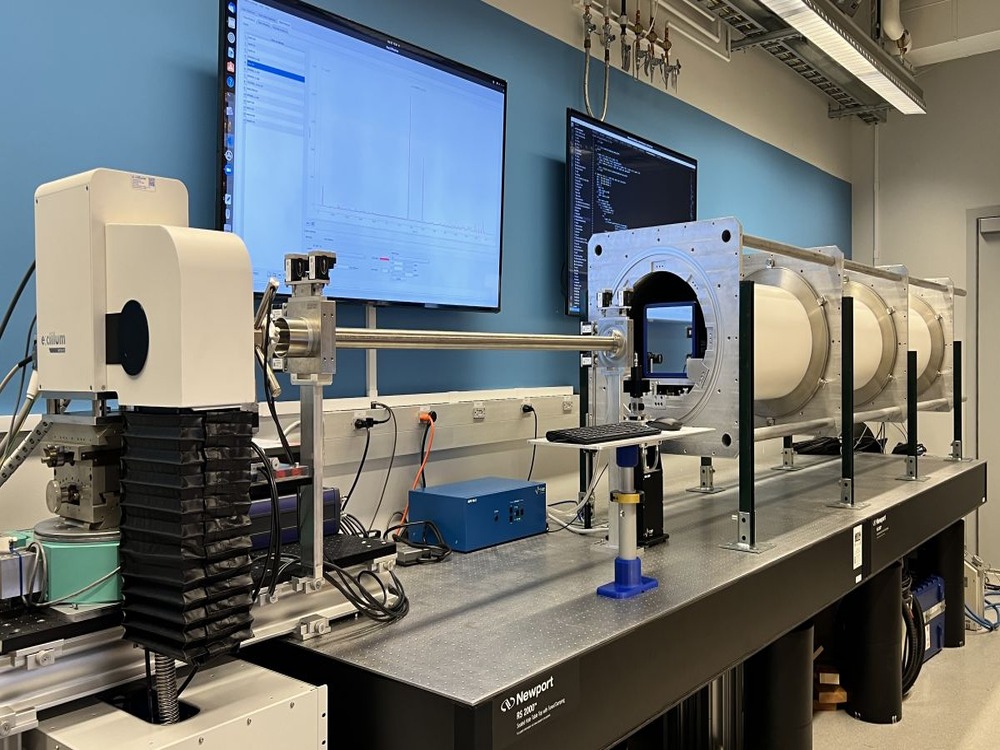
The three major components of an X-ray diffractometer are an X-ray tube, a sample holder, and an X-ray detector. It works by actually producing X-rays through a cathode ray tube. The generation process follows this approach: electrons generated by heating the filament are then accelerated toward a target. When the electrons hit the target material, they knock off some inner shell electrons, creating characteristic X-rays. These X-rays consist primarily of Kα and Kβ lines. Kα can then be divided into Kα1 and Kα2, and the latter has a shorter wavelength but higher intensity. The typical target material for single-crystal diffraction is copper, producing X-rays of around 1.5418 Å. The filtered X-ray beam by foils or a crystal monochromator ensures that monochromatic X-rays are ensured for all diffraction experiments. In this way, the beam will predominantly consist of Kα1, which is better suited for analysis.
The generated X-rays are then focused onto the sample. The reflected X-rays are measured as the sample, and the detector rotates. Hence, constructive interference occurs when the angle of incidence for X-rays obeys Bragg’s Law and a maximum intensity of the reflected X-rays is detected. The detector and the resulting signal measure this intensity is converted into count rate, thus being able to be displayed on a monitor or printed. In this setup, the sample is set at an angle (θ) and the detector at 2θ so that diffracted X-rays are captured. A goniometer operates in this setup because it controls the two angles to be maintained with millimeter accuracy for both the sample and the detector. Typically, for X-ray powder diffraction, data collection is conducted between 5° and 70° for 2θ angles, which are preset beforehand.
Sample
The samples should contain 50-100 milligrams of material for the powder method. The dimensions of single-crystal samples must range between 0.1 and 0.5 mm. Thin films should have a thickness ranging from 100 nm to several microns.
Result
X-ray diffraction analysis provides information concerning the material properties, identification phase, and crystallographic structure of samples under study. Highly accurate, non-destructive analyses are possible for various materials, from powders and thin films to solids.
Applications of X-ray Diffraction
The applications of X-ray diffraction are as follows:
Aspect | Description |
Crystallography | It determines the crystal structure, lattice parameters, and symmetry of materials. |
Material Characterization | It aids in analyzing microstructure, crystallite size, and strain within materials. |
Quality Control | It ensures consistency and quality in the materials and products involved in the industrial processes. |
Semiconductor Industry | It characterizes thin films, doping levels, and crystal quality of semiconductors. |
FAQs
XRD is a non-destructive technique for determining a material's chemical composition, crystal structure, crystal orientation, crystallite size, lattice strain, preferred orientation, and layer thickness.
There are two forms of XRD techniques: single-crystal and powder. The difference between these methods is scale. As the name suggests, a single-crystal analysis focuses on the exact atomic positions of a single well-ordered crystal, whereas powder XRD characterizes a bulk material sample.
It is non-destructive and provides detailed crystallographic information. It is relatively speedy and can be applied to studying different varieties of materials without major sample preparations.
XRD helps characterize semiconductor materials by determining the crystal quality, doping levels, and properties of thin films applied to semiconductor devices such as transistors and solar cells.
Grazing Incidence X-ray Diffraction is considered a specialty XRD technique that is very helpful in studying thin films and surface structures at shallow angles to provide detailed surface analysis.
 Metrology Testing Service

- Electron Backscatter Diffraction (EBSD)
- How can thermomechanical Analysis (TMA) identify the dimensional changes of a material?
- Optical Profilometry
- Thin-Layer Chromatography (TLC)
- Differential Hall Effect Metrology (DHEM)
- Titrimetry (Titration) Testing: Types, Methods & Analytical Applications
- High-Resolution Mass Spectrometry (HRMS) for Industrial Advancement
- Refractometry (Refractometry)
- View All


3 Easy Steps to Start Testing

Case Studies
In-depth examination of genuine material testing solutions
Case Study: Dopant & Ultra-Low Concentration Analysis via…

Case Study: Dopant & Ultra-Low Concentration Analysis via…
Introduction to STEM-EELS for Elemental Analysis Scanning Transmission Electron Microscopy (STEM) combined with Electron Energy Loss...
Read Case StudyCase Study: PVC Pipe Degradation Analysis Using FTIR…

Case Study: PVC Pipe Degradation Analysis Using FTIR…
PVC Pipe in Infrastructure — and Why Degradation Matters Polyvinyl chloride (PVC) pressure pipe is one...
Read Case StudyNano-scale roughness measurement of Si-wafers by Atomic Force…

Nano-scale roughness measurement of Si-wafers by Atomic Force…
Nano-scale surface roughness is a critical parameter in fabricated thin-films that are used in optics, solar...
Read Case StudyTalk to Our Experts Today!
Submit your contact info and we’ll get back to you within 24 hours


