
ASTM D7028-07 Glass Transition Temperature of Polymer Matrix Composites
The glass transition temperature (Tg) is determined using the standard testing method ASTM D7028-07. Dynamic Mechanical Analysis (DMA) technique is used for testing. The values are reported in the SI unit.


Scope:
ASTM D7028-07 test method defines the procedure to evaluate the dry and wet transition temperature (Tg) for polymer matrix composites. The polymer matrix composites contain high modulus, 20 GPa fibers that are analyzed using the dynamic mechanical analyzer (DMA). Experimental parameters, apparatus used, and the physical property measured affect the glass transition temperature. This test method is primarily intended for polymer matrix composites reinforced by continuous, oriented, high modulus fibers. The values are reported in SI units.
Test procedure:
In ASTM D7028-07 the specimen thickness, width, length, and weight are recorded. A flat rectangular strip of laminate is placed in the dynamic mechanical analyzer (DMA). It is then oscillated at a nominal frequency of 1Hz. The test specimen is heated at 5 °C/min. The same parameters are used for both dry and wet specimens to facilitate comparison. The glass transition temperature (DMA Tg) is noted when a significant drop in the storage modulus is observed during the method. The run is set to begin at room temperature or a temperature at least 50 °C below the estimated DMA Tg` and end at a temperature at least 50 °C above DMA Tg but below the decomposition temperature. Load and displacement data are recorded as a function of temperature. The specimen under test needs to be examined for any visual oddity such as blisters, cracks, etc. post completion of the test.
Specimen size:
Depending on the analyzer, typical specimen size can range from 56 ± 4 × 12 ± 1 × 2.0 ± 0.5 mm (L × W × T) to 22 ± 1 × 3 ± 1 × 1.0 ± 0.5 mm
Data:
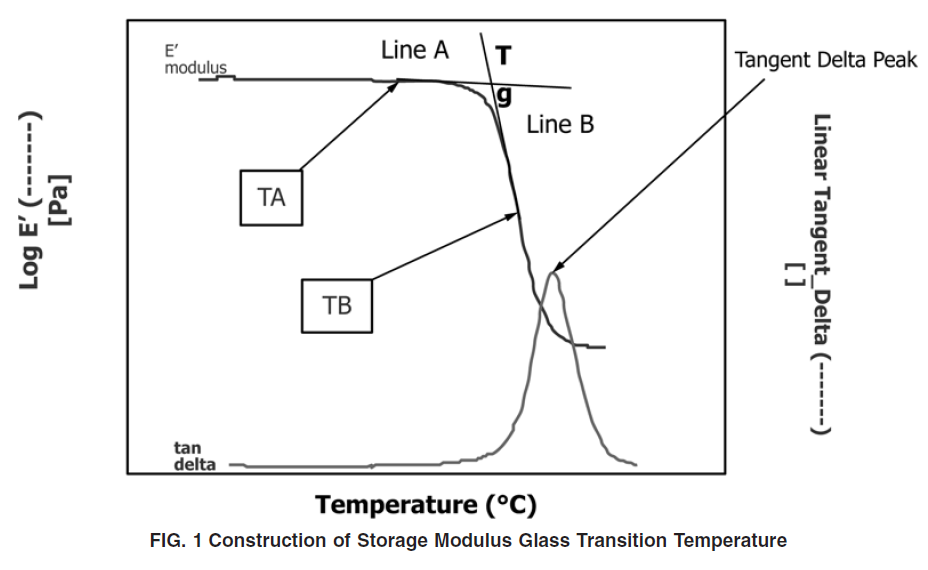
Plot logarithm of storage modulus (E’) and linear tangent delta (tan δ) versus the linear temperature. The DMA Tg is determined to be the intersection of two tangent lines from the storage modulus by this test method. The figure below shows a typical plot for determining the DMA Tg–
Talk to Our Experts Today!
Submit your contact info and we’ll get back to you within 24 hours
Full Spectrum of ASTM Material Testing — Backed by 2,000+ Trusted Lab Partners
ASTM standards for chemical composition, physical properties, failure analysis, and other routine and non-routine testing for polymers and plastics
ASTM standards for determination of mechanical, physical, and thermal properties, and performance of monolithic and composite ceramics
ASTM standards guiding various destructive, non-destructive and analytical tests for quality control of different metals and alloys
ASTM standards for chemical analysis of solid, liquid and gaseous materials for specification compliance and quality control
ASTM standards for various chemical, physical, stability and exposure analysis of paints and coatings
Our Services

Metrology
A variety of microscopy and spectroscopy tools available for precise measurements from the nano to the meter scale.
Learn More
Materials Testing
ASTM and ISO standard and custom chemical, mechanical, thermal, corrosion tests, etc. for all materials metals, ceramic or polymers.
Learn More
Product Testing
Thousands of tests for product quality and reliability under heat, humidity, temperature shock, vibration, drop, electrostatic discharge.
Learn More


