
ASTM E606: Strain-Controlled Fatigue Testing (LCF)
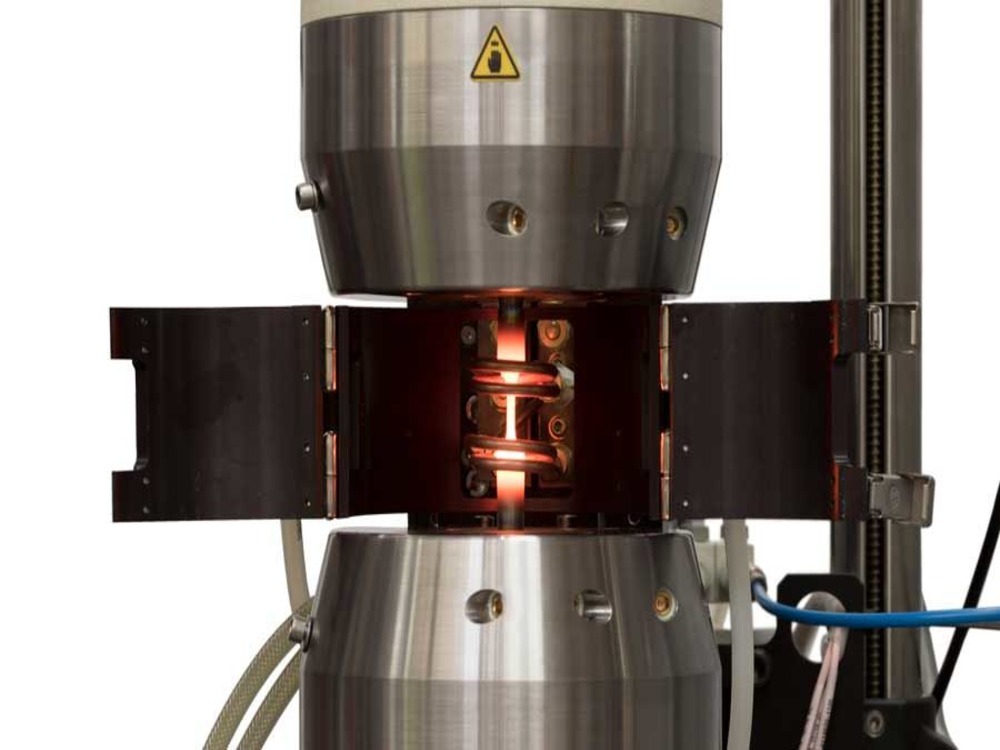
The ASTM E606 standard test technique uses uniaxial forces to assess the strain-controlled fatigue parameters of supposedly homogenous materials. The same factors that affect force-controlled fatigue also affect the phenomena of strain-controlled fatigue. The ASTM E606 test is designed to serve as a manual for fatigue testing of inelastic and plastic materials at low and high cycles. Read more about ASTM E606 Strain-Controlled Fatigue Test below.
TRUSTED BY


Precision-driven testing for dimensional accuracy and compliance
- Overview
- Scope, Applications, and Benefits
- Test Process
- Specifications
- Instrumentation
- Results and Deliverables
Overview
ASTM E606 is the global standard for Strain-Controlled Fatigue Testing, principally utilized to define the Low-Cycle Fatigue (LCF) behavior of metallic materials. ASTM E606 cycles a specimen between particular strain limits, in contrast to force-controlled tests (ASTM E466), which cycle a specimen between specific load limits.
This technique is essential for components that frequently undergo plastic deformation, such as turbine blades, engine pistons, and pressure vessels, where the material stretches and contracts beyond its elastic limit due to thermal expansion or high mechanical loads.

Scope, Applications, and Benefits
Scope
ASTM E606 covers the determination of strain-controlled fatigue properties of metallic materials under axial loading. The test method is used to generate low-cycle fatigue (LCF) data by subjecting a specimen to controlled cyclic strains, typically at constant amplitude, to evaluate the material’s response to repeated plastic and elastic deformation. The standard provides procedures for testing, data acquisition, and analysis to characterize cyclic stress–strain behavior and fatigue life under strain-controlled conditions.
Applications
- Fatigue assessment of structural and engineering metals
- Design and evaluation of aerospace, automotive, and power plant components
- Analysis of components exposed to thermal cycling and mechanical strain
- Qualification of materials for high-stress, low-cycle loading environments
- Research and development of new alloys and heat-treated materials
Benefits
- Enables accurate evaluation of low-cycle fatigue behavior of metals
- Provides critical data for strain-life (ε–N) fatigue analysis
- Helps in understanding cyclic hardening and softening characteristics
- Supports design validation for components subjected to plastic deformation
- Improves prediction of fatigue life under severe service conditions
- Aids in material selection and comparison for fatigue-critical applications
Testing Process
Specimen Preparation
Machine and finish specimen as per standard geometry and surface requirements.
1Equipment Setup
Install the specimen in a calibrated axial fatigue-testing machine with strain-control capability.
2Extensometer Attachment
Attach a suitable axial extensometer to accurately measure and control strain.
3Result Calculation
Determine fatigue life, cyclic stress–strain response, and strain–life parameters.
4Technical Specifications
| Parameter | Details |
|---|---|
| Loading Mode | Fully reversed or with specified mean strain |
| Strain Rate | Constant, as defined in the test program |
| Specimen Geometry | Standard cylindrical or flat specimen |
| Data Recorded | Strain, stress, cycles to failure |
| Failure Criterion | Fracture or defined load/strain drop |
Instrumentation Used
- Servo-hydraulic fatigue testing machine
- High-accuracy load cell
- Strain-controlled extensometer
- Fatigue-rated specimen grips and fixtures
- Controller for cyclic loading and waveform generation
- Data acquisition and fatigue analysis software
Results and Deliverables
- Number of cycles to failure under specified strain amplitude
- Cyclic stress–strain response of the material
- Evidence of cyclic hardening or cyclic softening behavior
- Hysteresis loop characteristics at selected cycle intervals
- Strain–life (ε–N) fatigue parameters derived from test data
- Stress amplitude variation with increasing fatigue cycles
- Mode of failure and fracture characteristics (if examined)
Frequently Asked Questions
ASTM E606 generally covers metallic materials, such as those alloys with typical compositions, including steels, aluminum alloys, titanium alloys, and most other metals and alloys. This test method applies to materials for which large plastic deformation may be expected under cyclic loading.
Standard loading profiles are sinusoidal, triangular, or periodic waveforms. The loading profile must be stated based on the material's expected service conditions and test objectives.
Yes, ASTM E606 can be adapted to high-temperature testing with proper test machines and environmental controls. Special considerations for high-temperature tests include temperature-controlled chambers and materials that won't degrade at elevated temperatures.
Environmental conditions like temperature, humidity, and corrosive environments can greatly influence fatigue behavior. Testing under controlled environmental conditions must be performed to properly assess the material's performance under close to real application conditions.
Case Studies
In-depth examination of genuine material testing solutions
Case Study: Dopant & Ultra-Low Concentration Analysis via…

Case Study: Dopant & Ultra-Low Concentration Analysis via…
Introduction to STEM-EELS for Elemental Analysis Scanning Transmission Electron Microscopy (STEM) combined with Electron Energy Loss...
Read Case StudyAnalysis of PVC Pipe Degradation Using FTIR Spectroscopy

Analysis of PVC Pipe Degradation Using FTIR Spectroscopy
PVC Pipe in Infrastructure — and Why Degradation Matters Polyvinyl chloride (PVC) pressure pipe is one...
Read Case StudyNano-scale roughness measurement of Si-wafers by Atomic Force…

Nano-scale roughness measurement of Si-wafers by Atomic Force…
Nano-scale surface roughness is a critical parameter in fabricated thin-films that are used in optics, solar...
Read Case Study
Request a Quote
Submit your material details and receive testing procedures, pricing, and turnaround time within 24 hours.
 Quick Turnaround and Hasslefree process
 Confidentiality Guarantee
 Free, No-obligation Consultation
 100% Customer Satisfaction
