
ASTM E111 Test for Young’s Modulus, Tangent Modulus, and Chord Modulus
ASTM E111 is used to determine Young's modulus, tangent modulus, and chord modulus of structural materials. This test method is limited to materials in which creep deformation is negligible compared to the strain (deformation) produced immediately upon loading. The values stated in SI units are to be regarded as standard.
TRUSTED BY


Precision-driven testing for dimensional accuracy and compliance
- Overview
- Scope, Applications, and Benefits
- Test Process
- Specifications
- Instrumentation
- Results and Deliverables
Overview
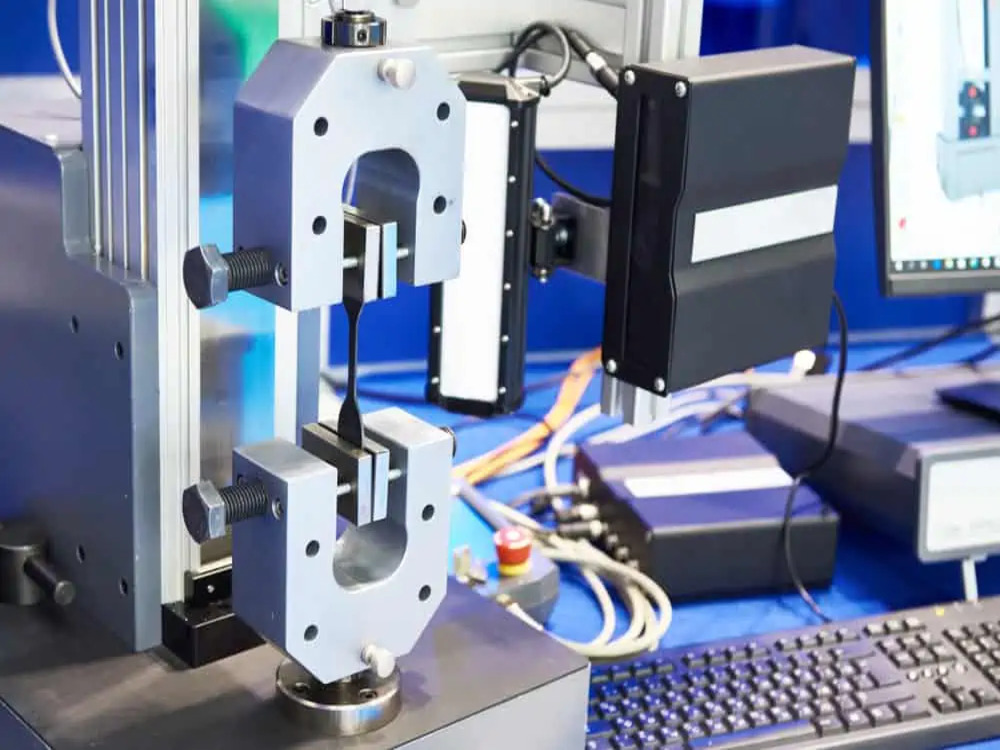
ASTM E111 is the standard test method for ascertaining Young’s Modulus (stiffness), tangent modulus, and chord modulus of structural materials subjected to uniaxial loading. It measures the slope of the stress-strain curve, particularly beneficial for materials exhibiting linear or mildly non-linear elastic behavior, where creep is minimal. The method uses universal testing machines with extensometers to quantify elastic deformation.
This test method is limited to materials in which creep deformation is negligible compared to the strain (deformation) produced immediately upon loading. The values are in SI units.

Scope, Applications, and Benefits
Scope
ASTM E111 is a vital component test procedure for measuring a material’s stress-strain curve. Numerous characteristics, including yield strength and Young’s modulus, are revealed by this curve, which also illustrates the relationship between stress, strain, load, and deformation.
A solid material experiences elastic deformation when a small load is applied. When the force is removed, the material reverts to its initial shape because elastic deformation is reversible.
Applications
- In determination of elastic properties of metals, polymers, composites, and ceramics.
- Used in finite element analysis (FEA) and structural analysis.
- Verifies consistency of material stiffness across production batches.
- Structural and mechanical properties analysis for components subjected to tensile loads.
- To assess deformation behavior under service conditions.
Benefits
- Standardized and reliable as these standards provide a reproducible method for modulus determination.
- Multiple modulus evaluation methods.
- High accuracy minimizes experimental error in modulus calculations.
- Cost-effective testing.
Testing Process
Specimen Preparation
The specimen is cleaned to remove contaminants and measured to determine initial dimensions.
1Specimen Installation
The prepared specimen is mounted securely on the appropriate test fixture
2Loading Method
A uniaxial force is applied to the specimen in tension or compression.
3End Surface Requirements
Specimen ends must be flat, parallel, and perpendicular to the lateral surfaces for compression testing.
4Technical Specifications
| Parameter | Details |
|---|---|
| Test Type | Tensile / Compressive |
| Measured Properties | Young’s, Tangent & Chord Modulus |
| Materials Tested | Metals, plastics, composites, ceramics |
| Strain Measurement | Extensometer / Strain gauge |
| Result Output | Stress–strain curve & modulus values |
| Test Environment | Ambient laboratory conditions |
Instrumentation Used
- Universal Testing Machine (UTM)
- Load cell with appropriate capacity
- Extensometer (contact or non-contact)
- Constant-rate crosshead drive
- Data acquisition and analysis system
- Measuring tools (vernier calipers or micrometer)
Results and Deliverables
- ASTM E111 testing helps understand the stress–strain behavior of materials and improve overall quality and durability.
- Accurately measures Young’s modulus, tangent modulus, and chord modulus, providing critical stiffness data.
- Offers valuable insight into how materials behave under applied stress, enabling optimized design of structural components.
- Aids in material selection and design, encouraging the development of new materials and technologies.
- Predicts material behavior under varying and extreme stress conditions, ensuring long-term functionality and structural integrity.
Frequently Asked Questions
ASTM E111 determines Young's modulus, tangent modulus, and chord modulus of structural materials.
The slope at a specified value of stress or strain on the stress-strain curve is called tangent modulus.
The chord drawn between any two specified points on the slope of the stress-strain curve is called chord modulus.
Young’s modulus is the ratio of tensile stress to tensile strain. In short, Young’s modulus determines how easily a material can stretch and deform.
The value of Young’s modulus remains constant, whereas the tangent modulus varies along the stress-strain curve.
Case Studies
In-depth examination of genuine material testing solutions
Case Study: Dopant & Ultra-Low Concentration Analysis via…

Case Study: Dopant & Ultra-Low Concentration Analysis via…
Introduction to STEM-EELS for Elemental Analysis Scanning Transmission Electron Microscopy (STEM) combined with Electron Energy Loss...
Read Case StudyAnalysis of PVC Pipe Degradation Using FTIR Spectroscopy

Analysis of PVC Pipe Degradation Using FTIR Spectroscopy
PVC Pipe in Infrastructure — and Why Degradation Matters Polyvinyl chloride (PVC) pressure pipe is one...
Read Case StudyNano-scale roughness measurement of Si-wafers by Atomic Force…

Nano-scale roughness measurement of Si-wafers by Atomic Force…
Nano-scale surface roughness is a critical parameter in fabricated thin-films that are used in optics, solar...
Read Case Study
Request a Quote
Submit your material details and receive testing procedures, pricing, and turnaround time within 24 hours.
 Quick Turnaround and Hasslefree process
 Confidentiality Guarantee
 Free, No-obligation Consultation
 100% Customer Satisfaction
