
Liquid Chromatography with Tandem Mass Spectrometry (LC-MS/MS)
Liquid Chromatography with Tandem Mass Spectrometry (LC-MS/MS) is a laboratory testing technique used to analyze and identify small molecules in a sample. It is a powerful analytical tool that can detect and quantify trace levels of compounds in complex sample matrices. The technique combines two analytical systems, liquid chromatography (LC) and tandem mass spectrometry (MS/MS), to obtain detailed information about the sample.
TRUSTED BY


Precision-driven testing for dimensional accuracy and compliance
- Overview
- Scope, Applications, and Benefits
- Test Process
- Specifications
- Instrumentation
- Results and Deliverables
Overview
Liquid Chromatography with Tandem Mass Spectrometry (LC-MS/MS) is a state-of-the-art technology used to identify and detect trace amounts of substances within a messy sample. LC-MS/MS is a technology that combines the advantages of liquid chromatography and tandem mass spectrometry. In liquid chromatography, separation is achieved, and tandem mass spectrometry is used to increase its sensitivity and selectivity.
To be more specific, a sample is first subjected to liquid chromatography. The separated compounds are then subjected to a mass spectrometer that ionises and fragments them. These compounds are then detected on the basis of their mass-to-charge ratios (m/z). The tandem feature allows for the selection of specific ions and examines how these ions fragment.

Scope, Applications, and Benefits
Scope
Liquid Chromatography-Tandem Mass Spectrometry (LC-MS/MS) is a powerful technique for detecting and quantifying the presence of compounds in complex mixtures. It uses the power of liquid chromatography for separation and the ultimate sensitivity and selectivity of mass spectrometry to detect compounds present at ultralow levels.
It is a technique for identifying what is present (qualitative) and how much of a particular compound is present (quantitative) in a sample.
Applications
- Residue analysis
- Contaminant testing
- Nutritional and vitamin analysis
- Lipidomics and small-molecule profiling
- Chemical impurity profiling in industrial chemicals
- Water treatment and disinfection by-product analysis
- Natural product and herbal compound analysis
- Stability and degradation product studies
Benefits
- High sensitivity for trace-level detection
- Excellent selectivity and specificity
- Ability to analyse complex sample matrices
- Simultaneous detection of multiple analytes
- High accuracy and reproducibility
- Wide dynamic range of quantification
- Rapid and reliable chemical identification
Test Process
Sample Preparation
The sample is extracted, filtered, or diluted to remove interfering substances.
1Chromatographic Separation
Liquid chromatography separates the compounds in the sample mixture.
2Ionization & Mass Analysis
Compounds are ionized and analysed based on their mass-to-charge ratio.
3Detection & Data Analysis
Fragment ions are detected and analyzed to identify and quantify the compounds.
4Technical Specifications
| Parameter | Details |
|---|---|
| Applicable Materials | Environmental samples, Agricultural products, Plant extracts, Industrial chemicals, |
| Ionization Techniques | Electrospray ionization (ESI), atmospheric pressure chemical ionization (APCI) |
| Analysis Type | Qualitative and quantitative analysis |
| Measured Parameters | Mass-to-charge ratio (m/z) of precursor and product ions |
| Detection Capability | Trace-level detection (ng/L to pg/L range) |
| Output Units | Concentration (mg/kg, µg/L, ng/mL) |
Instrumentation Used for Testing
- Liquid chromatography (LC) system
- Tandem mass spectrometer (MS/MS)
- Ion source (ESI or APCI)
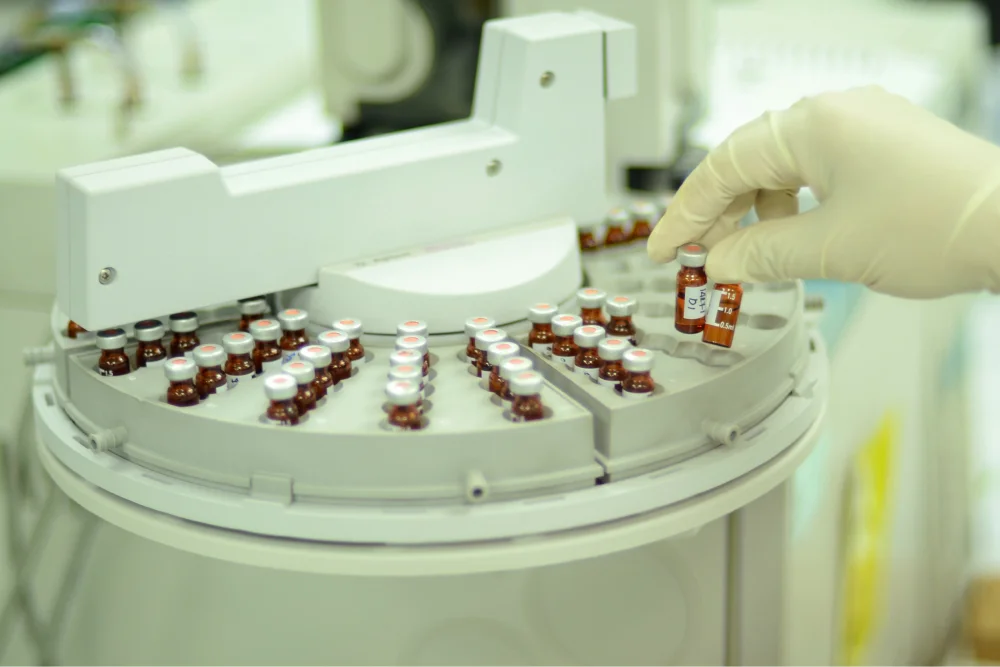
- Autosampler
- High-pressure pumps
- Analytical column
- Vacuum system
- Data acquisition and analysis software
Results and Deliverables
- Identification of target compounds
- Quantitative concentration of analytes
- Mass spectra and chromatograms
- Multi-compound residue analysis reports
- Trace contaminant detection
- Reports
Why Choose Infinita Lab for LC-MS/MS?
With Infinita Lab (www.infinitalab.com), you are guaranteed a Nationwide Network of Accredited Laboratories spread across the USA, the best Consultants from around the world, Convenient Sample Pick-Up and Delivery, and Fast Turnaround Time.
Our team understands the stakes and subtleties of every test. Whether you’re validating a new Product, de-risking a prototype, or navigating complex compliance requirements, our specialists guide the process with rigour and clarity.
Looking for a trusted partner to achieve your research goals? Schedule a meeting with us, send us a request, or call us at (888) 878-3090 to learn more about our services and how we can support you. Request a Quote
Frequently Asked Questions
LC-MS/MS is a potent technique used for disassembling, recognizing, and measuring trace amounts of compounds in a mixture. You'll find it used a lot in areas such as drug analysis, clinical analysis, environmental surveillance, food safety analysis, and research in biology.
It's a technique in which liquid chromatography is used for separating compounds and tandem mass spectrometry is used for recognizing and studying ions. In a mass spectrometer, one part of the machine captures precursor ions, which are disassembled, and another part captures product ions. It's a technique used for precise identification and measurement.
It can be used with a wide variety of samples including: - Foods and beverages - Environmental samples - Agricultural products
Concentrations are calculated using calibration standards, internal standards, and software-based data analysis. Identification is confirmed by comparing precursor and fragment ion patterns with reference databases.
The technique provides: Chromatograms showing separated compounds Mass spectra showing mass-to-charge (m/z) ratios of precursor and product ions Quantitative concentration of target analytes
Case Studies
In-depth examination of genuine material testing solutions
Dopant and Ultra-Low Concentration Elemental Analysis Using STEM…

Dopant and Ultra-Low Concentration Elemental Analysis Using STEM…
Introduction to STEM-EELS for Elemental Analysis Scanning Transmission Electron Microscopy (STEM) combined with Electron Energy Loss...
Read Case StudyAnalysis of PVC Pipe Degradation Using FTIR Spectroscopy

Analysis of PVC Pipe Degradation Using FTIR Spectroscopy
PVC Pipe in Infrastructure — and Why Degradation Matters Polyvinyl chloride (PVC) pressure pipe is one...
Read Case StudyNano-scale roughness measurement of Si-wafers by Atomic Force…

Nano-scale roughness measurement of Si-wafers by Atomic Force…
Nano-scale surface roughness is a critical parameter in fabricated thin-films that are used in optics, solar...
Read Case Study
Request a Quote
Submit your material details and receive testing procedures, pricing, and turnaround time within 24 hours.
 Quick Turnaround and Hasslefree process
 Confidentiality Guarantee
 Free, No-obligation Consultation
 100% Customer Satisfaction
