
Atomic Absorption Spectroscopy (AAS)
Discover the principles and applications of Atomic Absorption Spectroscopy (AAS) for precise elemental analysis. Learn how AAS is used to detect trace metals in various industries, including environmental monitoring and materials science, offering accurate and reliable results for quantitative analysis.
TRUSTED BY


Precision-driven testing for dimensional accuracy and compliance
- Overview
- Scope, Applications, and Benefits
- Test Process
- Specifications
- Instrumentation
- Results and Deliverables
Overview
Atomic Absorption Spectroscopy (AAS) is a method for determining the quantity of a given metal in a sample, whether it’s a solid, a liquid, or an environmental sample. Basically, it’s a simple concept: atoms of a particular element absorb light at specific wavelengths, and the wavelengths for a given element are unique.
A light beam of a specific wavelength, given off by a hollow cathode lamp specific to the particular element of interest, shines through the sample. The amount of light absorbed by the sample is directly proportional to the amount of the particular element present. Because of the sensitivity and specificity of AAS, it’s a popular method for trace metal analysis.

Scope, Applications, and Benefits
Scope
Atomic Absorption Spectroscopy (AAS) is something you use when you need to know exactly how much metal is present in something. It does this by shining light onto free atoms in the gas phase and measuring just how much of this light is absorbed, which in turn helps you detect trace levels or larger amounts of metals in something. AAS is used in various fields, including environmental, materials, and industrial testing.
The Applications of Atomic Absorption Spectroscopy are:
- Environmental samples
- Metals and alloys
- Polymers and plastics
- Industrial chemicals
Applications
- Trace metal analysis in environmental monitoring
- Quality control in manufacturing industries
- Heavy metal detection in water and wastewater
- Geological and mining analysis
- Metal purity verification
- Agricultural soil analysis
Benefits
- High sensitivity for trace metal detection
- Element-specific analysis
- High accuracy and precision
- Applicable to a wide range of sample matrices
- Rapid quantitative measurement
- Reliable quality control tool
- Standardised analytical methodology
Test Process
Sample Preparation
Samples are digested and diluted to convert metals into solution form.
1Instrument Calibration
Standard solutions are used to calibrate the AAS instrument.
2Atomization & Absorption
The sample is atomized and absorbs element-specific radiation.
3Detection & Analysis
Absorbance is measured and compared with calibration curves to determine concentration.
4Technical Specifications
| Parameter | Details |
|---|---|
| Atomization Methods | Flame Atomization, Graphite Furnace Atomization |
| Applicable Materials | Metals, environmental samples, polymers, chemicals, food products |
| Detection Range | ppm to ppb levels depending on element and atomization method |
| Measured Elements | Metallic elements such as Pb, Cd, Cu, Zn, Fe, Ni, Cr, Mn |
| Output Units | mg/kg, ppm, or ppb |
Instrumentation Used for Testing
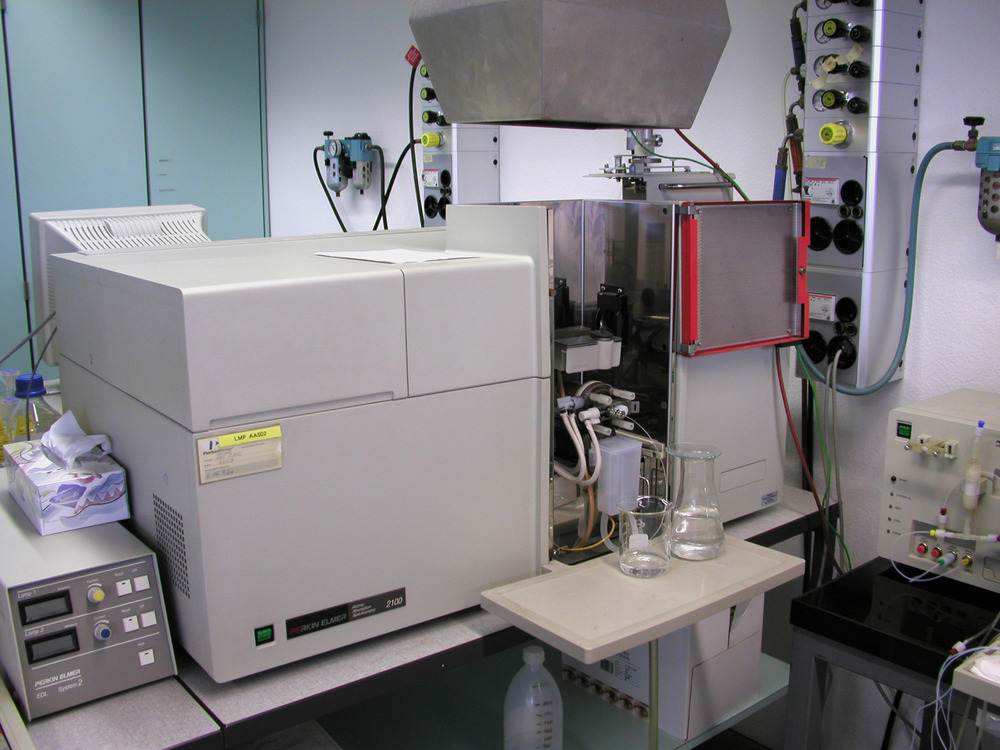
- Atomic Absorption Spectrophotometer (AAS)
- Hollow cathode lamps for specific elements
- Flame atomiser or graphite furnace atomiser
- Nebuliser and burner assembly
- Sample digestion system
- Analytical balance
- Calibration standards and reagents
- Data acquisition and analysis software
Results and Deliverables
- Quantitative metal concentration results
- Trace metal analysis reports
- Calibration and validation data
- Comparative elemental analysis
- Reports
Why Choose Infinita Lab for Atomic Absorption Spectroscopy?
With Infinita Lab (www.infinitalab.com), you are guaranteed a Nationwide Network of Accredited Laboratories spread across the USA, the best Consultants from around the world, Convenient Sample Pick-Up and Delivery, and Fast Turnaround Time.
Our team understands the stakes and subtleties of every test. Whether you’re validating a new Product, de-risking a prototype, or navigating complex compliance requirements, our specialists guide the process with rigor and clarity.
Looking for a trusted partner to achieve your research goals? Schedule a meeting with us, send us a request, or call us at (888) 878-3090 to learn more about our services and how we can support you. Request a Quote
Frequently Asked Questions
Atomic Absorption Spectroscopy (AAS) is an analytic technique for elemental analysis and trace metals in a sample.
It is based on the principle that atoms or ions absorb light of a particular wavelength.
AAS works by exposing a sample to a light source of defined wavelengths. The sample absorbs the light at characteristic wavelengths, and the drop in light intensity identifies and quantifies elements within it.
AAS presents an accurate and reliable elemental analysis. It is thus the basis for quality assurance to meet regulatory requirements and in product development. It assists in ensuring that high standards and consistency are maintained throughout the manufacturing process.
1. Graphite furnace atomic absorption spectroscopy 2. Flame atomic absorption spectroscopy
Case Studies
In-depth examination of genuine material testing solutions
Dopant and Ultra-Low Concentration Elemental Analysis Using STEM…

Dopant and Ultra-Low Concentration Elemental Analysis Using STEM…
Introduction to STEM-EELS for Elemental Analysis Scanning Transmission Electron Microscopy (STEM) combined with Electron Energy Loss...
Read Case StudyAnalysis of PVC Pipe Degradation Using FTIR Spectroscopy

Analysis of PVC Pipe Degradation Using FTIR Spectroscopy
PVC Pipe in Infrastructure — and Why Degradation Matters Polyvinyl chloride (PVC) pressure pipe is one...
Read Case StudyNano-scale roughness measurement of Si-wafers by Atomic Force…

Nano-scale roughness measurement of Si-wafers by Atomic Force…
Nano-scale surface roughness is a critical parameter in fabricated thin-films that are used in optics, solar...
Read Case Study
Request a Quote
Submit your material details and receive testing procedures, pricing, and turnaround time within 24 hours.
 Quick Turnaround and Hasslefree process
 Confidentiality Guarantee
 Free, No-obligation Consultation
 100% Customer Satisfaction
