


UL 263: Fire Resistance Building Construction Testing Services
One of the most useful material tests used by fire and flammability test labs to obtain a rating for structural steelwork is the UL 263 test. All types of construction materials and building products must have a fire-resistance rating before they can be installed or used due to local, federal, and organizational fire and safety codes.
TRUSTED BY


Get UL 263 compliant results — request your fire resistance building construction testing quote
- Overview
- Scope, Applications, and Benefits
- Test Process
- Specifications
- Instrumentation
- Results and Deliverables
What Is UL 263 Fire Resistance Building Construction?
UL 263 is used to assess the fire resistance rating of building construction assemblies and structural elements under controlled fire conditions. The standard is used to determine the duration for which the assembly can resist fire while maintaining its structural integrity and stability, and to assess its ability to restrict heat transfer.
UL 263 is commonly applied to walls, floors, roofs, columns, beams, and other building components that require a fire-resistance rating.

Applications and Benefits of UL 263 Fire Resistance Building Construction Testing
Scope
UL 263 tests the fire resistance of building assemblies and structural elements by subjecting them to a specified time period under controlled fire conditions. The test result indicates the assembly’s ability to retain its intended function during the fire test.
UL 263 evaluates:
● Fire resistance of building construction assemblies
● Structural stability during fire exposure
● Integrity of walls, floors, roofs, and structural elements
● Heat transmission through fire-rated assemblies
● Performance of materials and systems under controlled fire conditions
Applications
● Fire-rated wall assemblies
● Floor and roof systems
● Structural beams and columns
● Building partitions and barriers
● Ceiling and load-bearing assemblies
● Commercial and residential construction systems
Benefits
● Provides standardized fire resistance evaluation
● Supports fire-rating assessment of construction assemblies
● Helps verify structural performance under fire exposure
● Assists in building code and safety compliance
● Enables comparison of fire-resistant building systems
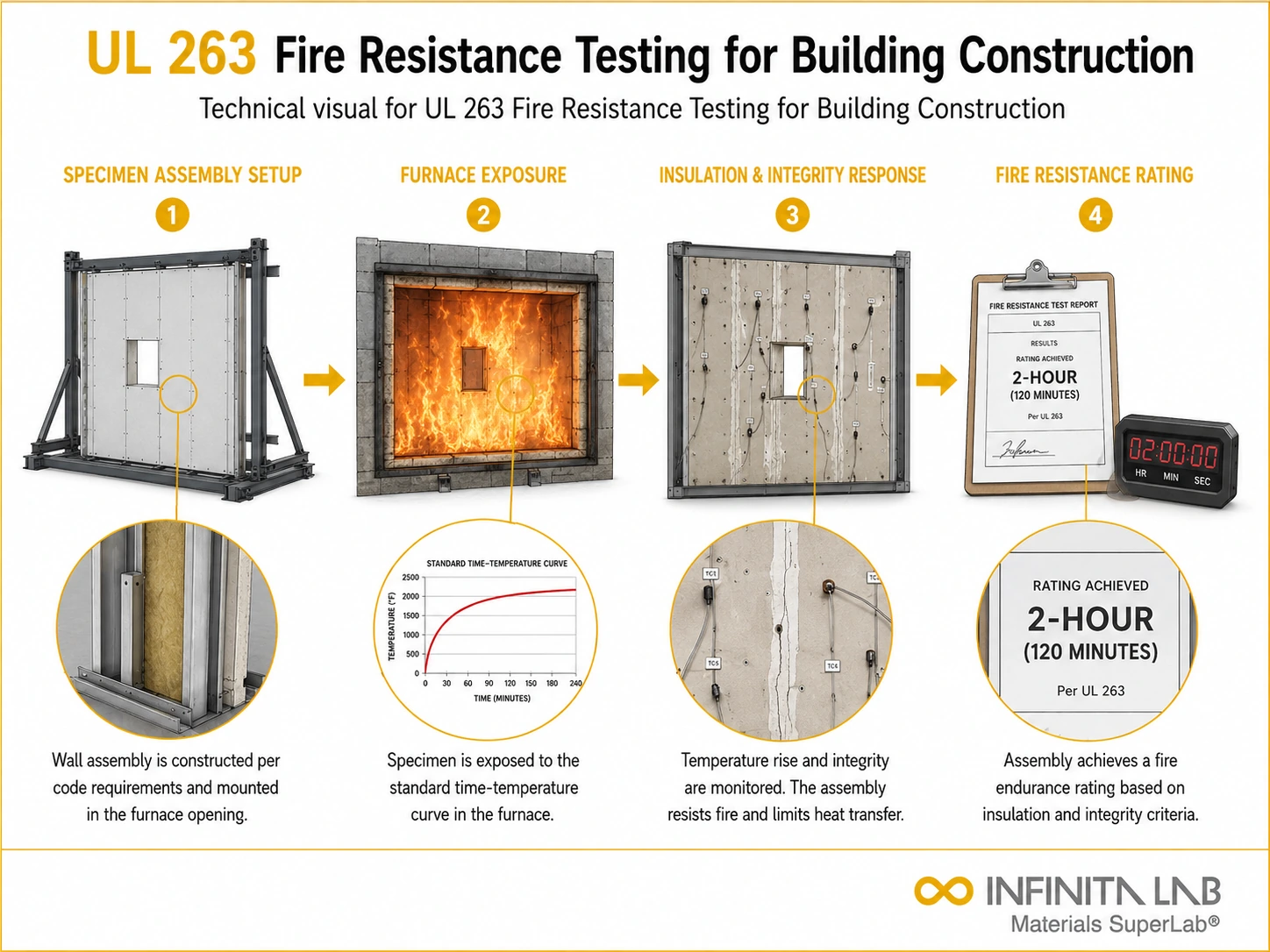
Our UL 263 Testing Procedure
Sample Preparation
The building assembly or structural specimen is constructed and installed in the required test frame or support structure.
1Fire Exposure
The specimen is exposed to controlled furnace conditions following the specified fire time-temperature curve.
2Performance Monitoring
Structural behavior, integrity, and temperature rise are monitored throughout the fire exposure period.
3Data Recording & Evaluation
The assembly is evaluated for fire endurance, heat transmission, and structural performance according to the acceptance criteria.
4UL 263 Test Parameters and Requirements
| Parameter | Details |
|---|---|
| Applicable Materials | Building assemblies and structural components |
| Test Exposure | Standardized fire resistance furnace exposure |
| Specimen Type | Walls, floors, roofs, beams, columns, and similar assemblies |
| Evaluation Criteria | Fire endurance, integrity, and heat transmission |
| Monitoring Conditions | Temperature rise and structural response |
| Measured Outputs | Fire resistance rating and assembly performance |


- Calibrated fire resistance test furnace with time-temperature curve control
- Structural loading system for sustained load application throughout fire exposure
- Thermocouple arrays for furnace and unexposed face temperature monitoring
- Flame and hot gas passage observation and recording equipment
- Deflection and deformation measurement instrumentation
- Data acquisition and real-time test logging system
Equipment and Instrumentation Used for UL 263 Testing
What You Receive: Test Report, Data, and Certification
- Fire exposure records, including furnace temperature curve, structural load data, and test duration
- Thermocouple temperature data for furnace and unexposed face monitoring points
- Structural failure, integrity, and insulation performance observations
- Test compliance result assessed against UL 263 fire resistance rating criteria
- UL 263 fire resistance test report for building code submissions, project submittals, and occupancy approvals
UL 263 Fire Resistance Building Construction FAQs
UL 263 tests how well building construction assemblies resist fire. It determines how long walls, floors, columns, roofs, and beams can hold up against standard fire exposure. The goal is to ensure they maintain structural stability and reduce heat transfer.
UL 263 helps check the fire resistance of structural assemblies used in buildings. It supports code compliance and makes sure that key elements stay intact long enough to protect occupants and assist firefighting efforts.
UL 263 is often used for walls, floors, ceilings, columns, beams, roofs, and other structural building assemblies. It ensures verified fire resistance performance under standardized furnace exposure conditions.
UL 263 testing places complete building assemblies in controlled furnace temperatures according to a standard time-temperature curve. It then measures structural strength, heat transfer, and fire resistance for the required rating period.
UL 263 tests fire resistance in controlled lab settings. It might not reflect all real fire situations that involve unusual fuel loads, structural damage, changes in ventilation, or differences in building installations.
Why Choose Infinita Lab for Fire Resistance Building Construction Testing
At the core of this breadth is our network of 2,000+ accredited laboratories across the USA, offering access to over 10,000 testing methods and analytical services. From advanced materials characterization (SEM, TEM, RBS, XPS) to mechanical, chemical, environmental, biological, and standardized ASTM/ISO-compliant testing, we deliver unmatched flexibility, specialization, and scale. You are never limited by geography, facility, or methodology — Infinita Lab connects you to the right expertise and testing solution, every time.

Need UL 263 Fire Resistance Building Construction Testing You Can Rely On?
Send query us at hello@infinitalab.com or call us at (888) 878-3090 to learn more about our services and how we can support you.



Request a Quote
Submit your material details and receive testing procedures, pricing, and turnaround time within 24 hours.
 Quick Turnaround and Hasslefree process
 Confidentiality Guarantee
 Free, No-obligation Consultation
 100% Customer Satisfaction
