
ASTM D1653 Testing: Complete Guide to Determining Water Vapor Transmission of Organic Coating Films
TRUSTED BY


Precision-driven testing for dimensional accuracy and compliance
- Overview
- Scope, Applications, and Benefits
- Test Process
- Specifications
- Instrumentation
- Results and Deliverables
Overview
ASTM D1653 determines the water vapor transmission rate (WVTR) of organic coating films by measuring the rate at which moisture passes through a coated substrate under controlled temperature and humidity conditions. It evaluates the permeability of coatings to water vapor, which is critical for protective performance.
This test is essential for assessing barrier properties of coatings used on metals, plastics, and other substrates. It helps predict resistance to moisture ingress, corrosion protection capability, and long-term durability, ensuring coatings perform effectively in environments where humidity control is critical.

Scope, Applications, and Benefits
Scope
ASTM D1653 defines procedures for measuring water vapor transmission through organic coating films applied to substrates. It provides quantitative data on permeability and supports evaluation of coating performance under controlled environmental conditions.
- Applicable to organic coatings on metal or other substrates
- Measures water vapor transmission rate (WVTR)
- Conducted under controlled temperature and humidity conditions
- Supports evaluation of moisture barrier performance
- Suitable for quality control and product development
- Helps assess coating integrity and uniformity
- Used for comparison between different coating systems
Applications
- Protective coatings for metal surfaces
- Packaging and barrier coating materials
- Marine and offshore coating systems
- Automotive and industrial coating evaluation
- Corrosion-resistant coating development
Benefits
- Determines moisture barrier effectiveness
- Helps prevent corrosion and degradation
- Supports coating selection and optimization
- Ensures consistent coating performance
- Enhances durability in humid environments
Test Process
Specimen Preparation
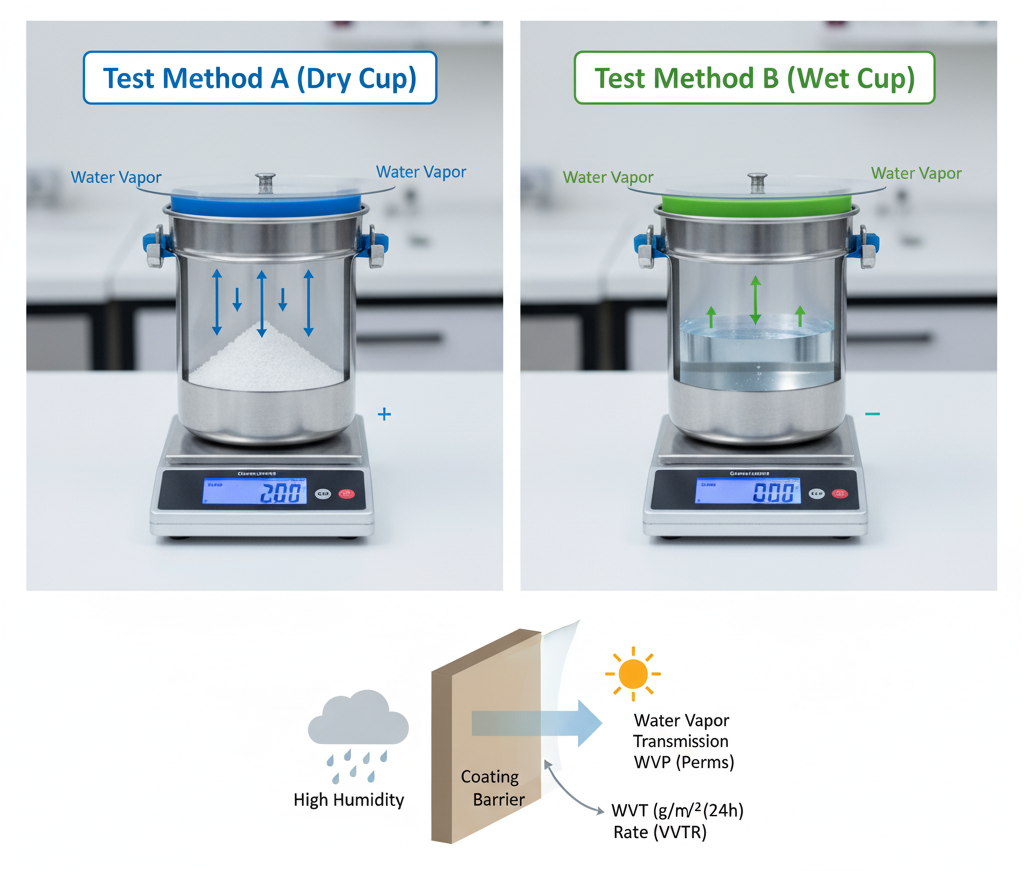
Coated specimen is prepared and sealed over a test cup containing desiccant or water.
1Conditioning
Assembly is placed in a controlled temperature and humidity environment.
2Measurement Cycle
Periodic weight changes are recorded due to vapor transmission.
3WVTR Calculation
Water vapor transmission rate is calculated based on weight change over time.
4Technical Specifications
| Parameter | Details |
|---|---|
| Material Type | Organic coating films on substrates |
| Measurement Parameter | WVTR (g/m²/day) |
| Environment | Controlled temperature and humidity |
| Test Assembly | Cup method with sealed specimen |
| Duration | Multiple hours to days depending on permeability |
| Output | Moisture transmission rate |
| Substrate Type | Metal or rigid backing materials |
Instrumentation Used for Testing
- WVTR test cups or permeability cells
- Controlled environmental chamber
- Analytical balance
- Sealing materials and fixtures
- Desiccant or water reservoir
Results and Deliverables
- Water vapor transmission rate (WVTR)
- Test conditions (temperature and humidity)
- Sample identification and coating details
- Time vs weight change data
- Compliance statement with ASTM D1653
Why Choose Infinita Lab for ASTM D1653?
At the core of this breadth is our network of 2,000+ accredited labs in the USA, offering access to over 10,000 test types. From advanced metrology (SEM, TEM, RBS, XPS) to mechanical, dielectric, environmental, and standardized ASTM/ISO testing, we give clients unmatched flexibility, specialization, and scale. You’re not limited by geography, facility, or methodology—Infinita connects you to the right testing, every time.
Looking for a trusted partner to achieve your research goals? Schedule a meeting with us, send us a request, or call us at (888) 878-3090 to learn more about our services and how we can support you. Request a Quote
Frequently Asked Questions
ASTM D1653 determines the amount of water vapor that passes through an organic coating film under controlled temperature and humidity conditions. It helps evaluate a coating’s resistance to moisture penetration and its ability to protect substrates from corrosion or degradation.
The WVT represents the amount of water vapor that passes through a coating film over time. A low WVT value indicates a sound moisture barrier, while a high WVT suggests the coating allows more vapor to pass through, which may reduce long-term protection.
Wet Cup Method: The test cup contains water, and vapor moves from the inside (high humidity) to the outside (low humidity). Dry Cup Method: The cup contains a desiccant, and vapor moves from the outside (high humidity) into the cup (low humidity). These methods simulate real-world exposure to both humid and dry environments.
The standard conditions are 23°C ± 2°C and 50% ± 5% relative humidity. The test continues until steady-state vapor transmission is achieved, ensuring the collection of reliable and reproducible data.
Water vapor transmission determines how effectively a coating prevents moisture ingress. High permeability can lead to corrosion, blistering, or degradation, while low transmission indicates strong protective performance in humid environments.
Case Studies
In-depth examination of genuine material testing solutions
Dopant and Ultra-Low Concentration Elemental Analysis Using STEM…

Dopant and Ultra-Low Concentration Elemental Analysis Using STEM…
Introduction to STEM-EELS for Elemental Analysis Scanning Transmission Electron Microscopy (STEM) combined with Electron Energy Loss...
Read Case StudyAnalysis of PVC Pipe Degradation Using FTIR Spectroscopy

Analysis of PVC Pipe Degradation Using FTIR Spectroscopy
PVC Pipe in Infrastructure — and Why Degradation Matters Polyvinyl chloride (PVC) pressure pipe is one...
Read Case StudyNano-scale roughness measurement of Si-wafers by Atomic Force…

Nano-scale roughness measurement of Si-wafers by Atomic Force…
Nano-scale surface roughness is a critical parameter in fabricated thin-films that are used in optics, solar...
Read Case Study
Request a Quote
Submit your material details and receive testing procedures, pricing, and turnaround time within 24 hours.
 Quick Turnaround and Hasslefree process
 Confidentiality Guarantee
 Free, No-obligation Consultation
 100% Customer Satisfaction
