
Accelerated Aging
Accelerated aging is the artificially expedited aging process of a product by subjecting it to aggravated operational and environmental conditions like temperature, pressure, humidity, and light. It is used to assess the long-term consequences of anticipated stress levels during a shorter period of time, typically in a lab setting using controlled standard test procedures. Accelerated aging tests are performed in the lab by Infinita Lab's experts to guarantee the functioning of your product.
TRUSTED BY


Precision-driven testing for dimensional accuracy and compliance
- Overview
- Scope, Applications, and Benefits
- Test Process
- Specifications
- Instrumentation
- Results and Deliverables
Overview
Accelerated aging testing evaluates the long-term stability and durability of materials and products by exposing them to elevated environmental conditions, such as temperature and humidity. The test accelerates degradation mechanisms to predict product performance over extended periods within a shorter time.
This method is widely used in medical devices, packaging, polymers, and electronics to estimate shelf life and identify potential failure modes. Accelerated aging helps simulate real-world storage and usage conditions for reliability assessment.

Scope, Applications, and Benefits
Scope
Accelerated aging testing determines how materials and products degrade over time under elevated environmental conditions. The test helps estimate long-term performance and shelf-life characteristics.
The test evaluates:
- Material degradation due to temperature and humidity
- Shelf-life estimation of products
- Changes in mechanical and physical properties
- Stability of materials under accelerated conditions
- Performance of products over simulated time
Applications
- Medical devices and sterile packaging
- Pharmaceutical products
- Plastic and polymer materials
- Food and consumer packaging
- Electronic components
- Product validation and reliability testing
Benefits
- Reduces the time required for long-term aging studies
- Supports shelf-life determination and labeling
- Identifies degradation mechanisms early
- Assists in material and product design
- Enables comparison of aging performance
Test Process
Sample Preparation
Samples are prepared, packaged, and conditioned according to intended use conditions.
1Environmental Setup
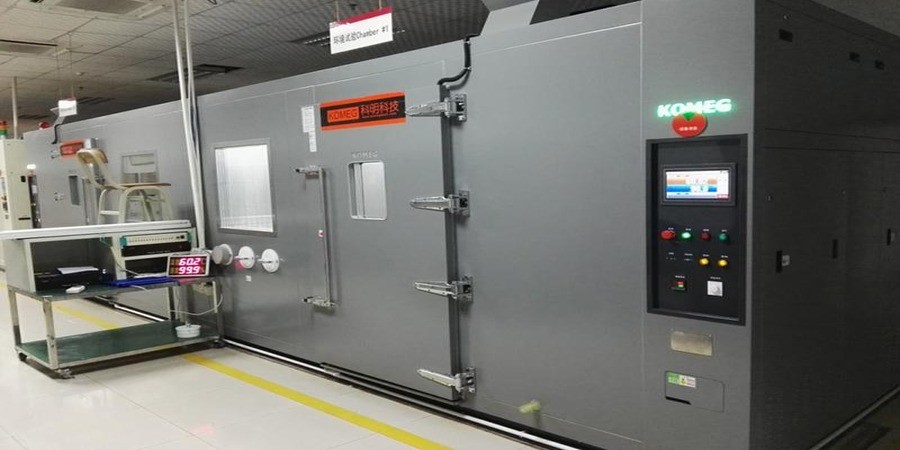
Specimens are placed in an aging chamber with controlled temperature and humidity settings.
2Accelerated Exposure
Elevated conditions are maintained for a defined duration to simulate long-term aging.
3Data Recording & Evaluation
Material and product properties are measured periodically and analyzed for degradation.
4Technical Specifications
| Parameter | Details |
|---|---|
| Applicable Materials | Polymers, packaging, medical devices, electronics |
| Temperature Range | 40°C to 80°C |
| Relative Humidity | 50% to 90% RH |
| Acceleration Factor | Q10 ≈ 2 |
| Exposure Duration | 1 week to 6 months |
| Measured Outputs | Mechanical properties, physical changes, shelf-life estimation |
Instrumentation Used for Testing
- Environmental aging chamber
- Temperature and humidity control system
- Sample storage racks
- Mechanical testing equipment
- Analytical instruments (FTIR, DSC)
- Data acquisition and monitoring system
Results and Deliverables
- Shelf-life estimation data
- Material degradation analysis
- Mechanical and physical property changes
- Aging performance comparison
- Test condition summary
- ASTM compliance report
Why Choose Infinita Lab for Accelerated aging testing?
Infinita Lab offers comprehensive Accelerated aging testing services, a Comprehensive lab network, project management, confidentiality, and rapid turnaround. Trust Infinita Lab for your material testing needs, Faster test results, cost savings, and reduced administrative workload.
Looking for a trusted partner to achieve your research goals? Schedule a meeting with us, send us a request, or call us at (888) 878-3090 to learn more about our services and how we can support you. Request a Quote
Frequently Asked Questions
Accelerated aging testing includes elevated temperature, humidity, light exposure, oxygen levels, and exposure duration, simulating long-term environmental effects to evaluate material degradation, stability, and predicted service life under controlled laboratory conditions.
Accelerated aging testing helps predict long-term performance within shorter timeframes, enabling faster product development, quality assurance, and validation of materials used in critical applications.
Accelerated aging testing is commonly applied to plastics, polymers, coatings, pharmaceuticals, medical devices, and packaging materials where durability and shelf life must be assessed.
Accelerated aging testing evaluates changes in mechanical strength, color, chemical stability, and functional performance, providing insight into degradation mechanisms and product lifespan.
Accelerated aging testing relies on assumptions such as Arrhenius behavior and may not fully replicate real environmental conditions, requiring correlation with real-time aging data for accurate long-term predictions.
Case Studies
In-depth examination of genuine material testing solutions
Dopant and Ultra-Low Concentration Elemental Analysis Using STEM…

Dopant and Ultra-Low Concentration Elemental Analysis Using STEM…
Introduction to STEM-EELS for Elemental Analysis Scanning Transmission Electron Microscopy (STEM) combined with Electron Energy Loss...
Read Case StudyAnalysis of PVC Pipe Degradation Using FTIR Spectroscopy

Analysis of PVC Pipe Degradation Using FTIR Spectroscopy
PVC Pipe in Infrastructure — and Why Degradation Matters Polyvinyl chloride (PVC) pressure pipe is one...
Read Case StudyNano-scale roughness measurement of Si-wafers by Atomic Force…

Nano-scale roughness measurement of Si-wafers by Atomic Force…
Nano-scale surface roughness is a critical parameter in fabricated thin-films that are used in optics, solar...
Read Case Study
Request a Quote
Submit your material details and receive testing procedures, pricing, and turnaround time within 24 hours.
 Quick Turnaround and Hasslefree process
 Confidentiality Guarantee
 Free, No-obligation Consultation
 100% Customer Satisfaction
