
ASTM D1353 Nonvolatile Matter In Volatile Solvent
Non Volatile matter in volatile solvents for use in paint, vanish, lacquer and related products is determined by standard method ASTM D1353 and it describes the analytical measurement of residual matter in solvents that are intended to be 100% volatile at 105 ± 5°C.
TRUSTED BY


Precision-driven testing for dimensional accuracy and compliance
- Overview
- Scope, Applications, and Benefits
- Test Process
- Specifications
- Instrumentation
- Results and Deliverables
Overview
ASTM D1353 is a widely used test method for determining the percentage of nonvolatile matter present in materials that are dissolved or dispersed in volatile solvents. The test quantifies the solid residue remaining after controlled evaporation of volatile components, providing an accurate measure of formulation composition. This parameter is essential in understanding the true functional content of coatings, adhesives, and similar materials.
The method plays a critical role in ensuring formulation consistency, performance reliability, and compliance with product specifications. By identifying the proportion of solids, it helps predict application properties such as film thickness, drying characteristics, and durability. ASTM D1353 is extensively used in quality control, research, and product development to maintain uniformity across batches and optimize material performance.

Scope, Applications, and Benefits
Scope
ASTM D1353 covers the determination of nonvolatile content in materials containing volatile solvents through controlled heating and evaporation processes. It establishes standardized procedures to ensure reproducibility and accuracy in measuring solid residue.
This test is applicable to a wide range of solvent-based systems where understanding the solid fraction is essential for performance and consistency.
- Applicable to coatings, adhesives, inks, and solvent-based formulations
- Measures the percentage of solid residue after solvent evaporation
- Suitable for quality control, formulation verification, and research applications
- Enables comparison between different materials and batches
- Ensures compliance with product specifications and standards
- Supports evaluation of drying and film-forming characteristics
Applications
- Determination of solid content in solvent-based coatings and adhesives
- Quality control of manufacturing batches for consistency
- Evaluation of formulation changes during product development
- Verification of compliance with product specifications
- Comparative analysis of different formulations and materials
- Assessment of drying and film formation properties
Benefits
- Provides accurate measurement of nonvolatile (solid) content
- Ensures consistency in product formulation and performance
- Helps optimize coating thickness and application efficiency
- Supports reliable quality control and batch verification
- Enables early detection of formulation deviations
- Improves overall product reliability and durability
Test Process
Sample Preparation
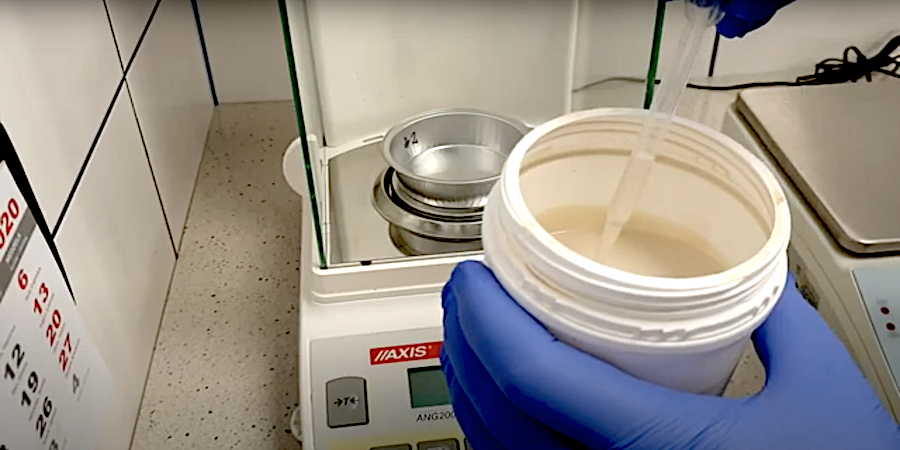
A precisely measured sample is placed in a pre-weighed container to ensure accurate initial mass determination.
1Controlled Evaporation
The sample is heated in an oven under specified conditions to completely remove volatile solvent components.
2Cooling and Stabilization
The residue is cooled in a desiccator to prevent moisture absorption and stabilize its weight.
3Final Weighing and Calculation
The remaining solid residue is weighed and used to calculate the percentage of nonvolatile matter.
4Technical Specifications
| Parameter | Details |
|---|---|
| Property Measured | Nonvolatile content expressed as percentage (%) |
| Sample Type | Solvent-based liquids or dispersions |
| Heating Method | Controlled oven drying process |
| Temperature Range | Typically defined based on material requirements |
| Measurement Basis | Initial and final weight comparison |
| Applicable Materials | Coatings, adhesives, inks, and similar products |
| Units | Percentage (%) of solid residue |
| Output Data | Quantitative solid content and residue characteristics |
Instrumentation Used for Testing
- Analytical balance with high precision
- Laboratory drying oven with temperature control
- Heat-resistant sample containers or dishes
- Desiccator for cooling and moisture control
- Temperature monitoring devices
Results and Deliverables
- Percentage of nonvolatile matter (solid content)
- Initial and final weight measurements
- Test temperature and duration details
- Observations on residue appearance and consistency
- Standard-compliant detailed test report
- Data supporting formulation consistency and quality
Why Choose Infinita Lab for ASTM D1353?
With Infinita Lab (www.infinitalab.com), you are guaranteed a Nationwide Network of Accredited Laboratories spread across the USA, the best Consultants from around the world, Convenient Sample Pick-Up and Delivery, and Fast Turnaround Time.
Our team understands the stakes and subtleties of every test. Whether you’re validating a new Product, de-risking a prototype, or navigating complex compliance requirements, our specialists guide the process with rigor and clarity.
Looking for a trusted partner to achieve your research goals? Schedule a meeting with us, send us a request, or call us at (888) 878-3090 to learn more about our services and how we can support you. Request a Quote
Frequently Asked Questions
Nonvolatile substances do not vaporize rapidly. They don't have a higher vapor pressure at the average room temperature and pressure. At room temperature, they will mostly be solids. Sodium chloride and silver nitrate are nonvolatile compounds.
ASTM D1353 is used to determine the percentage of nonvolatile matter in materials containing volatile solvents. It helps identify the solid content of coatings, adhesives, and similar formulations, ensuring consistency, quality, and compliance with product specifications during manufacturing and application.
This test ensures that the correct proportion of solids is maintained in a formulation. Variations in solid content can significantly affect application properties such as film thickness, adhesion, drying time, and overall performance.
It ensures that products meet required composition standards, supports consistent quality, and helps maintain performance reliability, making it a critical tool in manufacturing and quality control operations.
It provides a reliable measure of solid content, enabling manufacturers to maintain consistent product quality and detect deviations early in the production process.
Case Studies
In-depth examination of genuine material testing solutions
Dopant and Ultra-Low Concentration Elemental Analysis Using STEM…

Dopant and Ultra-Low Concentration Elemental Analysis Using STEM…
Introduction to STEM-EELS for Elemental Analysis Scanning Transmission Electron Microscopy (STEM) combined with Electron Energy Loss...
Read Case StudyAnalysis of PVC Pipe Degradation Using FTIR Spectroscopy

Analysis of PVC Pipe Degradation Using FTIR Spectroscopy
PVC Pipe in Infrastructure — and Why Degradation Matters Polyvinyl chloride (PVC) pressure pipe is one...
Read Case StudyNano-scale roughness measurement of Si-wafers by Atomic Force…

Nano-scale roughness measurement of Si-wafers by Atomic Force…
Nano-scale surface roughness is a critical parameter in fabricated thin-films that are used in optics, solar...
Read Case Study
Request a Quote
Submit your material details and receive testing procedures, pricing, and turnaround time within 24 hours.
 Quick Turnaround and Hasslefree process
 Confidentiality Guarantee
 Free, No-obligation Consultation
 100% Customer Satisfaction
