
ASTM E915 Practice for Verifying the Alignment of X-Ray Diffraction Instruments for Residual Stress Measurement
ASTM E915 covers the preparation and use of a flat stress-free test specimen for checking the systematic error caused by instrument misalignment or sample positioning in X-ray diffraction residual stress measurement, or both.
TRUSTED BY


Precision-driven testing for dimensional accuracy and compliance
- Overview
- Scope, Applications, and Benefits
- Test Process
- Specifications
- Instrumentation
- Results and Deliverables
Overview
ASTM E 915 X-Ray Diffraction Instrument Alignment Verification is a standardized practice established to verify that X-Ray Diffraction instruments used to measure residual stress are correctly aligned, thereby ensuring that accuracy requirements are met. The ASTM E 915 standard provides guidelines for procedures for verifying X-Ray Diffraction instrument alignment, as well as the requirements for ensuring that X-Ray Diffraction instruments are correctly aligned to accurately determine residual stress. The ASTM E 915 standard is essential to materials engineers, X-Ray Diffraction laboratory experts, and residual stress analysts, as it provides reliable information on X-Ray Diffraction instrument alignment.

Scope, Applications, and Benefits
Scope
The ASTM E 915 procedure is used to check the XRD instrument’s alignment with respect to residual stress analysis. This is done by using a stress-free powder sample and observing the position of the diffraction peak at specific psi angles, thereby ensuring that the measured d-spaces are consistent across psi angles within specified limits.
ASTM E 915 XRD alignment verification evaluates:
- Goniometer alignment and diffractometer geometry accuracy for residual stress measurement
- Peak position consistency across defined psi tilt angles using stress-free reference specimens
- Detector positioning and X-ray optics alignment for defined diffraction geometry conditions
- Instrument alignment acceptance across sin²ψ measurement range per ASTM E 915
- Compliance against the defined XRD instrument alignment acceptance criteria for residual stress programs
Applications
- XRD residual stress measurement laboratory instrument alignment verification programs
- Portable and laboratory X-ray diffractometer alignment assessment before residual stress measurement
- Aerospace, automotive, and defense component residual stress XRD instrument verification
- Research and production XRD residual stress measurement facility alignment programs
- XRD instrument commissioning and periodic performance verification programs
Benefits
- Provides reliable XRD instrument alignment data for residual stress measurement accuracy assurance
- Supports XRD residual stress measurement standard compliance and instrument assessment programs
- Identifies instrument misalignment before residual stress measurement programs
- Delivers traceable instrument alignment verification records for engineering and regulatory submissions
- Reduces measurement error risk by verifying XRD alignment early in instrument performance assessment
Test Process
Reference Specimen Preparation
Stress-free powder reference specimen prepared and mounted per ASTM E 915 requirements.
1Psi Tilt Scanning
Diffraction peak positions measured across defined psi tilt angle range on reference specimen.
2Peak Position Analysis
D-spacing consistency across psi angles analyzed to assess instrument alignment accuracy.
3Data Analysis & Reporting
Alignment data assessed against ASTM E 915 acceptance criteria for test compliance result.
4Technical Specifications
| Parameter | Details |
|---|---|
| Applicable Instruments | Laboratory and portable X-ray diffractometers for residual stress measurement |
| Reference Specimen | Stress-free iron or steel powder per ASTM E 915 alignment verification requirements |
| Psi Tilt Range | 0° to ±45° psi tilt range across sin²ψ values of 0 to 0.5 per ASTM E 915 |
| Peak Position Acceptance | D-spacing variation not exceeding ±0.0001 nm across full psi tilt range |
| Measured Parameters | Diffraction peak position and d-spacing consistency across psi tilt angles |
| Measured Outputs | Peak position data, d-spacing values, alignment deviation, and test compliance result |
Instrumentation Used for Testing
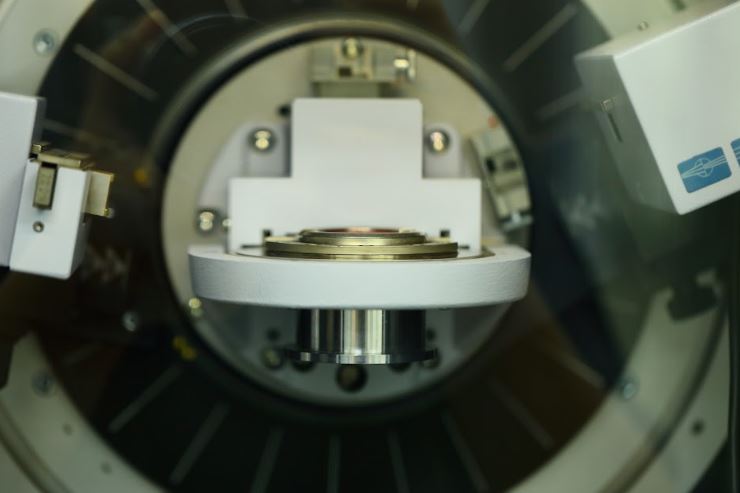
- X-ray diffractometer with goniometer and psi tilt capability for residual stress measurement
- Stress-free powder reference specimen for alignment verification measurement
- X-ray detector and optics system for diffraction geometry configuration
- Goniometer and specimen positioning system for psi tilt angle scanning
- Specialist XRD peak position analysis and alignment assessment software
- Data reporting and diffraction peak visualization system
Results and Deliverables
- Diffraction peak position and d-spacing data across the psi tilt angle range
- Peak position consistency analysis and alignment deviation assessment per ASTM E 915
- Instrument alignment acceptance determination against ASTM E 915 criteria
- Test compliance result assessed against XRD alignment acceptance requirements
- ASTM E 915 report
Why Choose Infinita Lab for ASTM E 915?
Infinita Lab offers comprehensive ASTM E 915 testing services, a Comprehensive lab network, project management, confidentiality, and rapid turnaround. Trust Infinita Lab for your material testing needs, Faster test results, cost savings, and reduced administrative workload.
Looking for a trusted partner to achieve your research goals? Schedule a meeting with us, send us a request, or call us at (888) 878-3090 to learn more about our services and how we can support you. Request a Quote
Frequently Asked Questions
ASTM E915 covers instrument alignment angle, detector positioning, specimen orientation, calibration standards, and peak position accuracy. It ensures that X-ray diffraction systems deliver reliable residual stress measurements by using proper procedures for verifying geometric alignment.
ASTM E915 uses certified reference materials that have known diffraction peak positions. This allows for verification of instrument alignment accuracy and consistency during residual stress measurement with X-ray diffraction techniques.
ASTM E915 looks at diffraction peak positions, angular alignment, and instrument geometry. It aims to ensure reliable residual stress measurements and consistent X-ray diffraction results.
ASTM E915 requires X-ray diffraction instruments, alignment fixtures, calibration standards, and precise positioning systems to ensure correct alignment and performance for measuring residual stress.
ASTM E915 tests alignment under controlled conditions. It may not address errors from specimen preparation, surface condition, or environmental factors that impact X-ray diffraction measurements.
Case Studies
In-depth examination of genuine material testing solutions
Dopant and Ultra-Low Concentration Elemental Analysis Using STEM…

Dopant and Ultra-Low Concentration Elemental Analysis Using STEM…
Introduction to STEM-EELS for Elemental Analysis Scanning Transmission Electron Microscopy (STEM) combined with Electron Energy Loss...
Read Case StudyAnalysis of PVC Pipe Degradation Using FTIR Spectroscopy

Analysis of PVC Pipe Degradation Using FTIR Spectroscopy
PVC Pipe in Infrastructure — and Why Degradation Matters Polyvinyl chloride (PVC) pressure pipe is one...
Read Case StudyNano-scale roughness measurement of Si-wafers by Atomic Force…

Nano-scale roughness measurement of Si-wafers by Atomic Force…
Nano-scale surface roughness is a critical parameter in fabricated thin-films that are used in optics, solar...
Read Case Study
Request a Quote
Submit your material details and receive testing procedures, pricing, and turnaround time within 24 hours.
 Quick Turnaround and Hasslefree process
 Confidentiality Guarantee
 Free, No-obligation Consultation
 100% Customer Satisfaction
