
ASTM E8/E8M-21 for Tension Testing
ASTM E8/E8M-21 standard outlines relevant details in measuring the tensile properties of metallic materials. It provides a systematic method to assess how materials stretch under pulling forces. The outcome identifies material strength and ductility, essential for engineering applications. Industries, such as aerospace and automotive, rely on these results to forestall material reliability. The process involves force on a specimen until it fractures, revealing vital data that guide material selection and design.
TRUSTED BY


Precision-driven testing for dimensional accuracy and compliance
- Overview
- Scope, Applications, and Benefits
- Test Process
- Specifications
- Instrumentation
- Results and Deliverables
Overview
ASTM E8/E8M-21 is the ASTM International standard test method for uniaxial tension testing of metallic materials at ambient temperature, intended to determine critical mechanical properties such as yield strength, tensile strength, elongation, and reduction of area, which are vital for material selection and engineering design.
ASTM E8/E8M-21. It is used to determine important mechanical properties such as yield strength, tensile strength, elongation, and reduction of area, which are critical for material selection and engineering design. While both guarantee a constant measurement of a metal’s response to pulling forces, the ‘M’ in E8M denotes the metric system. The main distinctions from E8 are particular gauge lengths.

Scope, Applications, and Benefits
Scope
The ASTM E8/E8M method describes the procedures for determining the room-temperature tensile properties of metallic materials. This testing technique covers various specimen geometries and dimensions, including round, flat, and sheet forms, in both machined and full-section types.
Applications
- Tensile testing of ferrous and non-ferrous metals
- Quality control in manufacturing and fabrication industries
- Material evaluation for aerospace, automotive, construction, and defense sectors
- Verification of raw materials, finished products, and welded joints
- Research and development of new metallic alloys
Benefits
- Provides a standardized tensile testing method for metallic materials.
- Accurately determines key mechanical properties such as yield strength, ultimate tensile strength, elongation, and reduction of area.
- Ensures repeatable and comparable results across laboratories.
- Supports material qualification and certification.
- Helps assess the effect of processing, heat treatment, and composition on metals.
- Aids engineers in design validation and performance prediction.
- Widely accepted for quality control and compliance purposes.
Testing Process
Specimen Preparation
Machine specimens to standard dimensions with smooth, defect-free surfaces.
1Test Setup
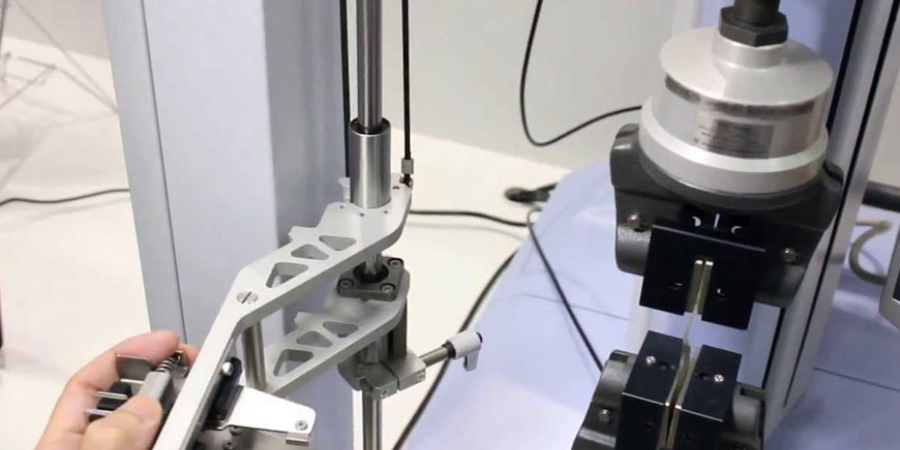
Mount and align the specimen in a calibrated universal testing machine.
2Voltage Application
Not applicable; apply controlled tensile load/strain rate until fracture.
3Data Collection & Dielectric Strength Calculation
Record load and elongation to obtain the stress–strain curve and tensile properties.
4Technical Specifications
| Parameter | Details |
|---|---|
| Specimen Type | Round or flat metallic tensile specimens |
| Surface Condition | Smooth and free from defects |
| Testing Machine | Calibrated Universal Testing Machine (UTM) |
| Load Measurement | Calibrated load cell |
| Result Units | MPa or psi; elongation in % |
| Measured Properties | Yield strength, UTS, elongation, reduction of area |
Instrumentation Used
- Universal Testing Machine (UTM)
- Load cell with appropriate capacity
- Extensometer (contact or non-contact)
- Specimen grips/fixtures
- Data acquisition and analysis system
- Measuring tools (calipers or micrometer for specimen dimensions)
Results and Deliverables
- The ASTM E8/E8M method provides accurate data on the tensile behavior of metallic materials. Key results include the following:
- Yield Strength: Yield strength is the stress beyond which there is permanent deformation.
- Ultimate Tensile Strength (UTS): It is the maximum amount of stress a material can endure without necking.
- Elongation (%): A measure of ductility, defined by the percent increase in gauge length at fracture.
- Reduction of Area (%): The reduction in cross-sectional area at the fracture point is a characteristic of material ductility.
Frequently Asked Questions
This test helps evaluate the mechanical strength and ductility of metals, ensuring they meet design and performance requirements for structural and manufacturing applications.
The method applies to ferrous and nonferrous metals, including steel, aluminum, copper, titanium, and their alloys, in forms such as bars, plates, sheets, and wires.
Key measurements include yield strength, ultimate tensile strength, elongation percentage, and reduction of area—derived from the stress-strain curve.
Case Studies
In-depth examination of genuine material testing solutions
Dopant and Ultra-Low Concentration Elemental Analysis Using STEM…

Dopant and Ultra-Low Concentration Elemental Analysis Using STEM…
Introduction to STEM-EELS for Elemental Analysis Scanning Transmission Electron Microscopy (STEM) combined with Electron Energy Loss...
Read Case StudyAnalysis of PVC Pipe Degradation Using FTIR Spectroscopy

Analysis of PVC Pipe Degradation Using FTIR Spectroscopy
PVC Pipe in Infrastructure — and Why Degradation Matters Polyvinyl chloride (PVC) pressure pipe is one...
Read Case StudyNano-scale roughness measurement of Si-wafers by Atomic Force…

Nano-scale roughness measurement of Si-wafers by Atomic Force…
Nano-scale surface roughness is a critical parameter in fabricated thin-films that are used in optics, solar...
Read Case Study
Request a Quote
Submit your material details and receive testing procedures, pricing, and turnaround time within 24 hours.
 Quick Turnaround and Hasslefree process
 Confidentiality Guarantee
 Free, No-obligation Consultation
 100% Customer Satisfaction
