
ASTM D790 and ISO 178 Test (Flexural Properties Testing)
For engineers and product designers, comprehending a material's response to bending forces is as important as delivering a finished product. The insight empowers them to create robust, reliable, and functional products. They should be optimal within the scope of design. Either of the following two standards are recommended for this examination, known as ASTM D790 and ISO 178. They outline the methodology for determining the flexural properties of plastics lacking some level of quality.
TRUSTED BY


Precision-driven testing for dimensional accuracy and compliance
- Overview
- Scope, Applications, and Benefits
- Test Process
- Specifications
- Instrumentation
- Results and Deliverables
Overview
ASTM D790 and ISO 178 flexural properties testing are the primary standardized test methods for measuring the flexural strength, flexural modulus, and flexural stress-strain behavior of plastics and polymer materials using three-point and four-point bending configurations — quantifying a material’s resistance to bending forces, stiffness under load, and deformation response to characterize mechanical performance under flexural stress conditions. ASTM D790 and ISO 178 define the specimen geometry, support span, loading rate, and calculation procedures required to accurately determine flexural properties — providing plastics manufacturers, materials engineers, product designers, and quality analysts with reliable bending performance data for material selection, product approval, and specification compliance programs.

Scope, Applications, and Benefits
Scope
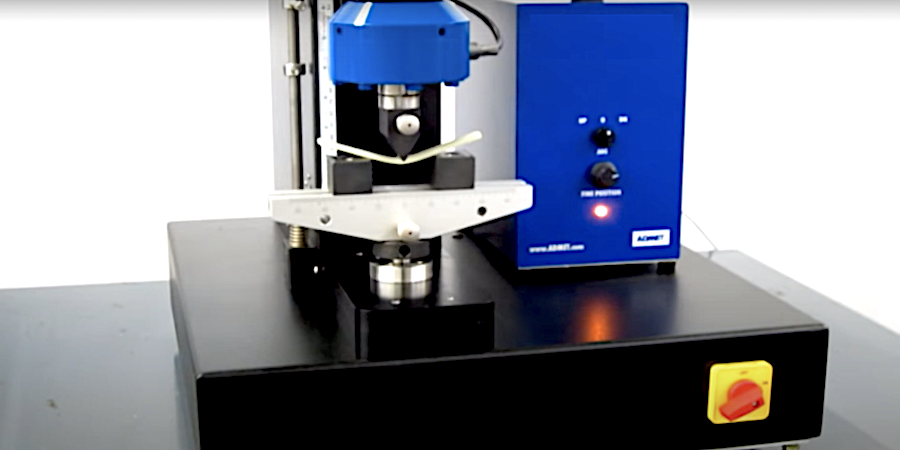
ASTM D790 and ISO 178 measure flexural properties by supporting rectangular beam specimens across a defined span and applying a central load through a loading nose — measuring the force and deflection response as the specimen bends and calculating flexural stress, flexural strain, and flexural modulus from the load-deflection curve data.
ASTM D790 and ISO 178 flexural properties testing evaluate:
- Flexural strength and maximum flexural stress at break or yield for plastics and composite materials
- Flexural modulus of elasticity characterizes material stiffness and resistance to bending deformation
- Flexural stress-strain behavior and load-deflection response across the bending range
- Comparative flexural performance across material formulations, grades, processing conditions, and reinforcement levels
- Compliance against minimum flexural strength and modulus requirements per plastics material and product specifications
Applications
- Unreinforced and fiber-reinforced thermoplastic and thermoset materials requiring flexural property characterization
- Composite materials, laminates, and sandwich structures require bending stiffness and strength determination
- Injection-molded, compression-molded, and extruded plastic components requiring flexural performance verification
- Raw material qualification and incoming inspection programs for plastics compounders and processors
- Product design validation and material substitution programs requiring comparative flexural data
Benefits
- Provides reliable flexural strength and modulus data for material selection and specification compliance
- Supports plastics supplier qualification and raw material acceptance programs
- Identifies flexural performance deficiencies in plastic formulations before product approval and deployment
- Delivers traceable bending test records for design submissions, regulatory filings, and customer data packages
- Reduces product failure risk by confirming flexural performance against design requirements early in development
Test Process
Sample Preparation
Specimens machined or molded to ASTM D790 or ISO 178 geometry requirements and conditioned per standard temperature and humidity requirements.
1Span and Rate Setup
Support span and crosshead speed configured per specimen depth and standard procedure requirements.
2Flexural Loading
Specimen loaded through central loading nose at defined rate while force and deflection continuously recorded.
3Data Analysis & Reporting
Flexural strength, flexural modulus, and stress-strain curve calculated from load-deflection data and assessed against specification criteria.
4Technical Specifications
| Parameter | Details |
|---|---|
| Applicable Materials | Unreinforced and reinforced thermoplastics, thermosets, composites, laminates, and filled polymer systems |
| Test Configuration | Three-point bending (standard); four-point bending available per ASTM D790 Procedure B and D6272 |
| Specimen Geometry | Rectangular beam specimens per ASTM D790 (127 × 12.7 mm) or ISO 178 (80 × 10 mm) dimensional requirements |
| Conditioning | 23°C / 50% RH standard conditioning per ASTM D618 or ISO 291 prior to testing |
| Temperature Range | Ambient and elevated/reduced temperature testing available for thermal performance characterization |
| Measured Outputs | Flexural strength (MPa), flexural modulus (GPa), flexural stress at yield or break, and load-deflection curve |
Instrumentation Used for Testing
- Universal testing machine with calibrated load cell for precise flexural force measurement
- Three-point bending fixture with defined loading nose and support span geometry per ASTM D790 and ISO 178
- Calibrated crosshead displacement or extensometer for accurate deflection measurement
- Environmental chamber for elevated and reduced temperature flexural testing
- Specimen conditioning chamber maintained at 23°C / 50% RH per standard conditioning requirements
- Data acquisition system for continuous load-deflection curve recording and flexural property calculation
Results and Deliverables
- Flexural strength (MPa) and flexural modulus (GPa) values for all tested specimens per ASTM D790 or ISO 178
- Load-deflection curves and flexural stress-strain data for each tested specimen
- Statistical summary of mean, standard deviation, and coefficient of variation across specimen replicates
- Test compliance result assessed against minimum flexural property requirements per applicable specification
- ASTM D790 and ISO 178 flexural properties test report
Why Choose Infinita Lab for ASTM D790 and ISO 178?
At the core of this breadth is our network of 2,000+ accredited labs in the USA, offering access to over 10,000 test types. From advanced metrology (SEM, TEM, RBS, XPS) to mechanical, dielectric, environmental, and standardized ASTM/ISO testing, we give clients unmatched flexibility, specialization, and scale. You’re not limited by geography, facility, or methodology—Infinita connects you to the right testing, every time.
Looking for a trusted partner to achieve your research goals? Schedule a meeting with us, send us a request, or call us at (888) 878-3090 to learn more about our services and how we can support you. Request a Quote
Frequently Asked Questions
ASTM D790 and ISO 178 are the standardized three-point bending test methods for measuring the flexural strength, flexural modulus, and stress-strain behavior of plastics — applying a central load across a supported specimen span and calculating bending performance properties from the recorded force and deflection response.
ASTM D790 and ISO 178 evaluate unreinforced thermoplastics, fiber-reinforced and filled polymer systems, thermoset resins, composite laminates, and injection-molded and compression-molded plastic components — providing flexural strength and modulus data across rigid and semi-rigid plastic materials requiring bending performance characterization.
Flexural strength is the maximum stress the specimen sustains before fracture or at a defined strain limit — representing the material's load-bearing capacity in bending. Flexural modulus is the slope of the initial linear region of the stress-strain curve — representing material stiffness and resistance to elastic bending deformation under load.
Yes — flexural testing per ASTM D790 and ISO 178 can be performed at elevated and reduced temperatures using environmental chambers to characterize flexural performance across service temperature ranges relevant to product design and material qualification requirements.
ASTM D790 is typically specified for North American product approvals, material datasheets, and customer specifications following ASTM standards, while ISO 178 is specified for European and international approvals, EN-referenced specifications, and global material qualification programs. Both methods measure equivalent flexural properties but use different specimen geometries and test parameters — making direct numerical comparison between results inappropriate without cross-reference testing.
Case Studies
In-depth examination of genuine material testing solutions
Dopant and Ultra-Low Concentration Elemental Analysis Using STEM…

Dopant and Ultra-Low Concentration Elemental Analysis Using STEM…
Introduction to STEM-EELS for Elemental Analysis Scanning Transmission Electron Microscopy (STEM) combined with Electron Energy Loss...
Read Case StudyAnalysis of PVC Pipe Degradation Using FTIR Spectroscopy

Analysis of PVC Pipe Degradation Using FTIR Spectroscopy
PVC Pipe in Infrastructure — and Why Degradation Matters Polyvinyl chloride (PVC) pressure pipe is one...
Read Case StudyNano-scale roughness measurement of Si-wafers by Atomic Force…

Nano-scale roughness measurement of Si-wafers by Atomic Force…
Nano-scale surface roughness is a critical parameter in fabricated thin-films that are used in optics, solar...
Read Case Study
Request a Quote
Submit your material details and receive testing procedures, pricing, and turnaround time within 24 hours.
 Quick Turnaround and Hasslefree process
 Confidentiality Guarantee
 Free, No-obligation Consultation
 100% Customer Satisfaction
