
ASTM D 421- Determination of Soil Constants and Their Properties
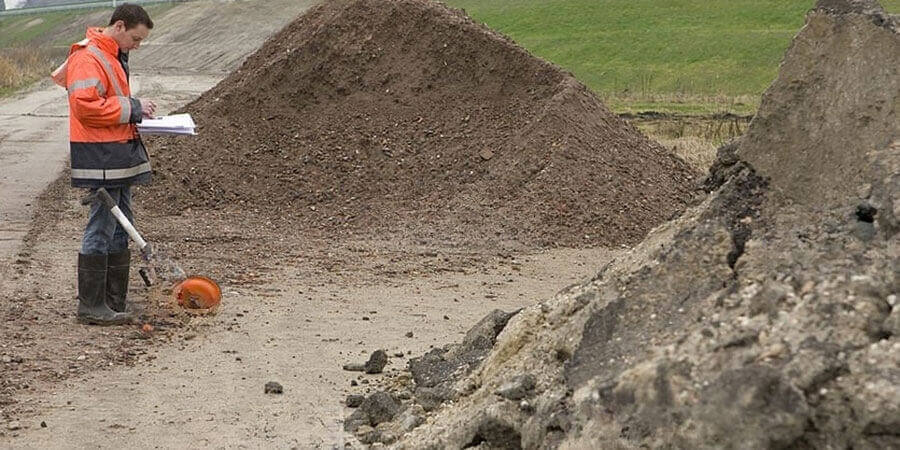
ASTM D 421 procedure pertains to the dry processing of soil samples obtained directly from the field, to conduct particle-size analysis and determine the soil constants.
TRUSTED BY


Precision-driven testing for dimensional accuracy and compliance
- Overview
- Scope, Applications, and Benefits
- Test Process
- Specifications
- Instrumentation
- Results and Deliverables
Overview
ASTM D421 is a standard practice used for the dry preparation of soil samples prior to determining soil constants and conducting particle-size analysis. Proper preparation ensures that soil particles are separated without altering their natural characteristics.
This method is widely used in geotechnical laboratories to prepare representative soil samples before testing properties such as grain size distribution, plasticity, and other soil classification parameters. Correct preparation improves the accuracy and reliability of soil testing results.

Scope, Applications, and Benefits
Scope
ASTM D421 outlines procedures for drying, disaggregating, and preparing soil samples before laboratory analysis. The method ensures that soil samples are properly conditioned for determining soil constants and particle-size distribution.
It also provides guidelines for handling soil specimens carefully to prevent crushing individual particles during preparation.
The scope includes:
Dry preparation of soil samples for laboratory testing
Separation of soil particles without altering their natural size
Preparation for particle-size analysis and soil constant determination
Maintaining representative soil sample characteristics
Supporting accurate geotechnical laboratory testing
Applications
Soil classification testing
Geotechnical engineering investigations
Construction and foundation analysis
Road and infrastructure development
Environmental soil analysis laboratories
Benefits
Ensures accurate soil sample preparation
Maintains natural soil particle characteristics
Improves reliability of soil testing results
Supports proper soil classification
Helps obtain representative samples for analysis
Test Process
Sample Collection
A representative soil sample is collected from the field and transported to the laboratory.
1Drying the Soil
The soil sample is air-dried or oven-dried to remove moisture before preparation.
2Disaggregation of Soil Clods
Soil lumps are gently broken using suitable tools without crushing the individual particles.
3Sample Preparation for Testing
The prepared soil is mixed and made ready for particle-size analysis and determination of soil constants.
4Technical Specifications
| Parameter | Details |
|---|---|
| Material Tested | Natural soil samples collected from field locations. |
| Preparation Method | Dry preparation before particle-size and soil constant analysis. |
| Drying Method | Air drying or controlled oven drying to remove moisture. |
| Sample Handling | Soil clods are disaggregated carefully to avoid particle breakage. |
| Particle Integrity | Individual soil grains must remain intact during preparation |
| Laboratory Conditions | Preparation conducted under controlled laboratory conditions. |
Instrumentation Used for Testing
Drying Oven
Mortar and Rubber Pestle
Sample Trays
Soil Mixing Tools
Standard Laboratory Sieves
Results and Deliverables
Properly prepared soil samples for laboratory testing
Verification of sample preparation according to ASTM D421
Documentation of soil preparation procedure
Prepared sample ready for particle-size and soil constant testing
Complete laboratory preparation report
Partnering with Infinita Lab for Optimal Results
Infinita Lab addresses the most frustrating pain points in the ASTM D 421 testing process: complexity, coordination, and confidentiality. Our platform is built for secure, simplified support, allowing engineering and R&D teams to focus on what matters most: innovation. From kickoff to final report, we orchestrate every detail—fast, seamlessly, and behind the scenes.
Looking for a trusted partner to achieve your research goals? Schedule a meeting with us, send us a request, or call us at (888) 878-3090 to learn more about our services and how we can support you. Request a Quote
Frequently Asked Questions
ASTM D421 is a standard practice used for the dry preparation of soil samples before performing particle-size analysis and determining soil constants. It ensures accurate and representative soil testing.
Proper preparation removes soil clumps and separates particles while preserving their natural size and structure. This helps obtain accurate and reliable laboratory results.
Crushing particles changes the actual particle-size distribution, which can lead to incorrect soil classification and inaccurate test results.
Prepared samples are used for sieve analysis, hydrometer analysis, Atterberg limits testing, and other soil property evaluations.
The method can be used for various natural soils, including sands, silts, and clays collected for laboratory analysis.
Case Studies
In-depth examination of genuine material testing solutions
Dopant and Ultra-Low Concentration Elemental Analysis Using STEM…

Dopant and Ultra-Low Concentration Elemental Analysis Using STEM…
Introduction to STEM-EELS for Elemental Analysis Scanning Transmission Electron Microscopy (STEM) combined with Electron Energy Loss...
Read Case StudyAnalysis of PVC Pipe Degradation Using FTIR Spectroscopy

Analysis of PVC Pipe Degradation Using FTIR Spectroscopy
PVC Pipe in Infrastructure — and Why Degradation Matters Polyvinyl chloride (PVC) pressure pipe is one...
Read Case StudyNano-scale roughness measurement of Si-wafers by Atomic Force…

Nano-scale roughness measurement of Si-wafers by Atomic Force…
Nano-scale surface roughness is a critical parameter in fabricated thin-films that are used in optics, solar...
Read Case Study
Request a Quote
Submit your material details and receive testing procedures, pricing, and turnaround time within 24 hours.
 Quick Turnaround and Hasslefree process
 Confidentiality Guarantee
 Free, No-obligation Consultation
 100% Customer Satisfaction
