
ASTM C39 Compressive Strength of Cylindrical Concrete Specimens
The ASTM C39 test method is used to determine the compressive strength of cylindrical concrete specimens such as drilled cores and molded cylindrical specimens. It is only applicable to concrete with a density of more than 800 kg/m3.
TRUSTED BY


Precision-driven testing for dimensional accuracy and compliance
- Overview
- Scope, Applications, and Benefits
- Test Process
- Specifications
- Instrumentation
- Results and Deliverables
Overview
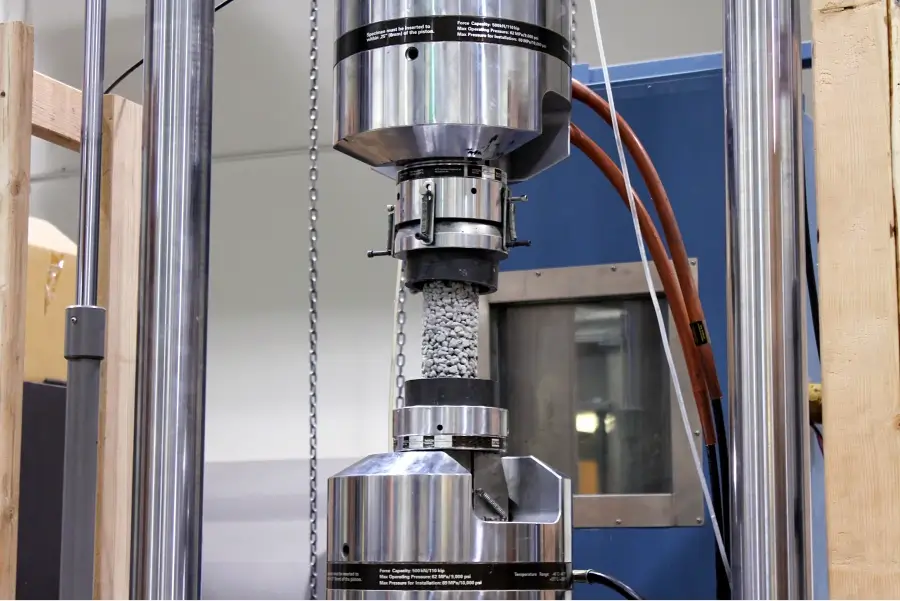
ASTM C39 determines the compressive strength of cylindrical concrete specimens by applying axial load until failure. This test is one of the most important methods for evaluating the strength and quality of concrete used in construction.
It is widely used in construction, infrastructure, and civil engineering projects. The results help ensure that concrete meets design specifications and can safely withstand applied loads.

Scope, Applications, and Benefits
Scope
ASTM C39 evaluates the compressive strength of hardened concrete using standardized cylindrical specimens. The test measures the maximum load the specimen can withstand before failure.
The test evaluates:
- Compressive strength of concrete
- Load-bearing capacity of concrete structures
- Quality and consistency of concrete mix
- Performance under axial compression
- Suitability for structural applications
Applications
- Structural concrete in buildings and bridges
- Pavements and road construction
- Precast and cast-in-place concrete
- Infrastructure and foundation projects
- Quality control in concrete production
- Civil engineering testing
Benefits
- Provides accurate strength measurement of concrete
- Ensures compliance with construction standards
- Supports structural design and safety
- Helps monitor concrete quality during production
- Enables comparison of concrete mixes
Test Process
Sample Preparation
Cylindrical concrete specimens are cured and prepared to required dimensions.
1Specimen Alignment
Samples are placed centrally in the compression testing machine.
2Load Application
Axial load is applied at a controlled rate until failure occurs.
3Data Recording & Evaluation
Maximum load is recorded to calculate compressive strength.
4Technical Specifications
| Parameter | Details |
|---|---|
| Applicable Materials | Concrete (cylindrical specimens) |
| Specimen Size | ~150 mm × 300 mm (standard) |
| Strength Range | ~10 MPa to 100 MPa |
| Loading Rate | ~0.25 MPa/s to 0.35 MPa/s |
| Test Age | Typically 7, 14, or 28 days |
| Measured Outputs | Compressive strength (MPa) |
Instrumentation Used for Testing
- Compression testing machine
- Load cell and control system
- Specimen capping or grinding equipment
- Alignment fixtures
- Measuring tools
- Data acquisition system
Results and Deliverables
- Compressive strength values (MPa)
- Failure load and mode
- Concrete quality assessment
- Comparative mix analysis
- Test condition summary
- ASTM compliance report
Why Choose Infinita Lab for ASTM C39?
At the core of this breadth is our network of 2,000+ accredited labs in the USA, offering access to over 10,000 test types. From advanced metrology (SEM, TEM, RBS, XPS) to mechanical, dielectric, environmental, and standardized ASTM/ISO testing, we give clients unmatched flexibility, specialization, and scale. You’re not limited by geography, facility, or methodology—Infinita connects you to the right testing, every time.
Looking for a trusted partner to achieve your research goals? Schedule a meeting with us, send us a request, or call us at (888) 878-3090 to learn more about our services and how we can support you. Request a Quote
Frequently Asked Questions
ASTM C39 includes compressive load, specimen diameter, height-to-diameter ratio, loading rate, curing conditions, and failure mode, evaluating compressive strength of cylindrical concrete specimens under controlled laboratory testing conditions.
ASTM C39 determines compressive strength, calculated from maximum load applied to the specimen, indicating structural capacity of concrete.
ASTM C39 is commonly applied to concrete cylinders prepared from fresh concrete used in construction and structural applications.
ASTM C39 requires a compression testing machine, loading platens, and specimen alignment devices to apply controlled compressive forces accurately.
ASTM C39 evaluates compressive strength under controlled laboratory conditions and may not fully represent in-situ concrete performance affected by curing, placement, and environmental conditions.
Case Studies
In-depth examination of genuine material testing solutions
Dopant and Ultra-Low Concentration Elemental Analysis Using STEM…

Dopant and Ultra-Low Concentration Elemental Analysis Using STEM…
Introduction to STEM-EELS for Elemental Analysis Scanning Transmission Electron Microscopy (STEM) combined with Electron Energy Loss...
Read Case StudyAnalysis of PVC Pipe Degradation Using FTIR Spectroscopy

Analysis of PVC Pipe Degradation Using FTIR Spectroscopy
PVC Pipe in Infrastructure — and Why Degradation Matters Polyvinyl chloride (PVC) pressure pipe is one...
Read Case StudyNano-scale roughness measurement of Si-wafers by Atomic Force…

Nano-scale roughness measurement of Si-wafers by Atomic Force…
Nano-scale surface roughness is a critical parameter in fabricated thin-films that are used in optics, solar...
Read Case Study
Request a Quote
Submit your material details and receive testing procedures, pricing, and turnaround time within 24 hours.
 Quick Turnaround and Hasslefree process
 Confidentiality Guarantee
 Free, No-obligation Consultation
 100% Customer Satisfaction
