
Accelerated UV Test as per ASTM G154
The ASTM G154 standard was created to simulate the conditions in which your products will be used, such as sunlight and moisture levels. You can adjust your design as needed after learning how much light or moisture your product can withstand before putting it on the market. If you're looking for a test lab that can deliver high-quality accelerated UV test results on time, Infinitalab is here to help.
TRUSTED BY


Precision-driven testing for dimensional accuracy and compliance
- Overview
- Scope, Applications, and Benefits
- Test Process
- Specifications
- Instrumentation
- Results and Deliverables
Overview
ASTM G154 is an accelerated weathering test method that uses standardized procedures to expose non-metallic materials to ultraviolet (UV) radiation, moisture, and heat to assess durability and weatherability. The test simulates environmental damage from sunlight, condensation, and temperature, and should be used to predict the performance of materials over time.
ASTM G154 is typically run alongside ASTM G155, but the significant difference between the two is that ASTM G154 uses fluorescent UV lamps, whereas ASTM G155 uses xenon arc lamps. This test procedure is well-suited for materials such as coatings, plastics, and polymers, which are sensitive to UV exposure and environmental aging.

Scope, Applications, and Benefits
Scope
ASTM G154 outlines procedures for simulating the degradation caused by sunlight, moisture, and heat using controlled laboratory conditions.
It evaluates:
- Resistance to UV radiation
- Effects of moisture and condensation
- Changes in physical and visual properties due to weathering
Fluorescent UV lamps are used to reproduce specific portions of the solar spectrum and moisture cycles.
Applications
- Durability testing of protective and decorative coatings
- Weatherability evaluation of plastics and polymers
- Performance assessment of automotive exterior and interior components
- Long-term exposure testing of construction materials such as roofing, siding, and window components
- Quality control and product development for UV-sensitive materials
Benefits
- Provides accelerated simulation of outdoor weathering
- Enables comparison of material formulations
- Helps predict service life under UV exposure
- Supports product development and material selection
- Ensures repeatable and standardized test results
Test Process
Specimen Preparation
Samples are prepared to suitable dimensions, commonly around 75 × 150 mm, ensuring uniform surfaces and defect-free edges.
1UV Exposure Setup
Specimens are placed in a chamber equipped with fluorescent UV lamps (UVA or UVB) and temperature control
2Cyclic Weathering
Samples undergo programmed cycles of UV exposure and moisture (condensation), such as 8 hours of UV followed by 4 hours of condensation.
3Evaluation & Data Collection
After exposure, specimens are evaluated for color changes, cracking, chalking, loss of gloss, and other degradation indicators.
4Technical Specifications
| Parameter | Details |
|---|---|
| Test Principle | Accelerated UV exposure using fluorescent lamps with moisture and heat cycles |
| Light Source | Fluorescent UV lamps (UVA-340, UVB-313) |
| Exposure Cycles | UV radiation followed by condensation |
| Sample Types | Coatings, plastics, polymers, non-metallic materials |
| Typical Sample Size | ~75 × 150 mm (modifiable as required) |
| Test Duration | Hundreds to thousands of hours, depending on the material and the test objective |
Instrumentation Used for Testing
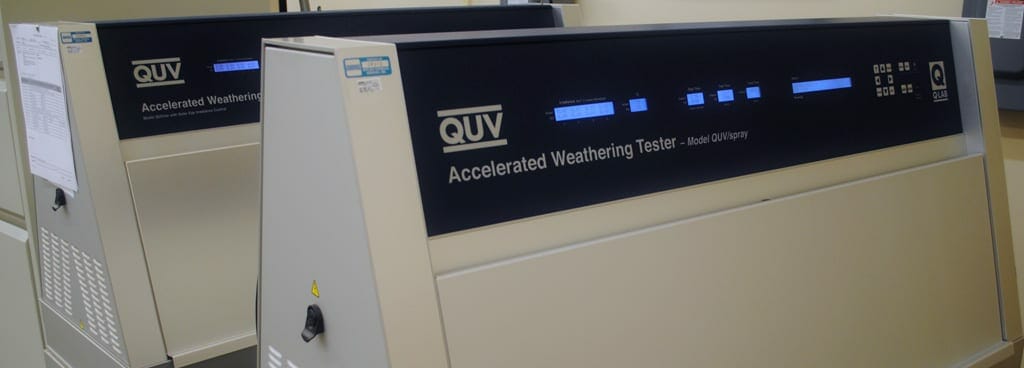
- Accelerated UV weathering chambers
- Fluorescent UVA and UVB lamps
- Temperature-controlled enclosures
- Condensation and moisture generation systems
- Exposure monitoring and data logging software
Results and Deliverables
- Visual and physical degradation assessment
- Comparison against unexposed control samples
- Documentation of color fade, cracking, chalking, and gloss loss
- Evaluation of UV and moisture resistance
- Suitability assessment for indoor, outdoor, or shaded applications
Why Choose Infinita Lab for ASTM G154?
At the core of this breadth is our network of 2,000+ accredited labs in the USA, offering access to over 10,000 test types. From advanced metrology (SEM, TEM, RBS, XPS) to mechanical, dielectric, environmental, and standardized ASTM/ISO testing, we give clients unmatched flexibility, specialization, and scale. You’re not limited by geography, facility, or methodology—Infinita connects you to the right testing, every time.
Looking for a trusted partner to achieve your research goals? Schedule a meeting with us, send us a request, or call us at (888) 878-3090 to learn more about our services and how we can support you. Request a Quote
Frequently Asked Questions
ASTM G154 and ASTM G155 are standards for accelerated weathering tests, but they differ in the type of light source used and the specific applications. ASTM G514 uses fluorescent UV lamps to simulate the effects of sunlight, particularly the UV portion of the spectrum. ASTM G155 uses a xenon arc lamp to simulate full-spectrum sunlight, including UV, visible, and infrared light.
ASTM G154 is often not utilized for metals because it is intended for nonmetallic materials such as plastics and coatings.
Moisture exposure is crucial since many materials deteriorate due to UV radiation and rain, dew, and humidity. Including moisture in the test improves the simulation of real-world weathering conditions.
Many materials can be examined, including plastics, coatings, paints, sealants, rubbers, and other nonmetallic materials used in outdoor applications.
ASTM G154 simulates UV exposure under controlled laboratory conditions and may not fully represent real outdoor environments where full-spectrum sunlight, temperature fluctuations, and environmental factors influence material degradation.
Case Studies
In-depth examination of genuine material testing solutions
Dopant and Ultra-Low Concentration Elemental Analysis Using STEM…

Dopant and Ultra-Low Concentration Elemental Analysis Using STEM…
Introduction to STEM-EELS for Elemental Analysis Scanning Transmission Electron Microscopy (STEM) combined with Electron Energy Loss...
Read Case StudyAnalysis of PVC Pipe Degradation Using FTIR Spectroscopy

Analysis of PVC Pipe Degradation Using FTIR Spectroscopy
PVC Pipe in Infrastructure — and Why Degradation Matters Polyvinyl chloride (PVC) pressure pipe is one...
Read Case StudyNano-scale roughness measurement of Si-wafers by Atomic Force…

Nano-scale roughness measurement of Si-wafers by Atomic Force…
Nano-scale surface roughness is a critical parameter in fabricated thin-films that are used in optics, solar...
Read Case Study
Request a Quote
Submit your material details and receive testing procedures, pricing, and turnaround time within 24 hours.
 Quick Turnaround and Hasslefree process
 Confidentiality Guarantee
 Free, No-obligation Consultation
 100% Customer Satisfaction
