
Inductively Coupled Plasma Optical Emission Spectroscopy (ICP-OES)
Inductively Coupled Plasma Optical Emission Spectroscopy (ICP-OES) is a technique that uses high-temperature plasma to produce free atoms and ions of a vaporized sample, for optical spectroscopic analysis of elements. Experts at Infinita Lab, USA, laboratory network, cater all your routine and specific test needs basing on the ICP-OES technique.
TRUSTED BY


Precision-driven testing for dimensional accuracy and compliance
- Overview
- Scope, Applications, and Benefits
- Test Process
- Specifications
- Instrumentation
- Results and Deliverables
Overview
ICP-OES is a widely used analytical technique for determining the elemental composition of materials by measuring the light emitted from excited atoms in a high-temperature plasma. It enables simultaneous multi-element detection with high accuracy and sensitivity.
This method is extensively used in the environmental, metals, pharmaceuticals, and materials industry for quantitative analysis of trace and major elements in liquids and digested solid samples. It is essential for quality control, compliance testing, and research due to its reliability and efficiency in handling complex sample matrices.

Scope, Applications, and Benefits
Scope
ICP-OES evaluates elemental composition by exciting atoms in plasma and measuring emitted wavelengths.
It enables accurate multi-element analysis across a wide concentration range.
- Multi-element elemental analysis
- Trace and major element detection
- Liquid and digested sample analysis
- Quantitative composition evaluation
- Quality control and validation
- Environmental and material testing
Applications
- Environmental water and soil analysis
- Metal and alloy testing
- Pharmaceutical quality testing
- Food and agricultural analysis
- Chemical and industrial materials
Benefits
- Simultaneous multi-element detection
- High accuracy and precision
- Wide dynamic range
- Fast analysis time
- Suitable for complex matrices
- Reliable quantitative results
- Supports regulatory compliance
Test Process
Sample Preparation
Sample is dissolved or digested into liquid form using appropriate chemical methods.
1Sample Introduction
Prepared solution is introduced into the plasma through a nebulizer system.
2Plasma Excitation
Sample is ionized in high-temperature plasma causing atoms to emit characteristic light.
3Detection and Analysis
Emitted wavelengths are measured to determine elemental concentrations accurately.
4Technical Specifications
| Parameter | Details |
|---|---|
| Material Type | Liquid samples and digested solids. |
| Plasma Source | Inductively coupled plasma (ICP). |
| Temperature Range | ~6000–10000 K plasma temperature. |
| Detection Range | ppm to ppb levels. |
| Wavelength Detection | Wavelength Detection |
Instrumentation Used for Testing
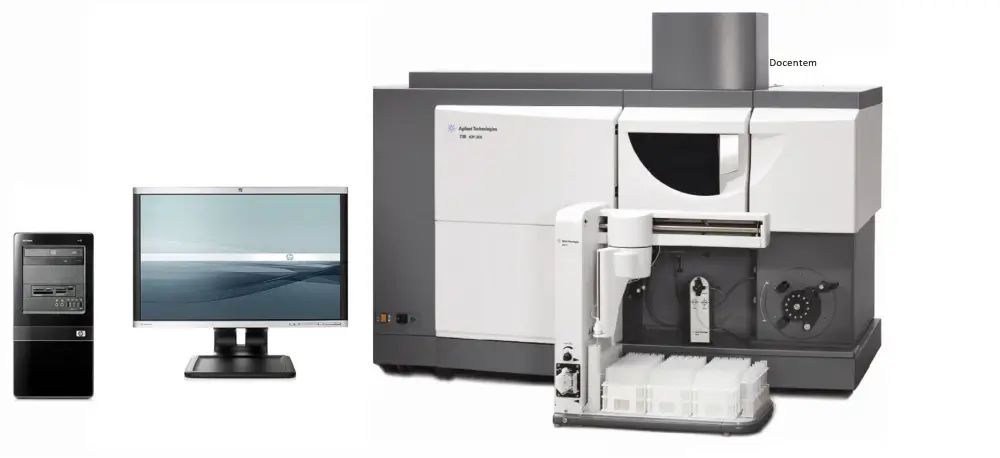
- ICP-OES spectrometer
- Nebulizer and spray chamber
- Plasma torch
- RF generator
- Optical detector system
- Gas supply (argon)
Results and Deliverables
- Elemental concentration data
- Multi-element analysis report
- Calibration and validation data
- Trace element detection results
- Compliance with standards
- Test documentation
- Final analytical report
Partnering with Infinita Lab for Optimal Results
Infinita Lab addresses the most frustrating pain points in the ICP-OES testing process: complexity, coordination, and confidentiality. Our platform is built for secure, simplified support, allowing engineering and R&D teams to focus on what matters most: innovation. From kickoff to final report, we orchestrate every detail—fast, seamlessly, and behind the scenes.
Looking for a trusted partner to achieve your research goals? Schedule a meeting with us, send us a request, or call us at (888) 878-3090 to learn more about our services and how we can support you. Request a Quote
Frequently Asked Questions
Inductively Coupled Plasma Optical Emission Spectroscopy can analyze various sample types, including aqueous solutions, organic liquids, and solids. However, these samples must be prepared in a form compatible with the ICP-OES system.
ICP-OES generally offers detection limits that are two to three orders of magnitude higher than ICP-MS. Most elements are typically found within the range of 1-10 ppb.
ICP-OES usually has higher detection limits, ranging from parts per million (ppm) to parts per billion (ppb). ICP-MS, however, has much lower detection limits, often in the parts per trillion (ppt) range, which makes it more sensitive for trace element analysis.
The plasma in ICP-OES has a high temperature (5,000–10,000 K). It effectively vaporizes, atomizes, and excites atoms from a sample. The excited atoms emit characteristic light, whose spectrum allows for determining elemental composition.
Aerospace, automotive, energy, electronics, and environmental Industries use ICP-OES for quality assurance, trace metal identification, and enhancing material reliability.
Case Studies
In-depth examination of genuine material testing solutions
Case Study: Dopant & Ultra-Low Concentration Analysis via…

Case Study: Dopant & Ultra-Low Concentration Analysis via…
Introduction to STEM-EELS for Elemental Analysis Scanning Transmission Electron Microscopy (STEM) combined with Electron Energy Loss...
Read Case StudyAnalysis of PVC Pipe Degradation Using FTIR Spectroscopy

Analysis of PVC Pipe Degradation Using FTIR Spectroscopy
PVC Pipe in Infrastructure — and Why Degradation Matters Polyvinyl chloride (PVC) pressure pipe is one...
Read Case StudyNano-scale roughness measurement of Si-wafers by Atomic Force…

Nano-scale roughness measurement of Si-wafers by Atomic Force…
Nano-scale surface roughness is a critical parameter in fabricated thin-films that are used in optics, solar...
Read Case Study
Request a Quote
Submit your material details and receive testing procedures, pricing, and turnaround time within 24 hours.
 Quick Turnaround and Hasslefree process
 Confidentiality Guarantee
 Free, No-obligation Consultation
 100% Customer Satisfaction
