
ASTM D2739 Volume Resistivity of Conductive Adhesive
The ASTM D2739 test method covers the determination of the volume resistivity of resin-based conductive adhesives in the cured condition. The test is performed on a thin adhesive film that has been created as part of a bonded specimen.
TRUSTED BY


Precision-driven testing for dimensional accuracy and compliance
- Overview
- Scope, Applications, and Benefits
- Test Process
- Specifications
- Instrumentation
- Results and Deliverables
Overview
ASTM D 2739 is the standard test method for volume resistivity of cured resin-based conductive adhesives. This test method measures the ability of an adhesive layer to conduct electrical current through its volume when used between metallic adherends.
The method is of particular relevance to applications such as electronic packaging where the adhesive provides an electrical path, such as conductive bonding and interconnect systems. ASTM D2739 provides standardized data on measuring electrical resistance under a defined geometry for comparing adhesive formulations and verifying manufacturing quality.

Scope, Applications, and Benefits
Scope
ASTM D2739 outlines procedures for measuring volume resistivity of cured conductive adhesives.
It evaluates:
- Electrical conductivity of cured adhesive layers
- Effect of curing conditions (room temperature or elevated)
- Performance of thin adhesive films
- Consistency of conductive properties across batches
- Influence of adhesive formulation and geometry
The results apply specifically to the tested configuration and are most meaningful for electronic applications.
Applications
- Electronic packaging and assembly
- Conductive bonding and grounding
- Sensor and interconnect systems
- Printed circuit board (PCB) assembly
- EMI/RFI shielding applications
- Microelectronics manufacturing
Benefits
- Provides quantitative electrical performance data
- Enables comparison of conductive adhesive formulations
- Supports quality control and batch verification
- Ensures compliance with electrical design requirements
- Improves the reliability of electronic assemblies
- Assists in material selection for conductive applications
Test Process
Specimen Preparation & Curing
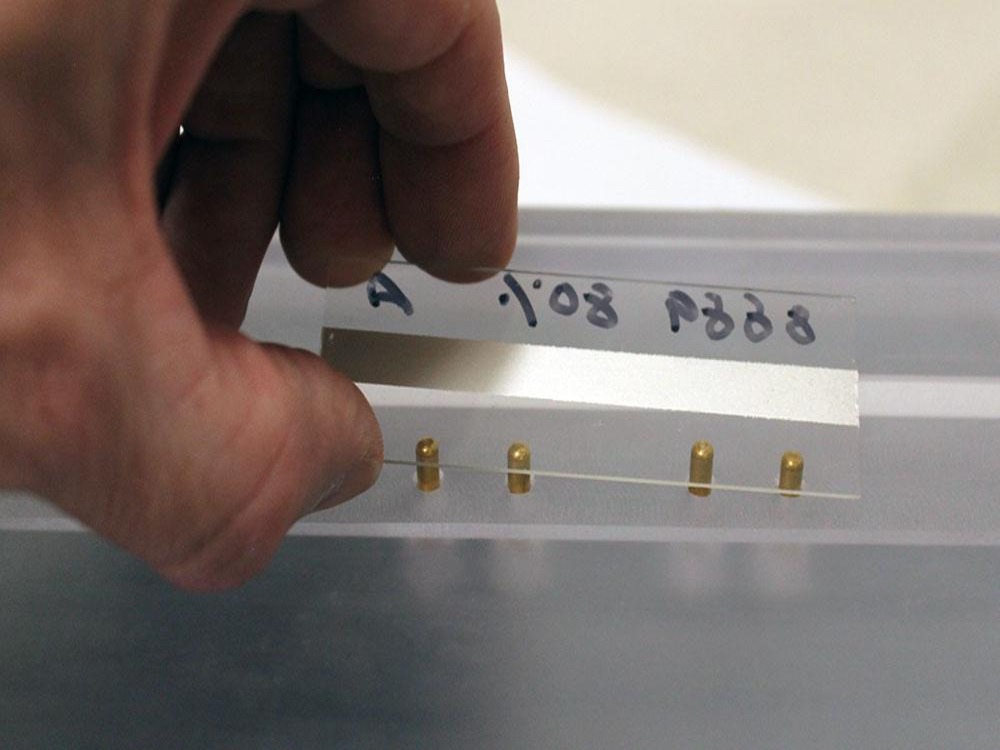
Conductive adhesive is applied between two metallic plugs and cured to form a controlled-thickness sandwich specimen.
1Conditioning
Cured specimens are conditioned at standard laboratory conditions (≈23 °C, 50% RH) for a specified duration.
2Resistance Measurement
Electrical resistance between metallic adherends is measured using a Kelvin bridge or equivalent precision instrument.
3Resistivity Calculation
Volume resistivity (ρv) is calculated from measured resistance and specimen geometry.
4Technical Specifications
| Parameter | Details |
|---|---|
| Applicable Materials | Resin-based conductive adhesives |
| Specimen Geometry | Thin adhesive layer between metallic plugs |
| Cure Conditions | Room temperature or elevated temperature |
| Conditioning Environment | ~23 °C, 50% RH |
| Measurement Units | Ohm-cm (or SI equivalent) |
Instrumentation Used for Testing
- Kelvin bridge or precision ohmmeter
- Metallic plug fixtures
- Temperature and humidity conditioning chamber
- Micrometer or thickness gauge
- Data acquisition and calculation software
Results and Deliverables
- Volume resistivity values (ohm-cm)
- Comparative electrical performance data
- Batch consistency verification
- Compliance documentation for electronic applications
- Data supporting material qualification
- Electrical performance reports
Frequently Asked Questions
The volume resistivity test is essential because it determines the adhesives' ability to conduct electricity. This property is necessary for applications where electrical performance and connectivity are critical, such as electronics, aerospace, and automotive industries
The ASTM D2739 test method determines the volume resistivity of resin-based conductive adhesives in the cured condition. The test is performed on a thin adhesive film created as part of a bonded specimen.
The ASTM D2739 test method uses brass tensile adhesion specimens with electrical connections. These specimens are prepared with adhesive layers cured between metal adherents.
The ASTM D2739 standard ensures that conductive adhesives meet specific resistivity requirements in electronics manufacturing, aerospace, automotive, telecommunications, and industrial applications.
ASTM D2739 assists manufacturers by ensuring that their conductive adhesives meet required electrical performance standards, optimizing product quality, and enhancing the reliability of adhesive applications in critical industries.
Case Studies
In-depth examination of genuine material testing solutions
Case Study: Dopant & Ultra-Low Concentration Analysis via…

Case Study: Dopant & Ultra-Low Concentration Analysis via…
Introduction to STEM-EELS for Elemental Analysis Scanning Transmission Electron Microscopy (STEM) combined with Electron Energy Loss...
Read Case StudyAnalysis of PVC Pipe Degradation Using FTIR Spectroscopy

Analysis of PVC Pipe Degradation Using FTIR Spectroscopy
PVC Pipe in Infrastructure — and Why Degradation Matters Polyvinyl chloride (PVC) pressure pipe is one...
Read Case StudyNano-scale roughness measurement of Si-wafers by Atomic Force…

Nano-scale roughness measurement of Si-wafers by Atomic Force…
Nano-scale surface roughness is a critical parameter in fabricated thin-films that are used in optics, solar...
Read Case Study
Request a Quote
Submit your material details and receive testing procedures, pricing, and turnaround time within 24 hours.
 Quick Turnaround and Hasslefree process
 Confidentiality Guarantee
 Free, No-obligation Consultation
 100% Customer Satisfaction
