
ASTM D792, ISO 1183 Specific Gravity and Density
ASTM D92 and ISO 1183: The determination of specific gravity and density for solid plastic items is carried out using ASTM D792 and ISO 1183 test techniques. It is convenient to measure a solid's specific gravity or density to determine its composition, track physical changes in a sample, assess the degree of homogeneity between several sampling units or specimens, or estimate the typical density of a huge object. These figures are crucial when trading solid plastic materials based on price per plastics weight unit.
TRUSTED BY


Precision-driven testing for dimensional accuracy and compliance
- Overview
- Scope, Applications, and Benefits
- Test Process
- Specifications
Overview
ASTM D792 and ISO 1183 provide standard methods for determining the specific gravity and density of solid plastics, including molded specimens, films, sheets, rods, and tubes. Density is one of the most fundamental physical properties of a plastic material — it is used for material identification, quality control, theoretical yield calculation, and correlation with other physical properties.
These methods cover immersion-based (displacement) techniques for solid plastics, providing rapid, accurate density data applicable to virtually all solid polymer forms without specialized instrumentation.

Scope, Applications, and Benefits
Scope
ASTM D792 / ISO 1183 evaluates:
- Apparent density and specific gravity (SG) of solid plastics
- Method A: Immersion in water (for materials denser than water, SG > 1)
- Method B: Immersion in a liquid other than water (for porous or water-absorbing materials)
- ISO 1183 Method A (immersion), B (pyknometer), C (gradient column), D (titration)
Applications
- Plastic raw material and compound incoming QC
- Material identity verification (density fingerprinting)
- Filled and reinforced compound density determination
- Foam and cellular plastic density characterization
- Recycled polymer verification and sorting
Benefits
- Simple, rapid, and low-cost density measurement
- No specialized instrumentation beyond a precision balance with a suspension kit
- Enables material identity and quality verification
- Applicable to all solid polymer forms
- Globally recognized for both commercial and R&D use
Test Process
Specimen Preparation
A solid plastic specimen of suitable mass (1–5 g) is prepared free from visible voids, flaws, or surface contamination; specimen is dried if hygroscopic.
1Weight in Air
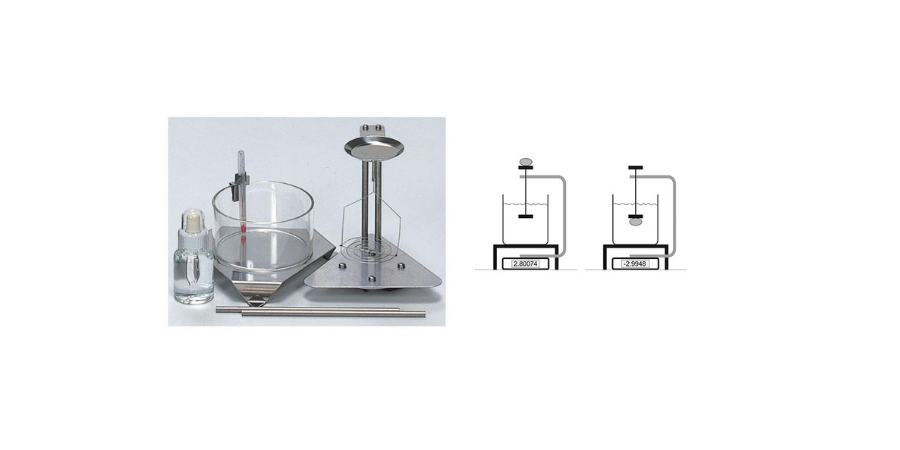
The specimen is weighed in air on an analytical balance to four decimal places (weight a).
2Weight in Immersion Liquid
The specimen is suspended by a fine wire in distilled water (or specified liquid for Method B) and the immersed weight is recorded (weight w).
3Density Calculation
Specific gravity = a / (a − w); density (g/cm³) = SG × density of immersion liquid at test temperature. Results are reported to four decimal places.
4Technical Specifications
| Parameter | Details |
|---|---|
| Principle | Archimedes displacement in immersion liquid |
| Immersion Liquid | Distilled water (Method A); 2-propanol, ethanol (Method B) |
| Balance Precision | ±0.1 mg |
| Test Temperature | 23 °C ± 1 °C |
| Applicable Materials | Solid plastics, including filled and unfilled grades |
- Analytical balance with sinker and suspension wire kit
- Density determination kit (bridge, beaker, wire basket)
- Thermometer and temperature-controlled liquid bath
- Distilled water or appropriate immersion liquid
- Calibration weights
- Specific gravity (dimensionless) and density (g/cm³)
- Test temperature and immersion liquid documentation
- Comparison to reference material or specification range
- Material identity/grade verification (if applicable)
- Full density test report per ASTM D792 or ISO 1183
Partnering with Infinita Lab for Optimal Results
Infinita Lab addresses the most frustrating pain points in the ASTM D792 / ISO 1183 testing process: complexity, coordination, and confidentiality. Our platform is built for secure, simplified support, allowing engineering and R&D teams to focus on what matters most: innovation. From kickoff to final report, we orchestrate every detail—fast, seamlessly, and behind the scenes.
Looking for a trusted partner to achieve your research goals? Schedule a meeting with us, send us a request, or call us at (888) 878-3090 to learn more about our services and how we can support you. Request a Quote
Frequently Asked Questions
Specific gravity is the dimensionless ratio of the material's density to water density at the same temperature. Density (g/cm³ or kg/m³) is the absolute mass per unit volume. Both are reported because specific gravity enables simple comparison without temperature correction, while absolute density is needed for engineering calculations.
No. The immersion method is not suitable for open-cell foams or highly porous materials that absorb the immersion liquid. ISO 845 (foam density) or ASTM D1622 (apparent density of rigid foams) should be used for cellular materials.
Each plastic material has a characteristic density range (e.g., LDPE: 0.910–0.940, POM: 1.39–1.43, PTFE: 2.14–2.20 g/cm³). Density measurement provides a rapid first-pass identity check, though it cannot uniquely distinguish all polymer types, especially filled or blended materials.
With proper balance calibration, specimen preparation, and temperature control, ASTM D792 achieves repeatability of ±0.001 g/cm³ and reproducibility of ±0.003 g/cm³ for most solid plastics.
Yes. Mineral fillers (calcium carbonate, talc, glass fiber) have densities of 2.5–4.0 g/cm³ — significantly higher than the polymer matrix. Increasing filler loading proportionally increases compound density, making density measurement a useful indirect check on filler loading.




Request a Quote
Submit your material details and receive testing procedures, pricing, and turnaround time within 24 hours.
 Quick Turnaround and Hasslefree process
 Confidentiality Guarantee
 Free, No-obligation Consultation
 100% Customer Satisfaction
