
ASTM E128 Maximum Pore Diameter and Permeability of Rigid Porous Filters for Laboratory Use
ASTM E128 test method covers the determination of maximum pore diameter and permeability of rigid porous filters used in the laboratory for filtration or diffusion. This test method establishes a uniform designation for maximum pore diameter and also provides a means of detecting and measuring changes that occur through continued use.


Scope:
ASTM E128 test method covers the determination of maximum pore diameter and permeability of rigid porous filters used in the laboratory for filtration or diffusion. They are applicable to filters made of sintered glass, ceramic, metal, or plastic.
Test Procedure:
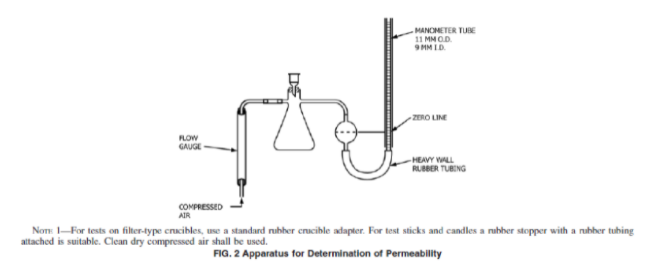
In ASTM E128, the maximum pore diameter is determined by immersing the filter in a suitable test liquid and applying air pressure until the first bubble of air passes through the filter (Figure 1). The maximum pore diameter is calculated from the surface tension of the test liquid and the applied pressure. Permeability is determined by measuring the flow of air through the filter when subjected to a pressure differential (Figure 2).
Figure 1: Apparatus for determining maximum pore diameter of rigid porous filters
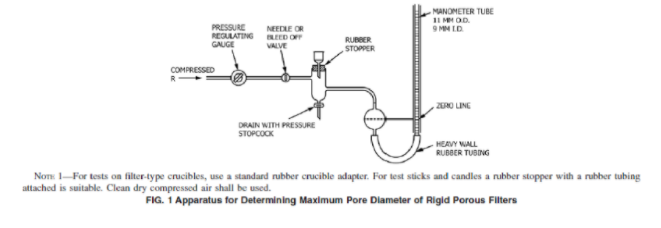
Figure 2: Apparatus for determination of permeability
Specimen size:
Materials for Filters: Glass, Porcelain, Stainless steel, Tetrafluoro-polyethylene, Trifluoromonochloropolyethylene, etc.
Data:
In ASTM E128, the maximum pore diameter is calculated from the following equation:
D = 30γ/p
Where:
D = maximum pore diameter
γ = surface tension of test liquid in dynes/cm at the temperature of the test, and
p = pressure, mm Hg
Calculate the permeability as follows:
Permeability = R/Ap
Where:
R = rate of flow of air, mL/min,
A = effective area of the filter, and
p = observed pressure of water, cm
Conclusion:
ASTM E128 test method covers the determination of maximum pore diameter and permeability of rigid porous filters used in the laboratory for filtration or diffusion.
Talk to Our Experts Today!
Submit your contact info and we’ll get back to you within 24 hours
Full Spectrum of ASTM Material Testing — Backed by 2,000+ Trusted Lab Partners
ASTM standards for chemical composition, physical properties, failure analysis, and other routine and non-routine testing for polymers and plastics
ASTM standards for determination of mechanical, physical, and thermal properties, and performance of monolithic and composite ceramics
ASTM standards guiding various destructive, non-destructive and analytical tests for quality control of different metals and alloys
ASTM standards for chemical analysis of solid, liquid and gaseous materials for specification compliance and quality control
ASTM standards for various chemical, physical, stability and exposure analysis of paints and coatings
Our Services

Metrology
A variety of microscopy and spectroscopy tools available for precise measurements from the nano to the meter scale.
Learn More
Materials Testing
ASTM and ISO standard and custom chemical, mechanical, thermal, corrosion tests, etc. for all materials metals, ceramic or polymers.
Learn More
Product Testing
Thousands of tests for product quality and reliability under heat, humidity, temperature shock, vibration, drop, electrostatic discharge.
Learn More


