
ASTM E647 Test for Measurement of Fatigue Crack Growth Rates
ASTM E647 test method is used to determine fatigue crack growth rates from near-threshold to Kmax controlled instability. A crack growth equation is used for calculating the size of a fatigue crack growing from cyclic loads.


Scope:
ASTM E647 test method is used to determine fatigue crack growth rates from near-threshold to Kmax controlled instability. Crack growth equations predict the crack size starting from a given initial flaw. The growth of fatigue cracks can result in catastrophic failure. A crack growth equation can be used to ensure safety, both in the design phase and during operation, by predicting the size of cracks. In critical structures, loads can be recorded and used to indicate the size of cracks to ensure that maintenance or retirement occurs before cracks fail.
This ASTM E647 test method is used for the following purposes:
- To determine the effect of the fatigue crack growth on the life of components subjected to cyclic loading.
- To select materials for durable products.
- To determine the effects of metallurgical, fabrication, environmental, and loading variables on fatigue crack growth.
Test Procedure:
This ASTM E647 test method involves cyclic loading of notched specimens that have been acceptably pre-cracked in fatigue. Crack size is measured, either visually or by an equivalent method, as a function of elapsed fatigue cycles, and these data are subjected to numerical analysis to establish the crack growth rate. Crack growth rates are expressed as a function of the stress-intensity factor range, ∆K, calculated from expressions based on linear elastic stress analysis.
Specimen Size:
As per ASTM E647, the specimen should be notched and predominantly elastic at all applied force values.
Data:
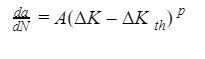
Threshold equation: To predict crack growth rate at the near-threshold region, the following equation is used in ASTM E647 testing:
Conclusion:
ASTM E647 test method is used to determine fatigue crack growth rates from near-threshold to Kmax controlled instability.
Talk to Our Experts Today!
Submit your contact info and we’ll get back to you within 24 hours
Full Spectrum of ASTM Material Testing — Backed by 2,000+ Trusted Lab Partners
ASTM standards for chemical composition, physical properties, failure analysis, and other routine and non-routine testing for polymers and plastics
ASTM standards for determination of mechanical, physical, and thermal properties, and performance of monolithic and composite ceramics
ASTM standards guiding various destructive, non-destructive and analytical tests for quality control of different metals and alloys
ASTM standards for chemical analysis of solid, liquid and gaseous materials for specification compliance and quality control
ASTM standards for various chemical, physical, stability and exposure analysis of paints and coatings
Our Services

Metrology
A variety of microscopy and spectroscopy tools available for precise measurements from the nano to the meter scale.
Learn More
Materials Testing
ASTM and ISO standard and custom chemical, mechanical, thermal, corrosion tests, etc. for all materials metals, ceramic or polymers.
Learn More
Product Testing
Thousands of tests for product quality and reliability under heat, humidity, temperature shock, vibration, drop, electrostatic discharge.
Learn More


