
ASTM E126 Inspection, Calibration, and Verification of ASTM Hydrometers
The purpose of this ASTM E126-13a test method is to establish a common method by which manufacturers, calibration laboratories, and users of hydrometers are used to inspect, verify, or calibrate them. The objective is to provide a standard method that is simple, easily understood, and to produce reliable results.


Scope:
ASTM E126 test method describes the principles, apparatus, and procedures for the inspection, calibration, and verification of ASTM glass hydrometers. This test method applies to ASTM hydrometers but can be used for other general hydrometers of the constant-mass, variable-displacement type.
Test Procedure:
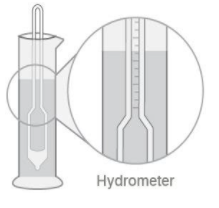
In ASTM E126, the hydrometer (Figure 1) is carefully inspected for; cracks, fissures, deep scratches, rough areas, or other obvious damage to the glass. A hydrometer is rejected if any of these defects are present. The hydrometer is checked for strain in the glass, especially at the stem/body junction with the use of a polariscope. A hydrometer is rejected if any of these defects are present. It is particularly important for thermo hydrometers.
The paper scale is inspected within the hydrometer stem. The paper scale is straight and without a twist. The linear dimensions and diameters are checked for compliance with specification requirements by comparing the hydrometer with the appropriate device.
For ASTM E126, the hydrometer is calibrated at a minimum of three calibration points, spaced approximately equally across its range, nominally high, low, and mid-scale. For example, a hydrometer with a range of 9° to 21° API shall be calibrated at (approximately) 10, 15, and 20 API.
Figure 1: A hydrometer
Specimen size:
Hydrometers
Data
The interval between graduations of density and relative density (specific gravity) hydrometers is smaller near the bottom of the scale. As per ASTM E126, the proper spacing shall be obtained from the following formula:
l = L × d2/d× (d – d1)/ (d2 – d1)
Where:
l = distance from the top line to any line, d, between the top and the bottom,
L = distance between the top and the bottom graduations of the scale,
d2 = density value, or relative density (specific gravity), of the bottom line, and
d1 = density value, or relative density (specific gravity), of the top line.
Conclusion:
ASTM E126 test method describes the principles, apparatus, and procedures for the inspection, calibration, and verification of ASTM glass hydrometers.
Talk to Our Experts Today!
Submit your contact info and we’ll get back to you within 24 hours
Full Spectrum of ASTM Material Testing — Backed by 2,000+ Trusted Lab Partners
ASTM standards for chemical composition, physical properties, failure analysis, and other routine and non-routine testing for polymers and plastics
ASTM standards for determination of mechanical, physical, and thermal properties, and performance of monolithic and composite ceramics
ASTM standards guiding various destructive, non-destructive and analytical tests for quality control of different metals and alloys
ASTM standards for chemical analysis of solid, liquid and gaseous materials for specification compliance and quality control
ASTM standards for various chemical, physical, stability and exposure analysis of paints and coatings
Our Services

Metrology
A variety of microscopy and spectroscopy tools available for precise measurements from the nano to the meter scale.
Learn More
Materials Testing
ASTM and ISO standard and custom chemical, mechanical, thermal, corrosion tests, etc. for all materials metals, ceramic or polymers.
Learn More
Product Testing
Thousands of tests for product quality and reliability under heat, humidity, temperature shock, vibration, drop, electrostatic discharge.
Learn More


