


ASTM E471: Thermal Flux Meter Calibration Testing Services
ASTM E 471 – 96 explains the determination of the char density profile of a charred ablator. This technique involves measuring, machining, and weighing a sample of a specific size to determine its density. Therefore, the sample should be strong enough to withstand all the techniques employed. Its value is stated in SI units.
TRUSTED BY


Get ASTM E471 compliant results — request your thermal flux meter calibration testing quote
- Overview
- Scope, Applications, and Benefits
- Test Process
- Specifications
- Instrumentation
- Results and Deliverables
What Is ASTM E471 Thermal Flux Meter Calibration?
ASTM E471 provides a standard test method for measuring the thermal resistance (R-value) of building thermal insulation materials using a guarded hot box or calibrated hot box apparatus. R-value is the definitive measure of an insulation material’s ability to resist heat flow, directly governing building energy performance and compliance with energy codes.
Accurate R-value testing is essential for insulation manufacturers, building product certifiers, energy code compliance, and building performance rating systems that rely on verified thermal resistance data.

Applications and Benefits of ASTM E471 Thermal Flux Meter Calibration Testing
Scope
ASTM E471 evaluates:
- Steady-state thermal resistance (R-value, m²·K/W or ft²·hr·°F/BTU)
- Thermal transmittance (U-value) of installed insulation assemblies
- Effect of moisture and density on R-value
- R-value at different mean temperatures
Applications
- Batt, blanket, and loose-fill insulation product certification
- Building code R-value compliance verification
- Wall, roof, and floor insulation assembly characterization
- Energy rating and green building certification (LEED, PassivHaus)
- Novel insulation material development
Benefits
- Provides a definitive steady-state R-value under controlled conditions
- Supports building energy code compliance documentation
- Enables comparison of competing insulation products on a consistent basis
- Applicable to all types of building insulation materials
- Widely recognized by code authorities and certifying bodies
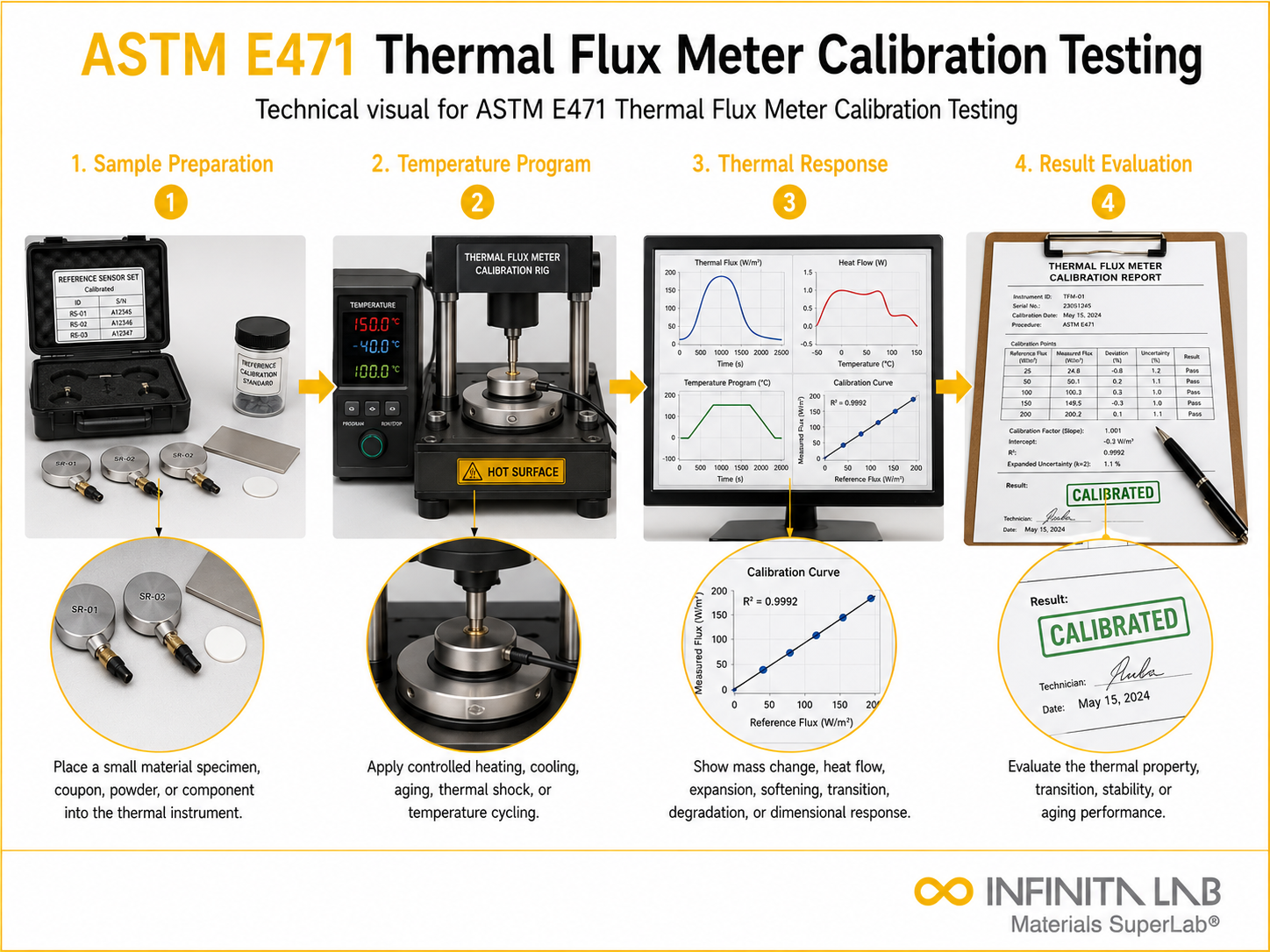
Our ASTM E471 Testing Procedure
Specimen Preparation
Insulation specimens are conditioned to the required density and moisture content; thickness, density, and mass are documented before testing.
1Hot Box Assembly
The specimen is mounted as a test panel in the guarded or calibrated hot box dividing the warm and cold metering areas; air-to-air temperature difference is established.
2Steady-State Heat Flow
The apparatus is operated until steady-state thermal equilibrium is achieved; heat input to the metered area, hot and cold side temperatures, and specimen thickness are recorded.
3R-Value Calculation
Thermal resistance (R) = ΔT × A / Q, where ΔT is temperature difference, A is area, and Q is heat flow rate; results are reported in SI and/or imperial units.
4ASTM E471 Test Parameters and Requirements
| Parameter | Details |
|---|---|
| Method | Guarded or calibrated hot box |
| Temperature Range | Typically −18 °C to 38 °C mean temperature |
| Applicable Materials | All building insulation types (fiberglass, cellulose, foam, mineral wool) |
| Measured Output | R-value (m²·K/W or ft²·°F·hr/BTU) |
| Steady-State Criterion | ≤1% variation in heat flow over defined period |


- Guarded or calibrated hot box apparatus (ASTM E471 compliant)
- Calibrated heat flux meters and temperature sensors
- Environmental chamber for hot and cold side temperature control
- Thickness and density measurement tools
- Data logging and steady-state verification system
Equipment and Instrumentation Used for ASTM E471 Testing
What You Receive: Test Report, Data, and Certification
- Measured R-value (and U-value) at specified mean temperature
- Temperature profile across the specimen
- Density and thickness documentation
- Uncertainty budget for measured R-value
- Full thermal resistance test report per ASTM E471
ASTM E471 Thermal Flux Meter Calibration FAQs
R-value (thermal resistance) measures how well a material resists heat flow — higher is better. U-value (thermal transmittance) is the reciprocal of total R-value for an assembly (U = 1/R) — lower is better. R-values are additive for layered assemblies; U-values are used in heat loss calculations for whole building energy modeling.
Yes. Most insulation materials show moderate R-value variation with mean temperature. Foam insulation R-values typically decrease slightly at elevated temperatures. ASTM E471 testing at multiple mean temperatures provides data for accurate energy modeling across climate conditions.
Moisture significantly reduces R-value by displacing air (a poor conductor) with water (a much better conductor). Wet fiberglass can lose 30–50% of its dry R-value. Closed-cell foam boards are much more moisture-resistant than open-cell or fibrous insulation.
A guarded hot box uses an actively controlled guard zone around the metering area to eliminate lateral heat losses, providing higher accuracy for precision testing. A calibrated hot box uses correction factors derived from calibration with known specimens to account for lateral losses — simpler but slightly less accurate.
ASTM E471 is one of several accepted methods for R-value determination. ASTM C518 (heat flow meter method) is more commonly used for product certification due to its simpler operation, while ASTM E471 hot box testing is used for complex assemblies. Building codes reference product-certified R-values from ASTM C518 or C177 testing in most cases.
Why Choose Infinita Lab for Thermal Flux Meter Calibration Testing
At the core of this breadth is our network of 2,000+ accredited laboratories across the USA, offering access to over 10,000 testing methods and analytical services. From advanced materials characterization (SEM, TEM, RBS, XPS) to mechanical, chemical, environmental, biological, and standardized ASTM/ISO-compliant testing, we deliver unmatched flexibility, specialization, and scale. You are never limited by geography, facility, or methodology — Infinita Lab connects you to the right expertise and testing solution, every time.

Looking for an Accredited Partner for ASTM E471 Thermal Flux Meter Calibration Testing?
Send query us at hello@infinitalab.com or call us at (888) 878-3090 to learn more about our services and how we can support you.



Request a Quote
Submit your material details and receive testing procedures, pricing, and turnaround time within 24 hours.
 Quick Turnaround and Hasslefree process
 Confidentiality Guarantee
 Free, No-obligation Consultation
 100% Customer Satisfaction
