


ASTM E1256: Radiation Thermometer Calibration Testing Services
ASTM E1256 test method determines the properties of thermometers. The calibration accuracy, repeatability, field-of-view, response time, warm-up time, and long-term stability are determined. The final results of this method are displayed keeping in view the international standards and inch-pound units.
TRUSTED BY


Get ASTM E1256 compliant results — request your radiation thermometer calibration testing quote
- Overview
- Scope, Applications, and Benefits
- Test Process
- Specifications
- Instrumentation
- Results and Deliverables
What Is ASTM E1256 Radiation Thermometer Calibration?
ASTM E1256 establishes standardized methods for evaluating the performance of single waveband radiation thermometers, commonly known as infrared thermometers. These instruments measure temperature based on emitted thermal radiation from a target surface within a specific spectral band.
The standard focuses on key performance parameters such as accuracy, repeatability, response time, and field of view. ASTM E1256 ensures reliable temperature measurement in non-contact applications, supporting calibration, verification, and comparison of radiation thermometers used in industrial, laboratory, and research environments.

Applications and Benefits of ASTM E1256 Radiation Thermometer Calibration Testing
Scope
ASTM E1256 defines procedures for testing and characterizing single waveband radiation thermometers under controlled conditions. It ensures consistent evaluation of measurement performance and instrument reliability.
- Evaluates performance of infrared radiation thermometers
- Applicable to single spectral waveband instruments
- Measures accuracy, stability, and response characteristics
- Uses calibrated blackbody sources for reference
- Ensures reproducible and standardized testing conditions
Applications
- Calibration and verification of infrared thermometers
- Non-contact temperature measurement validation
- Industrial process monitoring and control
- Quality assurance in manufacturing
- Research and thermal system evaluation
- Equipment performance comparison and certification
Benefits
- Ensures accurate non-contact temperature measurement
- Provides standardized performance evaluation
- Supports calibration and traceability
- Identifies instrument limitations and errors
- Enhances reliability in thermal measurements
- Enables comparison between different instruments
Our ASTM E1256 Testing Procedure
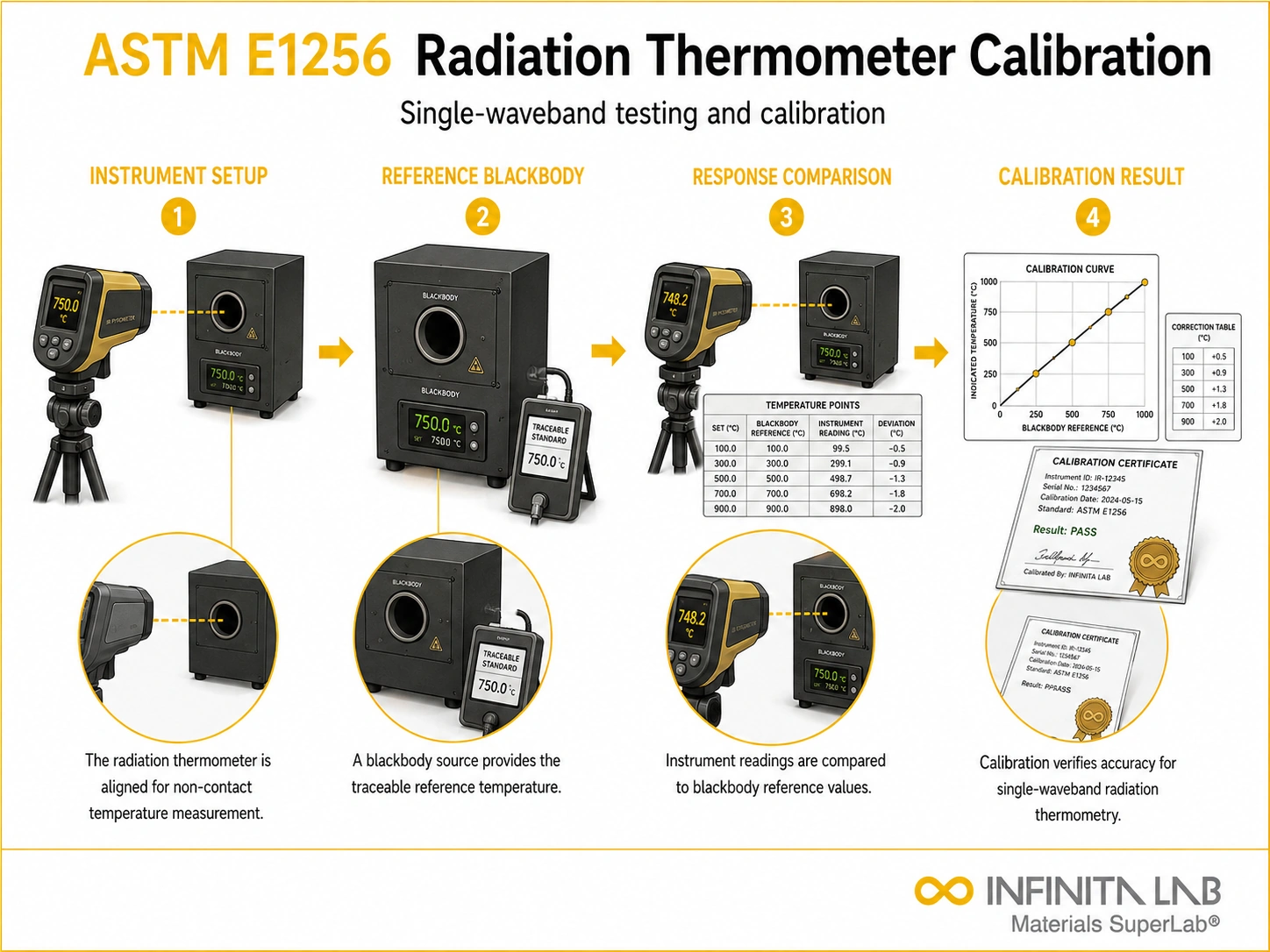
Instrument Setup
The radiation thermometer is aligned with a calibrated blackbody source.
1Temperature Stabilization
The blackbody is set to known temperatures and allowed to stabilize.
2Measurement Recording
Thermometer readings are taken at multiple temperature points.
3Performance Evaluation
Results are compared with reference values to assess accuracy and response.
4ASTM E1256 Test Parameters and Requirements
| Parameter | Details |
|---|---|
| Standard | ASTM E1256 |
| Test Principle | Measurement of emitted thermal radiation within a single spectral band |
| Applicable Devices | Single waveband radiation (infrared) thermometers |
| Measurement Output | Temperature (°C or K) |
| Spectral Range | Defined narrow wavelength band specific to instrument |
| Response Time | Time required for stable temperature reading |


- Radiation thermometer (device under test)
- Blackbody calibration source
- Temperature controllers
- Alignment fixtures
- Data acquisition system
- Optical positioning system
- Environmental control setup
Equipment and Instrumentation Used for ASTM E1256 Testing
What You Receive: Test Report, Data, and Certification
- Temperature measurement accuracy data
- Calibration and correction curves
- Response time and repeatability results
- Field of view and targeting performance
- Test report with methodology and conditions
- Compliance verification with ASTM E1256
ASTM E1256 Radiation Thermometer Calibration FAQs?
Emissivity directly influences measured radiation intensity; incorrect emissivity settings cause systematic temperature errors, especially for reflective or low-emissivity surfaces, making proper adjustment essential for accurate non-contact temperature measurement.
Blackbody sources provide nearly ideal radiation with known emissivity and temperature, serving as reliable reference standards to evaluate and calibrate thermometer accuracy across a defined temperature range.
Single waveband thermometers are sensitive to emissivity variations and environmental interference, unlike multi-wavelength systems that can compensate for these effects, potentially reducing accuracy in complex measurement conditions.
If the target does not fully fill the field of view, background radiation may affect readings, leading to inaccurate temperature measurements, especially in small or distant targets.
Detector type, signal processing speed, and thermal stabilization affect response time, influencing how quickly the instrument can track temperature changes in dynamic environments.
Why Choose Infinita Lab for Radiation Thermometer Calibration Testing?
At the core of this breadth is our network of 2,000+ accredited laboratories across the USA, offering access to over 10,000 testing methods and analytical services. From advanced materials characterization (SEM, TEM, RBS, XPS) to mechanical, chemical, environmental, biological, and standardized ASTM/ISO-compliant testing, we deliver unmatched flexibility, specialization, and scale. You are never limited by geography, facility, or methodology — Infinita Lab connects you to the right expertise and testing solution, every time.

Need ASTM E1256 Radiation Thermometer Calibration Testing You Can Rely On?
Send query us at hello@infinitalab.com or call us at (888) 878-3090 to learn more about our services and how we can support you.



Request a Quote
Submit your material details and receive testing procedures, pricing, and turnaround time within 24 hours.
 Quick Turnaround and Hasslefree process
 Confidentiality Guarantee
 Free, No-obligation Consultation
 100% Customer Satisfaction
