

What Is ASTM E452 Refractory Thermocouple Radiation Calibration?
ASTM E 452 thermocouple calibration testing is the standardized test method for calibrating refractory metal thermocouples against a calibrated radiation thermometer at temperatures above 800°C (1472°F) — providing accurate, traceable thermocouple emf calibration data for tungsten-rhenium and other refractory metal thermocouple types that cannot be used in oxidizing atmospheres. ASTM E 452 defines the equalizing block furnace configuration, blackbody cavity approximation requirements, radiation thermometer sighting procedures, and emf deviation calculation methods required to calibrate refractory metal thermocouples — providing thermocouple wire producers, manufacturers, and high-temperature measurement specialists with reliable calibration data for thermocouple accuracy assurance and measurement traceability programs.

Applications and Benefits of ASTM E452 Refractory Thermocouple Radiation Calibration Testing
Scope
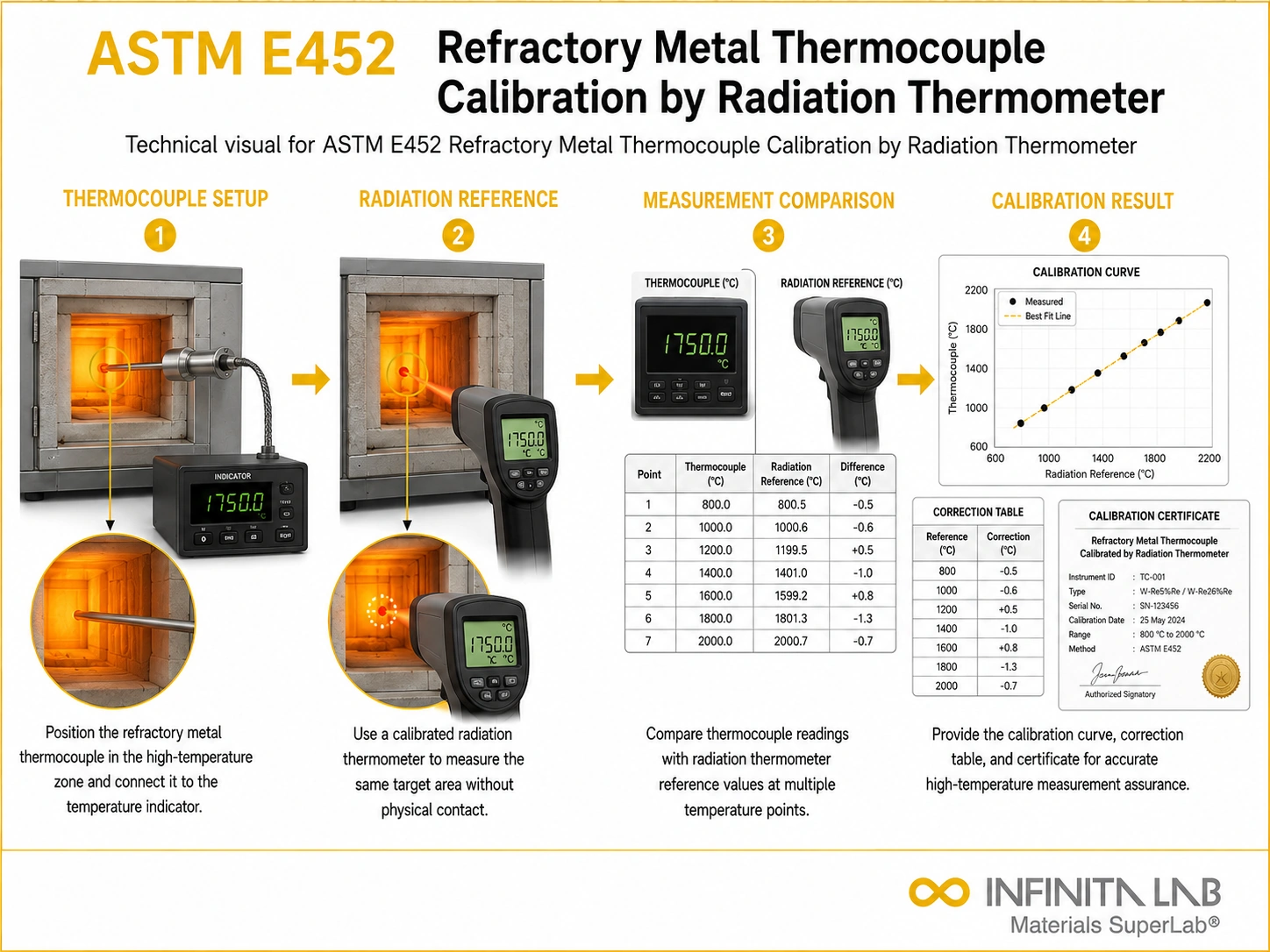
ASTM E 452 calibrates refractory metal thermocouples by placing the measuring junction in an equalizing block with a cavity approximating blackbody conditions, measuring the blackbody cavity temperature with a calibrated radiation thermometer, and recording the thermocouple emf at each calibration temperature — calculating the emf deviation ΔE = Er − E between the table reference value and measured thermocouple emf at each calibration point.
ASTM E 452 refractory metal thermocouple calibration evaluates:
- Thermocouple emf accuracy at calibration temperatures above 800°C in non-oxidizing furnace environments
- Emf deviation ΔE between ASTM reference table values and measured thermocouple emf at each calibration point
- Blackbody temperature measurement accuracy of the equalizing block cavity using a radiation thermometer
- Calibration performance of tungsten-rhenium and other refractory metal thermocouple types
- Compliance against thermocouple emf accuracy requirements for high-temperature measurement programs
Applications
- Tungsten-rhenium thermocouple wire and assembly calibration for high-temperature measurement programs
- Refractory metal thermocouple calibration for vacuum furnace, sintering, and hot press processing
- Aerospace and defense high-temperature sensor calibration for propulsion and re-entry applications
- Nuclear and energy facility high-temperature thermocouple calibration programs
- Thermocouple wire producers and manufacturers requiring ASTM E 452 calibration data
Benefits
- Provides reliable refractory metal thermocouple calibration data for high-temperature measurement accuracy
- Supports thermocouple accuracy assurance and measurement traceability requirements above 800°C
- Identifies thermocouple emf deviations before deployment in critical high-temperature measurement programs
- Delivers traceable calibration records for engineering and regulatory submissions
- Reduces high-temperature measurement error risk by verifying thermocouple calibration early in assessment
Our ASTM E452 Testing Procedure
Furnace & Equalizing Block Setup
Refractory metal thermocouple junction placed in equalizing block cavity approximating blackbody conditions.
1Radiation Thermometer Sighting
Calibrated radiation thermometer sighted into equalizing block cavity to measure blackbody temperature.
2Emf Recording
Thermocouple emf recorded at each calibration temperature above 800°C per ASTM E 452 procedures.
3Data Analysis & Reporting
Emf deviation ΔE = Er − E calculated at each calibration point and assessed for test compliance result.
4ASTM E452 Test Parameters and Requirements
| Parameter | Details |
|---|---|
| Applicable Thermocouples | Refractory metal thermocouples including tungsten-rhenium types W-Re5/W-Re26 and W/W-Re26 |
| Minimum Calibration Temperature | 800°C (1472°F) minimum per ASTM E 452 temperature applicability requirements |
| Furnace Atmosphere | Non-oxidizing atmosphere — vacuum, hydrogen, or inert gas per ASTM E 452 requirements |
| Blackbody Cavity | Equalizing block cavity approximating blackbody conditions for radiation thermometer temperature measurement |
| Emf Deviation Formula | ΔE = Er − E where Er is ASTM reference table emf and E is measured thermocouple emf at calibration point |
| Measured Outputs | Emf values at calibration temperatures, ΔE deviation data, and test compliance result |


- Calibrated radiation thermometer for blackbody cavity temperature measurement above 800°C
- Equalizing block with blackbody cavity approximation furnace per ASTM E 452 requirements
- High-temperature non-oxidizing furnace with vacuum, hydrogen, or inert gas atmosphere control
- Precision millivolt measurement system for refractory metal thermocouple emf recording
- ASTM reference emf table data for deviation calculation at each calibration temperature point
- Data acquisition and calibration reporting system
Equipment and Instrumentation Used for ASTM E452 Testing
What You Receive: Test Report, Data, and Certification
- Thermocouple emf measurements at each calibration temperature above 800°C per ASTM E 452
- Emf deviation ΔE = Er − E values at each calibration point against the ASTM reference table
- Radiation thermometer, temperature, and blackbody cavity condition records
- Test compliance result assessed against thermocouple emf accuracy requirements
- ASTM E 452 thermocouple calibration report for instrument traceability, thermocouple producer, and high-temperature measurement program submissions
ASTM E452 Refractory Thermocouple Radiation Calibration FAQs
ASTM E 452 applies to all refractory metal thermocouple types that cannot operate in oxidizing atmospheres — including W-Re5/W-Re26 (Type C), W/W-Re26 (Type D), and iridium-rhodium thermocouple systems used in vacuum furnaces, hot press sintering, and aerospace high-temperature measurement applications.
Refractory metals including tungsten and rhenium oxidize rapidly above 300°C in air — oxidation alters thermocouple wire composition, changes the Seebeck coefficient, and introduces systematic emf errors, making vacuum, hydrogen, or inert gas furnace atmospheres mandatory for valid ASTM E 452 calibration above 800°C.
ASTM E 452 identifies radiation thermometer calibration uncertainty and operating accuracy as the dominant uncertainty source — since the radiation thermometer establishes the reference temperature against which thermocouple emf is measured, any radiation thermometer uncertainty directly propagates into the thermocouple calibration uncertainty budget.
The equalizing block cavity approximates blackbody emissivity approaching 1.0 — eliminating emissivity correction uncertainty from the radiation thermometer temperature measurement and ensuring the measured blackbody temperature accurately represents the true temperature of the thermocouple measuring junction within the cavity.
ASTM E 452 calibration is required across vacuum furnace heat treatment, powder metallurgy sintering, aerospace propulsion testing, nuclear fuel processing, crystal growth, and advanced ceramics processing industries — where refractory metal thermocouples provide the only practical temperature measurement solution above 1600°C.
Why Choose Infinita Lab for Refractory Thermocouple Radiation Calibration Testing?
At the core of this breadth is our network of 2,000+ accredited laboratories across the USA, offering access to over 10,000 testing methods and analytical services. From advanced materials characterization (SEM, TEM, RBS, XPS) to mechanical, chemical, environmental, biological, and standardized ASTM/ISO-compliant testing, we deliver unmatched flexibility, specialization, and scale. You are never limited by geography, facility, or methodology — Infinita Lab connects you to the right expertise and testing solution, every time.

Looking for an Accredited Partner for ASTM E452 Refractory Thermocouple Radiation Calibration Testing?
Send query us at hello@infinitalab.com or call us at (888) 878-3090 to learn more about our services and how we can support you.





