


ASTM E1362 Calibration Testing for Non-Concentrator PV Secondary Reference Cells
ASTM E1362 test method determines the electrical performance of the photovoltaic device. The calibration and characterization of secondary terrestrial photovoltaic reference cells are covered in this method. The final results of this method are displayed keeping in view the international standards and inch-pound units.
TRUSTED BY


Precision-driven testing for dimensional accuracy and compliance
- Overview
- Scope, Applications, and Benefits
- Test Process
- Specifications
- Instrumentation
- Results and Deliverables
Overview
ASTM E1362 defines the procedure for calibrating non-concentrator photovoltaic (PV) secondary reference cells used to measure solar irradiance and evaluate PV device performance. These reference cells are calibrated against primary standards to ensure accurate and traceable measurements of solar energy under standard test conditions.
The method establishes a reliable link between reference cells and national or international standards, ensuring consistency across laboratories and field measurements. It is essential for photovoltaic testing, as accurate calibration directly affects the reliability of solar panel efficiency measurements and performance characterization.

Scope, Applications, and Benefits
Scope
ASTM E1362 applies to the calibration of secondary reference cells used in non-concentrator photovoltaic systems. It ensures traceability to primary standards and accurate measurement of solar irradiance.
- Calibration of non-concentrator photovoltaic reference cells
- Establishment of traceability to primary reference standards
- Measurement under standard test conditions (STC)
- Applicable to silicon and other PV reference technologies
- Evaluation of short-circuit current response to irradiance
Applications
- Calibration of solar irradiance measurement systems
- Photovoltaic module and cell efficiency testing
- Solar energy research and development
- Performance monitoring of solar installations
- Laboratory and field PV testing
- Standardization of solar measurement systems
Benefits
- Ensures traceable and accurate solar measurements
- Improves reliability of PV performance data
- Enables consistent calibration across laboratories
- Supports standardization in solar testing
- Enhances confidence in energy yield calculations
- Reduces measurement uncertainty in PV systems
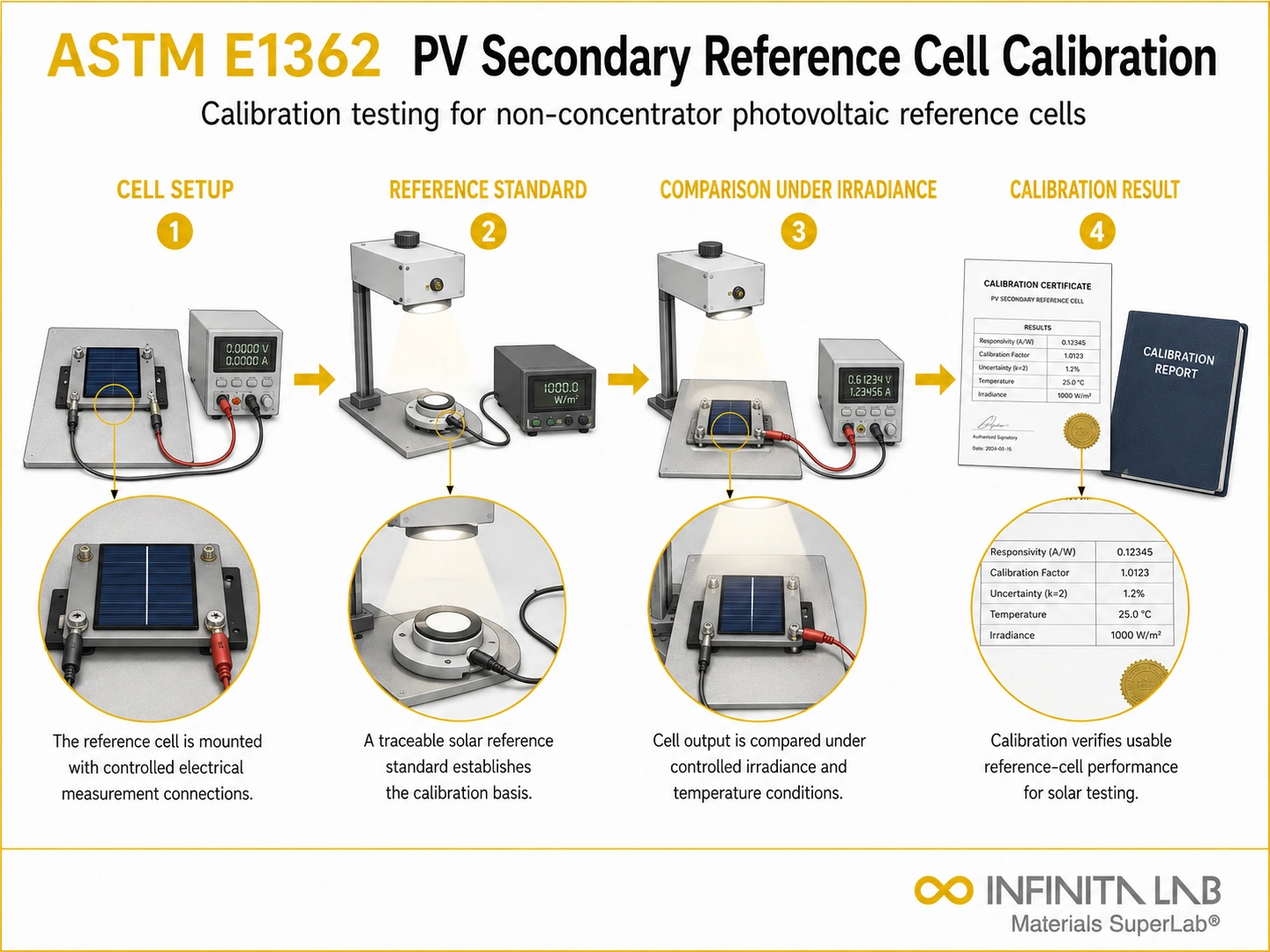
Test Process
Reference Setup
Install the reference cell and align it under standard test conditions.
1Irradiance Measurement
Expose the cell to a known irradiance level using a calibrated light source.
2Signal Recording
Measure the electrical response, typically short-circuit current.
3Calibration Calculation
Compare response to primary standards to determine calibration factor.
4Technical Specifications
| Parameter | Details |
|---|---|
| Calibration Type | Secondary reference cell calibration |
| Measurement Parameter | Short-circuit current (Isc) |
| Irradiance Range | Standard solar irradiance (~1000 W/m²) |
| Spectral Range | Solar spectrum (AM1.5) |
| Temperature Condition | Standard Test Condition (25°C) |
| Cell Type | Non-concentrator photovoltaic cells |
| Output Signal | Electrical current proportional to irradiance |


- Solar simulator or calibrated light source
- Reference photovoltaic cells
- Electrical measurement system (current meter)
- Temperature control system
- Pyranometer or irradiance monitor
- Data acquisition and calibration software
Instrumentation Used for Testing
Results and Deliverables
- Calibration factor for reference cell
- Short-circuit current response data
- Irradiance measurement traceability report
- Calibration certificate
- Uncertainty analysis report
- Performance validation data
Frequently Asked Question
A secondary reference cell is used to measure solar irradiance in photovoltaic testing. It is calibrated against a primary standard to ensure accurate and traceable measurements, enabling reliable evaluation of solar panel performance and efficiency.
Traceability ensures that measurements are linked to internationally recognized standards. This guarantees consistency, accuracy, and comparability of solar measurements across different laboratories and testing environments, which is essential for reliable photovoltaic performance data.
Short-circuit current is directly proportional to solar irradiance. By measuring this current, the reference cell can accurately determine the intensity of incoming solar radiation, which is critical for photovoltaic testing and calibration.
Primary reference cells are calibrated directly against national standards, while secondary reference cells are calibrated using primary cells. Secondary cells are used more frequently in routine measurements due to their practicality.
It provides accurate and traceable calibration of reference cells, ensuring reliable irradiance measurements. This leads to more precise evaluation of solar panel performance and energy output.
Why Choose Infinita Lab for Advanced Materials Testing and Characterization?
At the core of this breadth is our network of 2,000+ accredited laboratories across the USA, offering access to over 10,000 testing methods and analytical services. From advanced materials characterization (SEM, TEM, RBS, XPS) to mechanical, chemical, environmental, biological, and standardized ASTM/ISO-compliant testing, we deliver unmatched flexibility, specialization, and scale. You are never limited by geography, facility, or methodology — Infinita Lab connects you to the right expertise and testing solution, every time.

Looking for a Trusted Partner for Accurate and Reliable Testing Services?
Send query us at hello@infinitalab.com or call us at (888) 878-3090 to learn more about our services and how we can support you.



Request a Quote
Submit your material details and receive testing procedures, pricing, and turnaround time within 24 hours.
 Quick Turnaround and Hasslefree process
 Confidentiality Guarantee
 Free, No-obligation Consultation
 100% Customer Satisfaction
