


ASTM E1270 Equal-Arm Balance Testing & Calibration
ASTM E1270 aims to test balances whose lever-arm ratio is substantially equal to unity. It is applicable for testing equal-arm balances of any capacity and sensitivity. It examines the lever arm ratio, sensitivity at loads, damping ratio, period of oscillation, and many related characteristics.
TRUSTED BY


Precision-driven testing for dimensional accuracy and compliance
- Overview
- Scope, Applications, and Benefits
- Test Process
- Specifications
- Instrumentation
- Results and Deliverables
Overview
ASTM E1270 specifies a standardized procedure for evaluating the performance and accuracy of equal arm balances used for mass comparison. These balances operate on the principle of equilibrium, where unknown mass is determined by comparison with known standard weights placed on opposite pans.
The method ensures that equal arm balances provide precise and reliable measurements by assessing sensitivity, repeatability, and balance accuracy. It establishes uniform testing practices, enabling consistent calibration and verification of balances used in laboratory and metrology environments for high-precision weighing applications.

Scope, Applications, and Benefits
Scope
ASTM E1270 covers procedures for testing equal arm balances to verify their performance characteristics, including sensitivity and accuracy. It applies to balances used for comparative mass measurements in controlled environments.
Key Scope Elements:
- Evaluation of equal arm balance accuracy and sensitivity
- Verification using certified reference weights
- Assessment of repeatability and consistency
- Applicable to laboratory and metrology balances
- Includes environmental condition considerations
Applications
- Calibration laboratories for mass measurement
- Verification of laboratory weighing instruments
- Educational and research institutions
- Quality control in precision measurement tasks
- Reference balance validation in metrology setups
- Comparative mass determination processes
Benefits
- Ensures high precision in mass comparison measurements
- Provides standardized evaluation procedures
- Enhances measurement consistency and repeatability
- Supports traceability to certified mass standards
- Identifies mechanical or alignment issues in balances
- Improves confidence in analytical weighing results
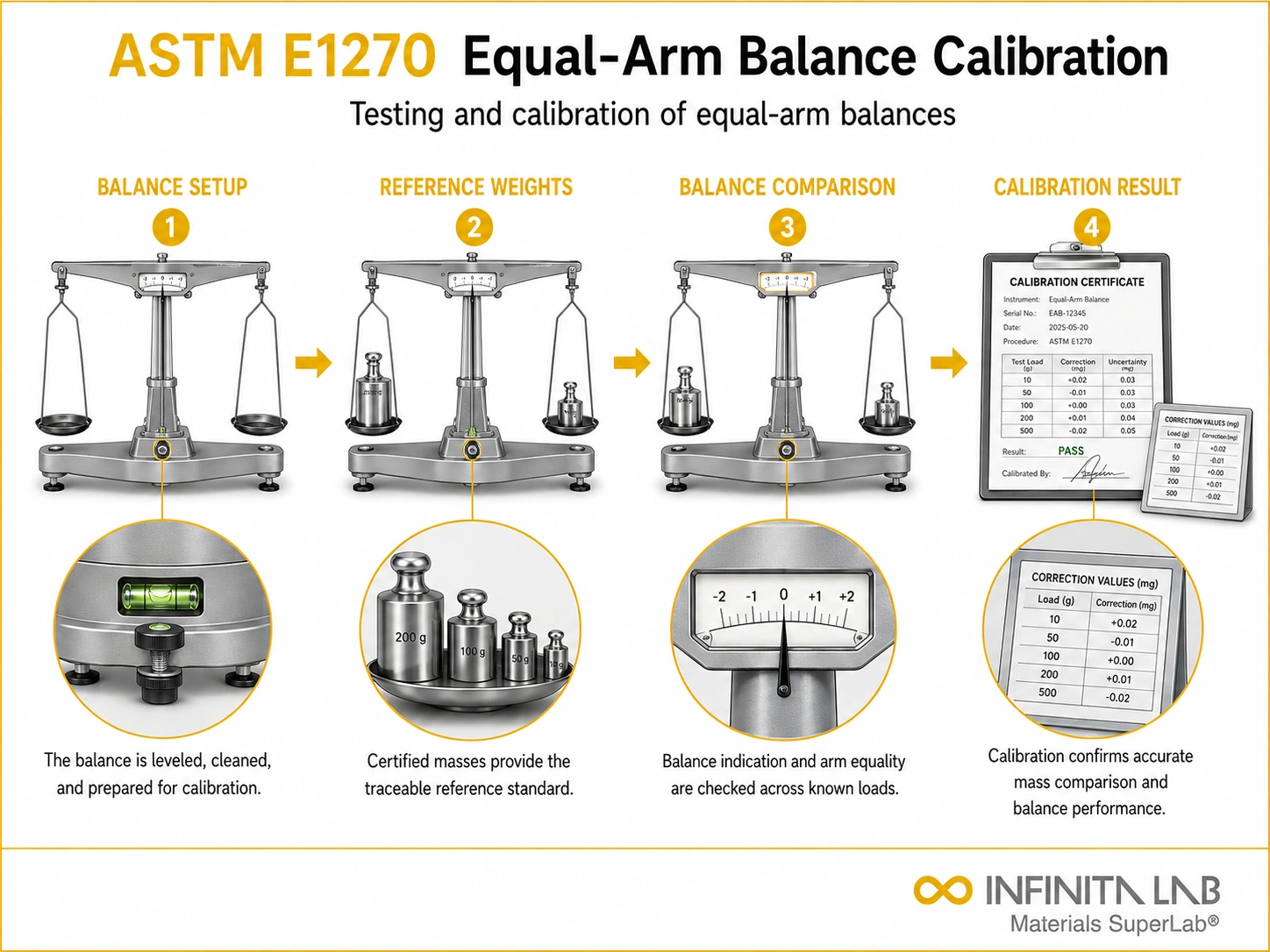
Test Process
Balance Inspection
Check the balance for cleanliness, alignment, and mechanical integrity before testing.
1Reference Weight Placement
Place certified standard weights on one pan and unknown or test weights on the opposite pan.
2Equilibrium Assessment
Observe beam position and determine balance response to assess sensitivity and accuracy.
3Result Evaluation
Compare observed deviations with tolerance limits and record calibration corrections if needed.
4Technical Specifications
| Parameter | Details |
|---|---|
| Balance Type | Equal arm mechanical balance |
| Measurement Principle | Mass comparison via equilibrium |
| Sensitivity | Minimum detectable mass difference defined by balance design |
| Accuracy Tolerance | Typically within specified mg-level deviations |
| Environmental Conditions | Stable temperature and minimal vibration |
| Beam Length | Symmetrical arms for equal load distribution |
| Reading Resolution | Defined by pointer or scale sensitivity |


- Equal arm balance
- Certified reference weights
- Draft shield or enclosure
- Leveling device
- Thermometer (for environmental monitoring)
- Vibration isolation platform
- Data recording system
Instrumentation Used for Testing
Results and Deliverables
- Balance accuracy verification report
- Sensitivity assessment results
- Calibration correction values
- Repeatability analysis
- Traceability documentation
- Compliance evaluation with ASTM criteria
Frequently Asked Question
An equal arm balance operates on the principle of mechanical equilibrium, where masses placed on both pans create equal moments about a central pivot. When balanced, the unknown mass equals the known reference mass, enabling precise comparative measurement.
ASTM E1270 provides a standardized method to evaluate balance performance, ensuring accuracy, sensitivity, and repeatability. It helps detect mechanical issues and ensures that measurements remain traceable to certified mass standards.
Environmental factors such as temperature, air currents, and vibrations are minimized using controlled laboratory conditions, draft shields, and vibration isolation systems to prevent measurement disturbances.
Errors may arise from mechanical misalignment, unequal arm lengths, friction at the pivot, or environmental influences. ASTM E1270 helps identify and quantify these errors through systematic testing.
The standard provides a structured approach to evaluating balance performance, ensuring accuracy, traceability, and consistency, which are essential for maintaining high-quality metrological measurements.
Why Choose Infinita Lab for Advanced Materials Testing and Characterization?
At the core of this breadth is our network of 2,000+ accredited laboratories across the USA, offering access to over 10,000 testing methods and analytical services. From advanced materials characterization (SEM, TEM, RBS, XPS) to mechanical, chemical, environmental, biological, and standardized ASTM/ISO-compliant testing, we deliver unmatched flexibility, specialization, and scale. You are never limited by geography, facility, or methodology — Infinita Lab connects you to the right expertise and testing solution, every time.

Looking for a Trusted Partner for Accurate and Reliable Testing Services?
Send query us at hello@infinitalab.com or call us at (888) 878-3090 to learn more about our services and how we can support you.



Request a Quote
Submit your material details and receive testing procedures, pricing, and turnaround time within 24 hours.
 Quick Turnaround and Hasslefree process
 Confidentiality Guarantee
 Free, No-obligation Consultation
 100% Customer Satisfaction
