


ASTM E1363: TMA Temperature Calibration Testing Services
The ASTM E1363 test method determines the characteristics of thermo mechanical analyzers by describing their temperature calibrations from − 50 to 1100°C. The method addresses a larger temperature range and is similar to ISO 11359-1. The final results of this method are displayed keeping in view the international standards and inch-pound units.
TRUSTED BY


Get ASTM E1363 compliant results — request your TMA temperature calibration testing quote
- Overview
- Scope, Applications, and Benefits
- Test Process
- Specifications
- Instrumentation
- Results and Deliverables
What Is ASTM E1363 TMA Temperature Calibration?
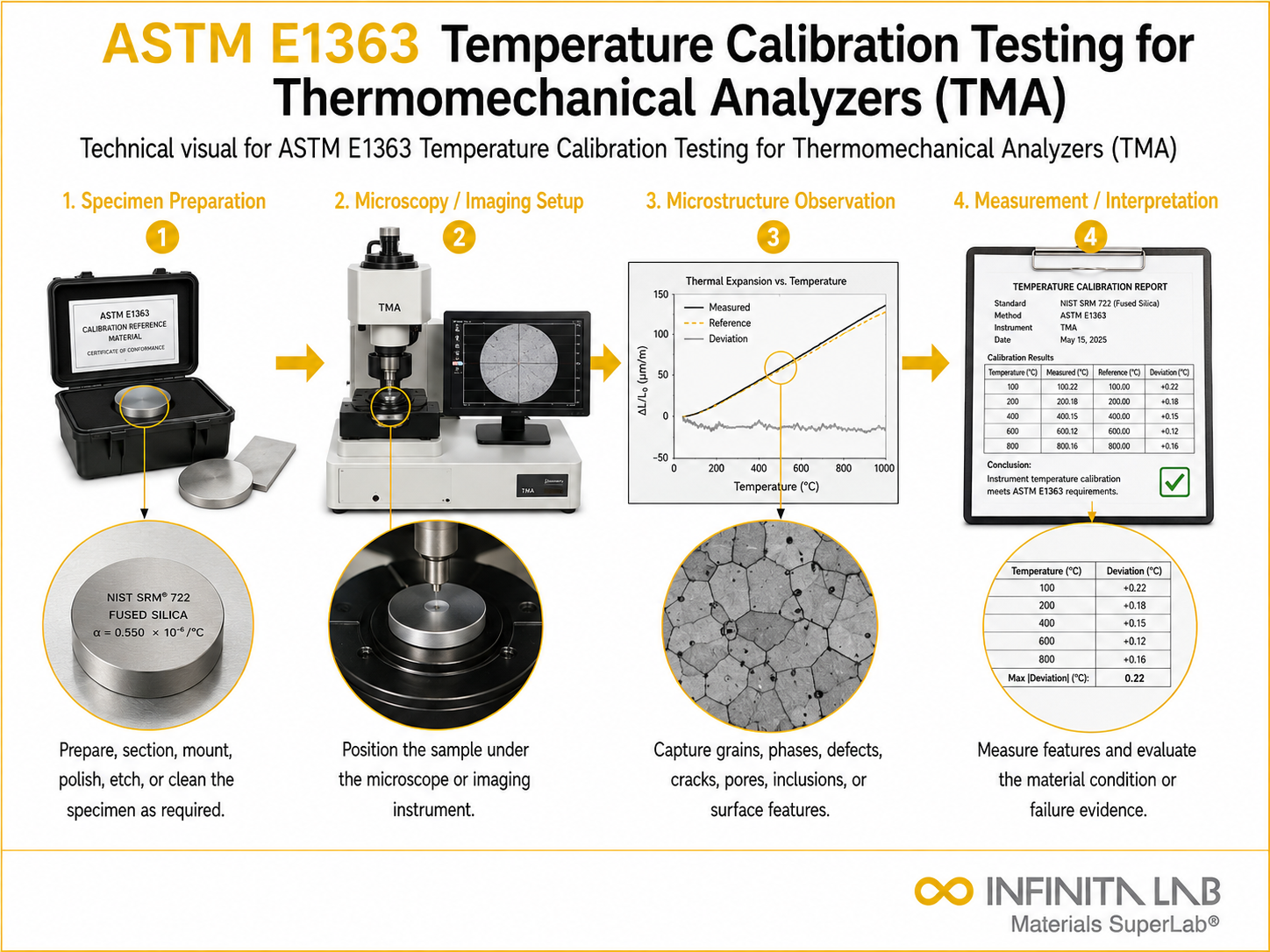
ASTM E1363 defines the procedure for calibrating the temperature measurement system of thermomechanical analyzers (TMA). Accurate temperature calibration ensures that dimensional changes in materials are correctly correlated with true sample temperature during thermal expansion, softening, or phase transition studies.
This standard is critical for maintaining precision in thermal analysis, as even minor temperature deviations can lead to significant errors in interpreting material behavior. The method establishes a reliable relationship between instrument readings and known temperature standards, ensuring consistency, repeatability, and traceability across laboratories.

Applications and Benefits of ASTM E1363 TMA Temperature Calibration Testing
Scope
ASTM E1363 applies to the calibration of temperature sensors in thermomechanical analyzers used in material characterization. It ensures accurate measurement of temperature-dependent dimensional changes.
- Calibration of temperature sensors in thermomechanical analyzers
- Verification of temperature accuracy across operating ranges
- Applicable to polymers, metals, ceramics, and composites
- Ensures alignment with reference temperature standards
- Used for both expansion and deformation measurements
Applications
- Polymer thermal expansion analysis
- Glass transition temperature (Tg) determination
- Material softening and deformation studies
- Quality control in material manufacturing
- Research and development in material science
- Evaluation of thermal stability of materials
Benefits
- Ensures precise temperature measurement in TMA systems
- Improves accuracy of thermal property data
- Enhances repeatability of experimental results
- Maintains traceability to certified temperature standards
- Reduces errors in thermal transition analysis
- Supports reliable material characterization
Our ASTM E1363 Testing Procedure
Standard Preparation
Select a certified temperature reference material with known transition points.
1Instrument Stabilization
Stabilize the thermomechanical analyzer at controlled conditions.
2Measurement Run
Record temperature response as the reference material undergoes thermal transition.
3Calibration Adjustment
Compare observed values with known standards and apply corrections if required.
4ASTM E1363 Test Parameters and Requirements
| Parameter | Details |
|---|---|
| Calibration Type | Temperature calibration of TMA |
| Measurement Range | Typically -150°C to 1000°C depending on instrument |
| Reference Materials | Certified substances with known transition temperatures |
| Accuracy Requirement | High precision within ±1°C or better |
| Sensor Type | Thermocouple or equivalent temperature sensor |
| Heating Rate | Controlled, typically 1–20°C/min |
| Atmosphere | Controlled (inert or air depending on test) |


- Thermomechanical analyzer (TMA)
- Certified temperature reference materials
- Calibration standards (melting point or transition materials)
- Temperature sensors (thermocouples, RTDs)
- Data acquisition system
- Temperature-controlled furnace or chamber
Equipment and Instrumentation Used for ASTM E1363 Testing
What You Receive: Test Report, Data, and Certification
- Calibration curve for temperature accuracy
- Correction factors for temperature readings
- Verification report of instrument performance
- Traceability documentation
- Calibration certificate
- Measurement uncertainty report
ASTM E1363 TMA Temperature Calibration FAQs
Temperature calibration ensures that dimensional changes measured by the TMA correspond accurately to real sample temperatures. Without proper calibration, errors in transition detection, such as glass transition or melting points, can lead to incorrect material characterization and unreliable research outcomes.
Errors arise from sensor miscalibration, thermal lag, furnace non-uniformity, and heat transfer inconsistencies. These factors can cause deviations between actual and measured temperatures, affecting the accuracy of material property analysis.
Reference materials with known, precise transition temperatures provide a benchmark for calibration. By comparing measured values to these known standards, the instrument can be adjusted to correct temperature deviations and ensure accurate readings.
Thermal lag causes a delay between the actual sample temperature and the measured sensor response. This leads to discrepancies in recorded data, especially during rapid heating, and must be minimized for accurate calibration.
Improper calibration leads to incorrect temperature readings, misinterpretation of thermal transitions, and unreliable material properties, which can affect product design and quality control decisions
Why Choose Infinita Lab for TMA Temperature Calibration Testing?
At the core of this breadth is our network of 2,000+ accredited laboratories across the USA, offering access to over 10,000 testing methods and analytical services. From advanced materials characterization (SEM, TEM, RBS, XPS) to mechanical, chemical, environmental, biological, and standardized ASTM/ISO-compliant testing, we deliver unmatched flexibility, specialization, and scale. You are never limited by geography, facility, or methodology — Infinita Lab connects you to the right expertise and testing solution, every time.

Looking for an Accredited Partner for ASTM E1363 TMA Temperature Calibration Testing?
Send query us at hello@infinitalab.com or call us at (888) 878-3090 to learn more about our services and how we can support you.



Request a Quote
Submit your material details and receive testing procedures, pricing, and turnaround time within 24 hours.
 Quick Turnaround and Hasslefree process
 Confidentiality Guarantee
 Free, No-obligation Consultation
 100% Customer Satisfaction
