


ASTM D1505: Density Gradient Polymer Testing Services
The ASTM D 1505 standard test method covers the density of solid plastics that can be determined using this test procedure. This testing procedure compares the depth to which a test specimen sinks in a liquid column with a density gradient to standards of known densities.
TRUSTED BY


Get ASTM D1505 compliant results — request your density-gradient polymer testing quote
- Overview
- Scope, Applications, and Benefits
- Test Process
- Specifications
- Instrumentation
- Results and Deliverables
What Is ASTM D1505: Density Gradient Polymer Testing?
ASTM D1505, the Standard Test Method for Density of Plastics by the Density-Gradient Technique, is a precision test method used to determine the exact density of solid plastic materials, including resin pellets, powders, films, sheets, moulded parts, and extruded profiles. Density is one of the most fundamental physical properties of a polymer because it correlates directly with degree of crystallinity, molecular structure, processing history, and mechanical performance. This makes the test especially valuable for semi-crystalline resins such as polyethylene and polypropylene, where even small density shifts can signal meaningful differences in structure and performance.
At a high level, the method prepares a density-gradient column: two miscible liquids of different densities are carefully layered in a tall graduated glass tube and allowed to form a smooth, continuous gradient that increases steadily from top to bottom. The column is calibrated using glass float standards of precisely known density. A conditioned test specimen is then lowered into the column, where it settles at the exact depth where the surrounding liquid matches its own density. By comparing the specimen’s resting position to the calibrated float standards with a cathetometer and applying an interpolation calculation, density can be determined to within 0.0002 g/cm³, or better than 0.05 per cent — a level of precision few other methods can match.
Because polymer density is so closely tied to internal structure, ASTM D1505 testing supports far more than a simple physical measurement. It gives manufacturers a dependable way to verify resin consistency between production lots, confirm finished parts meet specification, detect processing defects, and support material selection, quality assurance, and regulatory documentation across the plastics supply chain.

Applications and Benefits of ASTM D1505: Density Gradient Polymer Testing
Scope
ASTM D1505 establishes a standardised procedure for determining the density of solid plastics using the density-gradient column technique and, where reference values are available, for estimating per cent crystallinity from that density data.
- Applicable to plastics across the general density range of the technique, including polyethene (LDPE, LLDPE, HDPE), polypropylene, polystyrene, PVC, PET, nylon, and other thermoplastics and thermosets.
- Suitable for multiple sample formats, including resin pellets, powders, films, sheets, injection- or compression-moulded parts, extruded profiles, and fabricated components.
- Capable of resolving density differences of better than 0.05 per cent, making it sensitive enough to detect subtle variations between resin lots or production runs.
- Applicable to a wide range of industries, including packaging, wire and cable, automotive, medical devices, consumer goods, construction, and electronics.
- Used for lot-to-lot resin consistency checks, incoming raw-material inspection, finished-part quality control, failure analysis, and research and development.
- Can support estimation of per cent crystallinity in semi-crystalline polymers when the amorphous and fully crystalline reference densities of the material are known.
- Requires only a small specimen size, limiting material consumption and making the method practical for limited-quantity or high-value samples.
- Methodologically comparable to ISO 1183 Method C (density gradient column method), allowing results to be cross-referenced across globally distributed manufacturing and supply chains.
Applications
- Packaging and film manufacturers verifying that resin density controls product stiffness, barrier performance, and seal quality as expected.
- Wire and cable producers confirming the density and crystallinity of insulation and jacketing compounds.
- Automotive and industrial component manufacturers checking molded or extruded part density for structural consistency.
- Medical device and consumer goods companies validating incoming resin lots against purchase specifications.
- Polymer producers and compounders performing research, process optimisation, and ongoing quality control.
- Third-party and regulatory testing programs supporting specification compliance and dispute resolution.
Benefits
- Delivers exceptionally high-precision density values, accurate to better than 0.05 percent.
- Enables reliable per cent-crystallinity estimation for semi-crystalline resins.
- Detects lot-to-lot resin variability before it affects downstream processing or part performance.
- Requires only a small specimen size, minimising material consumption.
- Supports quality assurance, incoming inspection, and finished-product verification programs.
- Produces data that is directly comparable across ASTM D1505 and ISO 1183 test programs.
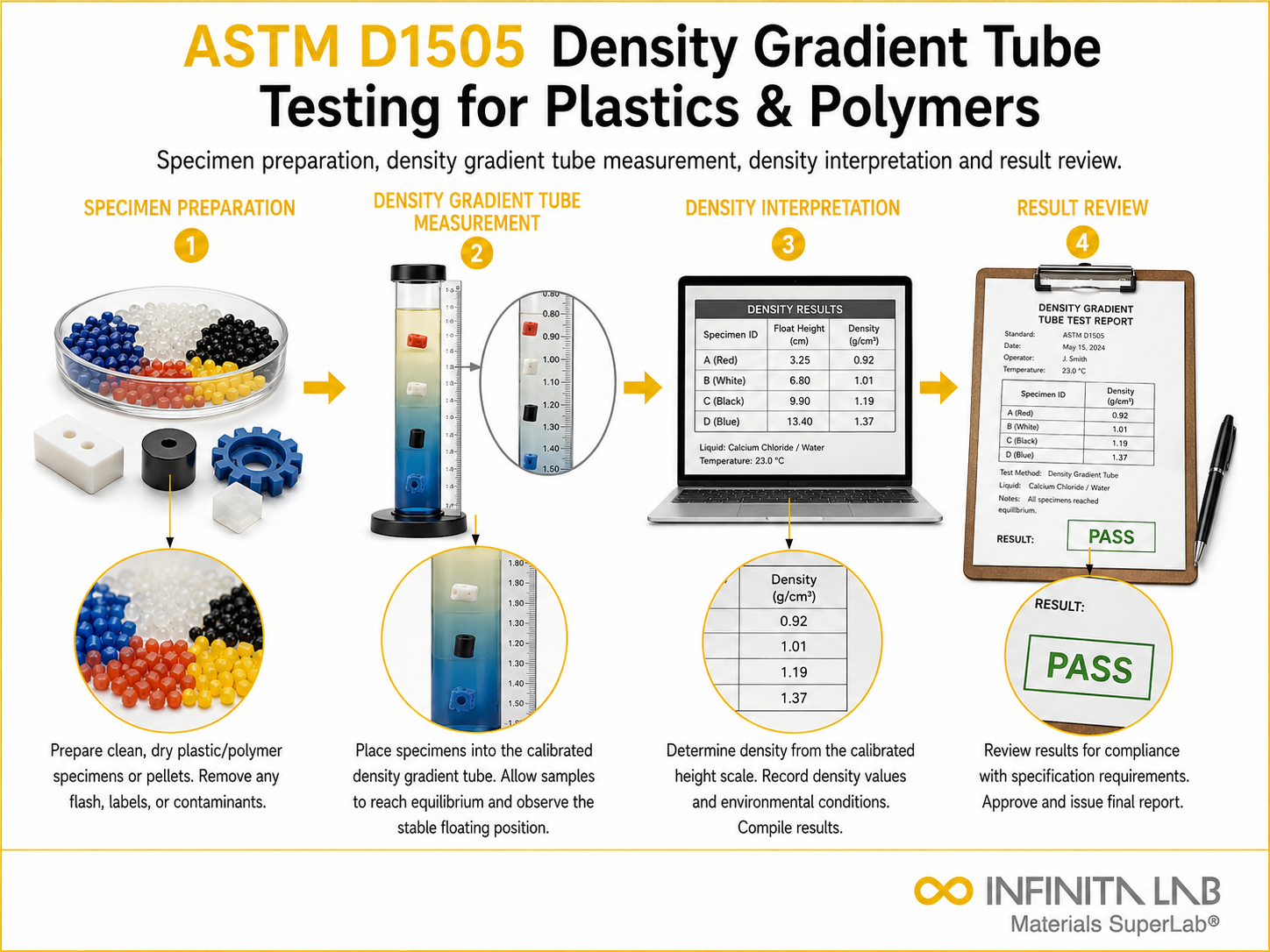
Our ASTM D1505 Testing Procedure
Gradient Column Preparation
Prepare and calibrate the density-gradient column using liquids of different densities and certified float standards.
1Specimen Preparation
Prepare and condition representative specimens, ensuring they are clean and free from trapped air.
2Density Measurement
Immerse specimens, allow them to equilibrate, and measure their positions within the gradient column.
3Calculation and Reporting
Calculate density by interpolation between reference standards and document the final results.
4ASTM D1505 Test Parameters and Requirements
| Parameter | Details |
|---|---|
| Sample details | Solid plastic materials in the form of pellets, powder, film, sheet, molded parts, or extruded profiles |
| Sample preparation | Cut or prepared to a size and shape that allows precise measurement of the specimen's volume center, avoiding stress, heat, or compression that could alter density |
| Equipment | Density-gradient column apparatus with calibrated glass float standards spanning the expected density range of the material |
| Observation parameters | Equilibrium position of each specimen relative to the calibrated float standards, based on the average of three specimen readings |
| Environmental control | Column and specimens maintained at a stable, controlled temperature (typically 23°C ± 0.1°C, or as otherwise specified) throughout the test, since the density of the column liquids is sensitive to temperature change |


- Density-Gradient Column – A tall, graduated glass tube containing a calibrated liquid density gradient in which specimens are suspended.
- Glass Float Standards – Reference floats of precisely known density used to calibrate the column and interpolate specimen density.
- Cathetometer – A precision optical instrument used to measure the exact height and position of specimens and floats within the column.
- Constant-Temperature Bath – Maintains the column at a stable, controlled temperature throughout testing.
- Charging/Wire Basket – Introduces and withdraws float standards and specimens without disturbing the gradient.
- Analytical Balance – Used when preparing gradient liquids to precise density specifications.
- Timer / Data Logger – Records equilibration time and measurement intervals.
Equipment and Instrumentation Used for ASTM D1505 Testing
What You Receive: Test Report, Data, and Certification
- Precise density value for each tested specimen, typically reported to four decimal places (g/cm³).
- Average density across replicate specimens, along with the observed variability between readings.
- Per cent-crystallinity estimate, when applicable and requested, for semi-crystalline polymers.
- Comparison of results against specification limits or reference and historical values.
- A suitability assessment of the material lot or part for its intended application.
ASTM D1505: Density Gradient Polymer Testing FAQs
ASTM D1505 measures the density of solid plastic materials using the density-gradient column technique, and, where reference values are available, can be used to estimate the material's percent crystallinity.
The method can resolve density differences of better than 0.05 percent, or approximately 0.0002 g/cm³, making it one of the most precise density-measurement techniques available for plastics.
The method accepts resin pellets, powders, films, sheets, molded parts, extruded profiles, and other fabricated plastic components, provided a specimen can be cut that allows its volume center to be measured precisely.
Percent crystallinity is calculated by comparing the measured density of the sample against the known densities of the fully amorphous and fully crystalline forms of the same polymer.
Most specimens reach equilibrium in the density-gradient column within about ten minutes, though thin films may require significantly longer conditioning time; overall project turnaround depends on sample volume and lab scheduling.
Why Choose Infinita Lab for Advanced Materials Testing and Characterization?
At the core of this breadth is our network of 2,000+ accredited laboratories across the USA, offering access to over 10,000 testing methods and analytical services. From advanced materials characterization (SEM, TEM, RBS, XPS) to mechanical, chemical, environmental, biological, and standardized ASTM/ISO-compliant testing, we deliver unmatched flexibility, specialization, and scale. You are never limited by geography, facility, or methodology — Infinita Lab connects you to the right expertise and testing solution, every time.

Looking for a Trusted Partner for Accurate and Reliable Testing Services?
Send query us at hello@infinitalab.com or call us at (888) 878-3090 to learn more about our services and how we can support you.



Request a Quote
Submit your material details and receive testing procedures, pricing, and turnaround time within 24 hours.
 Quick Turnaround and Hasslefree process
 Confidentiality Guarantee
 Free, No-obligation Consultation
 100% Customer Satisfaction
