


ASTM E1980: Solar Reflectance Index SRI Calculation Testing Services
Accredited ASTM E1980 solar reflectance index SRI calculation testing from Infinita Lab, performed to the exact standard requirements - accurate, reproducible results with full documentation for compliance, R&D, and quality control programs.
TRUSTED BY


Get ASTM E1980 compliant results - request your solar reflectance index SRI calculation testing quote
- Overview
- Scope, Applications, and Benefits
- Test Process
- Specifications
- Instrumentation
- Results and Deliverables
What Is ASTM E1980 Solar Reflectance Index SRI Calculation?
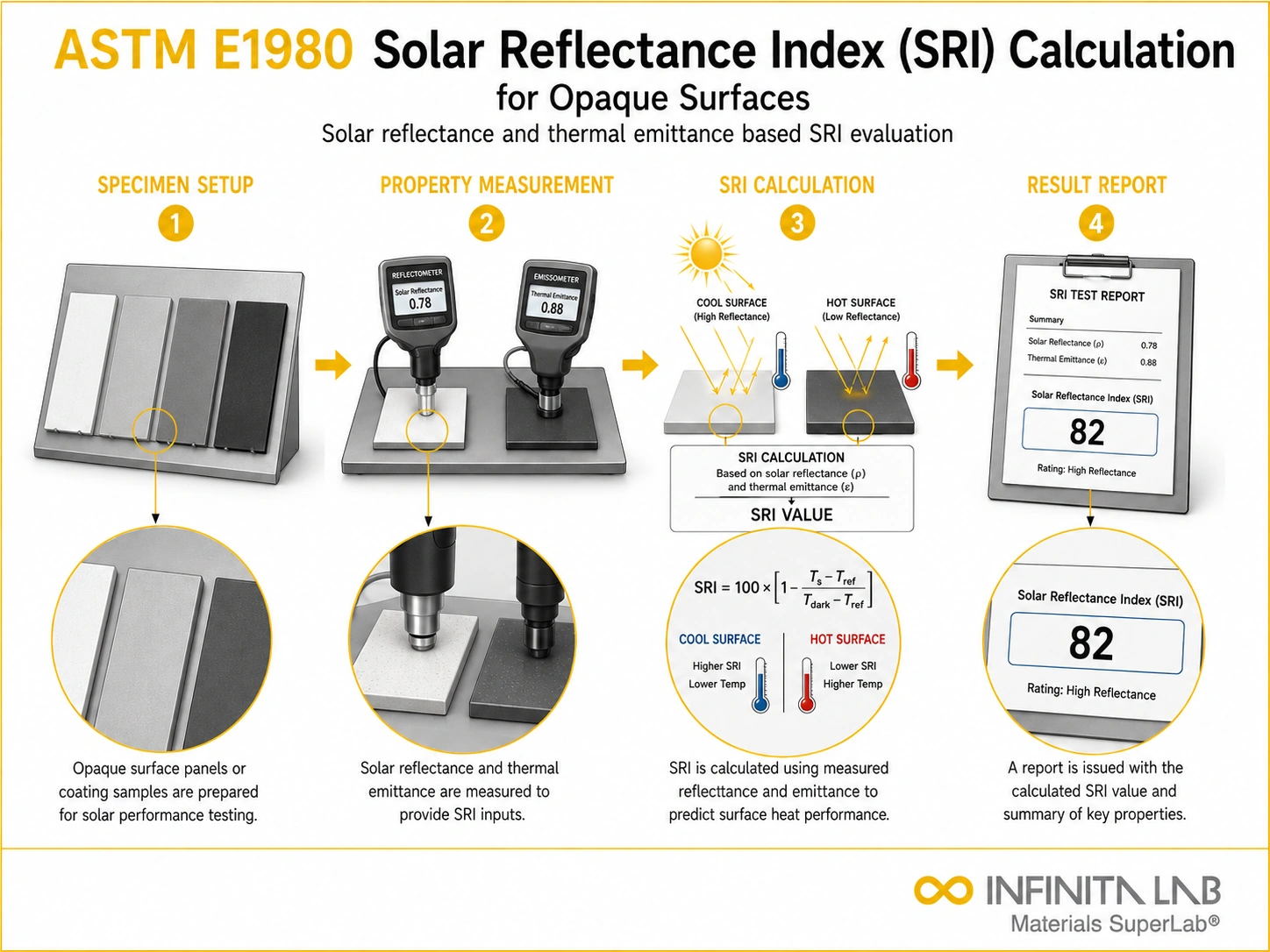
ASTM E1980, Standard Practice for Calculating Solar Reflectance Index of Horizontal and Low-Sloped Opaque Surfaces, is a calculation-based practice rather than a direct physical measurement. It defines the method for computing the Solar Reflectance Index (SRI), a single numeric value that expresses how much solar heat a roofing, paving, or other opaque horizontal or low-sloped surface absorbs versus reflects and re-emits. Rather than measuring SRI directly with an instrument, ASTM E1980 combines two independently measured surface properties: solar reflectance, determined per ASTM E903 (laboratory spectrophotometer with integrating sphere) or ASTM C1549 (portable solar reflectometer), and thermal emittance, determined per ASTM E408 or ASTM C1371 (emissometer).
These inputs are used together with standardised convection coefficient assumptions and a steady-state heat balance equation to calculate the equilibrium surface temperature a material would reach under defined solar and ambient conditions. That result is then normalised against two reference surfaces: standard black, assigned SRI = 0, and standard white, assigned SRI = 100. Surfaces that are more reflective and higher-emitting than standard white can register SRI values above 100, while very dark, low-emittance materials fall near or below zero.
Because SRI condenses reflectance and emittance into one comparable figure, it underpins nearly every cool-roof rating, energy code, and green building program in use today. Cool Roof Rating Council (CRRC) product certification, LEED and other green building credits for heat-island reduction, and energy codes such as ASHRAE 90.1 and California Title 24 all reference SRI thresholds for qualifying low-slope roofing and paving. Infinita Lab connects manufacturers, specifiers, and building product developers with accredited laboratories that perform the underlying reflectance and emittance measurements and apply the ASTM E1980 calculation to generate defensible, code- and certification-ready SRI values.

Applications and Benefits of ASTM E1980 Solar Reflectance Index SRI Calculation Testing
Scope
- ASTM E1980 defines the calculation procedure used to derive the Solar Reflectance Index (SRI) of horizontal and low-sloped opaque surfaces from independently measured optical and thermal properties.
- The practice does not measure SRI directly; it relies on solar reflectance data obtained per ASTM E903 (laboratory spectrophotometer with integrating sphere) or ASTM C1549 (portable solar spectrum reflectometer).
- Thermal emittance, the second required input, is measured per ASTM E408 (thermopile-based method) or ASTM C1371 (portable emissometer).
- The calculation incorporates standardised convection coefficient assumptions to model heat transfer between the surface and surrounding air under specified solar and ambient conditions.
- SRI is expressed on a scale referenced to standard black (SRI = 0) and standard white (SRI = 100), with values above 100 possible for surfaces that are both highly reflective and high-emittance.
- The practice applies to opaque, horizontal, and low-sloped surfaces, including roofing membranes, roof coatings, metal roofing, asphalt shingles, concrete, and paving or hardscape materials.
- It supports both initial (as-manufactured) and aged SRI determinations, since reflectance and emittance can change after weathering, soiling, or accelerated exposure testing.
- Industries served include roofing membrane and coating manufacturers, metal roofing producers, concrete and paving material suppliers, and building product developers seeking cool-surface performance data.
- Typical use cases include cool roof product certification, green building credit documentation, energy code compliance submittals, and urban heat island mitigation studies.
- Testing supports product listing with rating bodies such as the Cool Roof Rating Council (CRRC), as well as project-level documentation for LEED and similar green building certification programs.
Applications
- Cool roof membrane, coating, and single-ply roofing product certification through the Cool Roof Rating Council (CRRC) Rated Products Directory.
- LEED and other green building certification submittals requiring documented SRI values for heat-island-reduction credits.
- Energy code compliance demonstrations under codes and standards such as ASHRAE 90.1 and California Title 24 that set minimum SRI thresholds for low-slope roofing.
- Municipal and utility cool-roof or cool-pavement incentive programs that require third-party SRI data.
- Pavement, hardscape, and concrete product evaluation for urban heat island mitigation initiatives.
- Product development and R&D comparisons of reflective coatings, granule colours, or membrane formulations before market launch.
- Specification support for architects and building owners selecting low-slope roofing systems for hot-climate or heat-island-sensitive projects.
Benefits
- Provides a single, standardised SRI value that architects, code officials, and certification bodies can use directly without separately interpreting reflectance and emittance data.
- Uses recognized, accredited input methods (E903/C1549 for reflectance, E408/C1371 for emittance), giving results that are defensible for code and certification submittals.
- Enables side-by-side comparison of different roofing, coating, or paving products on a common cool-surface performance scale.
- Supports both initial and aged SRI reporting, giving manufacturers a complete performance picture over a product’s service life.
- Helps manufacturers and specifiers demonstrate compliance with CRRC, LEED, and energy code requirements from one coordinated test program.
- Reduces the risk of submittal rejection by ensuring reflectance, emittance, and SRI calculation inputs are traceable to the correct ASTM methods.
Our ASTM E1980 Testing Procedure
Input Property Measurement
Measure solar reflectance and thermal emittance of the test surface using relevant ASTM test methods
1Reference Surface Selection
Use standard black and standard white reference surfaces defined in the practice
2Surface Temperature Calculation
Calculate the steady-state surface temperature of the test material
3Result Interpretation
Express results as a dimensionless index indicating relative heat rejection capability
4ASTM E1980 Test Parameters and Requirements
| Parameter | Details |
|---|---|
| Standard | ASTM E1980 – Standard Practice for Calculating Solar Reflectance Index (SRI) of Horizontal and Low-Sloped Opaque Surfaces |
| Sample Types | Roofing materials, roof coatings, paving materials, tiles, membranes, and other opaque construction surfaces |
| Electrode Configuration | Not applicable (optical and thermal calculation-based method) |
| Measured Output | Solar Reflectance Index (SRI) |
| Environmental Influence | Calculated under standardized conditions of solar radiation, ambient temperature, sky temperature, and wind speed |
| Applicable Frequency | Not applicable (static thermal performance calculation |


- UV/VIS/NIR Spectrophotometer with Integrating Sphere – measures spectral solar reflectance across the solar wavelength range per ASTM E903.
- Portable Solar Spectrum Reflectometer – provides field-applicable solar reflectance measurements per ASTM C1549.
- Emissometer (Portable and Laboratory) – measures thermal emittance per ASTM E408 or ASTM C1371 using calibrated infrared detectors.
- High- and Low-Emittance Calibration Standards – used to verify and calibrate emissometer readings before and during testing.
- Reflectance Calibration Standards – reference tiles or panels used to verify spectrophotometer and reflectometer accuracy.
- Specimen Preparation and Conditioning Equipment – used to clean, cut, and condition roofing, coating, or paving specimens before measurement.
- SRI Calculation and Reporting Software – applies the ASTM E1980 equilibrium temperature equation to measured inputs and generates traceable calculation records.
Equipment and Instrumentation Used for ASTM E1980 Testing
What You Receive: Test Report, Data, and Certification
- Calculated Solar Reflectance Index (SRI) value(s), including initial and, where requested, aged SRI results.
- Measured solar reflectance and thermal emittance data with the specific ASTM method used for each (E903, C1549, E408, or C1371).
- A detailed test report documenting specimen information, instrumentation, calibration references, and the ASTM E1980 calculation methodology applied.
- Comparison of calculated SRI against relevant CRRC, LEED, or energy code thresholds, where applicable.
- Data suitable for submittal to the Cool Roof Rating Council (CRRC) Rated Products Directory or green building certification documentation.
- Consultation support for interpreting results and selecting appropriate reflectance and emittance test methods for future product development.
ASTM E1980 Solar Reflectance Index SRI Calculation FAQs
ASTM E1980 is a standard practice for calculating the Solar Reflectance Index (SRI) of low-sloped and horizontal opaque surfaces.
Solar Reflectance Index (SRI) indicates the roof's ability to reject solar heat, and is the combined value of reflectivity and emittance.
Solar reflectance and thermal emissivity are measured at Certimac using a UV-VIS-NIR spectrophotometer and an emission meter in accordance with ASTM E 903 and ASTM C1371-15 and ASTM E1980-11.
To meet LEED requirements, a roofing material must have an SRI of 29 or higher for steep-slope (>2:12) roofing and a SRI value of 78 or higher for low-slope roofing.
An SRI testing laboratory measures a material’s solar reflectance and thermal emittance using appropriate optical and thermal measurement equipment. These values are then used to calculate the Solar Reflectance Index (SRI) according to ASTM E1980 under specified environmental conditions.
Why Choose Infinita Lab for Solar Reflectance Index SRI Calculation Testing
When your Solar Reflectance Index SRI Calculation results have to hold up - for compliance, a customer audit, or an engineering decision - ASTM E1980 accuracy and an unbiased third-party report matter more than price. Infinita Lab routes your ASTM E1980 solar reflectance index SRI calculation testing to ISO/IEC 17025-accredited U.S. partner labs with hands-on method experience, so you get defensible data, transparent reporting, and turnaround times built around your project deadline - not ours.

Need ASTM E1980 Solar Reflectance Index SRI Calculation Testing You Can Rely On?
Send query us at hello@infinitalab.com or call us at (888) 878-3090 to learn more about our services and how we can support you.



Request a Quote
Submit your material details and receive testing procedures, pricing, and turnaround time within 24 hours.
 Quick Turnaround and Hasslefree process
 Confidentiality Guarantee
 Free, No-obligation Consultation
 100% Customer Satisfaction
