


ASTM D5526: Plastic Anaerobic Accelerated Landfill Biodegradation Testing Services
ASTM D5526-18 is created to determine the anaerobic biodegradability of plastic items when they were put in biologically active settings that mimicked landfill conditions.The values are considered as a standard when expressed in SI units. Read more about ASTM D5526-18 Biodegradation of Plastic Under Accelerated Landfill Conditions below
TRUSTED BY


Get ASTM D5526 compliant results — request your plastic anaerobic accelerated landfill biodegradation testing quote
- Overview
- Scope, Applications, and Benefits
- Test Process
- Specifications
- Instrumentation
- Results and Deliverables
What Is ASTM D5526 Plastic Anaerobic Accelerated Landfill Biodegradation?
The ASTM D5526-18 standard test method evaluates the biodegradation behavior of plastic materials under simulated landfill conditions. In this test, regulated mixtures of plastics and household waste are created, and their breakdown is observed under anaerobic, landfill-like conditions.
The technique aids in evaluating the environmental and human health effects of landfill-degraded plastics. Throughout a landfill’s active life, accelerated biodegradation helps recover landfill gas, reduce long-term aftercare, and reduce waste volume.

Applications and Benefits of ASTM D5526 Plastic Anaerobic Accelerated Landfill Biodegradation Testing
Scope
ASTM D5526-18 establishes a standardized laboratory procedure for determining anaerobic biodegradation of plastics in landfill-simulated conditions.
It evaluates:
- Gas generation from biodegradation
- Decomposition rate of plastic materials
- Interaction with organic waste
- Carbon conversion efficiency
- Environmental impact of degraded plastics
- Long-term landfill behaviour
Applications
- Biodegradable plastic development
- Environmental impact assessment
- Waste management research
- Landfill gas recovery studies
- Regulatory compliance testing
- Sustainable material evaluation
- Product certification
Benefits
- Simulates real landfill conditions
- Quantifies biodegradation rate
- Supports sustainable product design
- Improves landfill gas recovery feasibility
- Reduces post-closure landfill care
- Enables environmental risk assessment
- Standardized comparison method
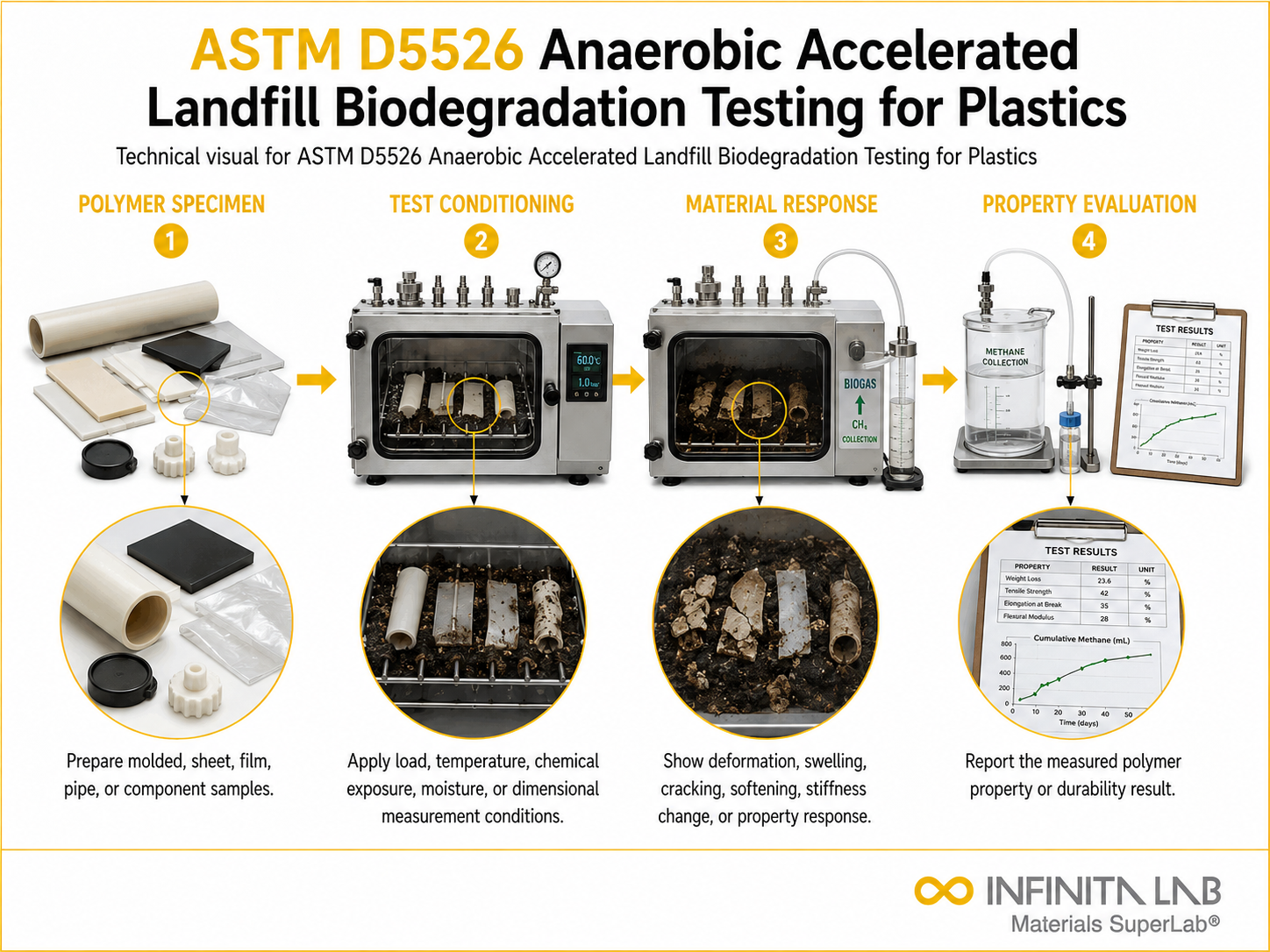
Our ASTM D5526 Testing Procedure
Reactor Setup
Waste and plastic samples are loaded into sealed reactors and placed in incubators at 35 ± 2°C for stabilization.
1Incubation
Reactors are kept under dark conditions for extended incubation.
2Pressure Monitoring
Internal pressure is monitored and measured when it reaches 700 mbar.
3Gas Release & Continuation
Gas is released to atmospheric pressure, and testing continues until gas production stops or reference degradation exceeds 70%.
4ASTM D5526 Test Parameters and Requirements
| Parameter | Details |
|---|---|
| Incubation Temperature | 35 ± 2°C |
| Test Environment | Dark, anaerobic |
| Monitoring Method | Pressure transducer |
| Test Duration | Up to 4 months or longer |
| Output Units | Percentage (%) |


- Sealed anaerobic reactors
- Temperature-controlled incubator
- Pressure transducer
- Gas release valves
- Data logging system
- Analytical balance
Equipment and Instrumentation Used for ASTM D5526 Testing
What You Receive: Test Report, Data, and Certification
- % Biodegradation calculation
- Gas generation data
- Comparative performance report
- Environmental impact assessment
- Certification documentation
- Research validation reports
ASTM D5526 Plastic Anaerobic Accelerated Landfill Biodegradation FAQs
ASTM D5526 determines the degree and rate of anaerobic biodegradation of plastic materials under accelerated landfill conditions. The test evaluates the conversion of carbon in the plastic into gaseous carbon, primarily through anaerobic biological activity.
The method was developed for plastic materials exposed to biologically active landfill-like conditions. Test specimens are mixed with pretreated household waste and exposed to a methanogenic inoculum under dry, static, non-mixed conditions.
Biodegradation is evaluated by measuring the conversion of carbon from the plastic into gaseous carbon, including carbon dioxide and methane. Results are compared with appropriate reference materials to determine the extent of anaerobic biodegradation under the specified laboratory conditions.
ASTM D5526 was designed to create a standardized, accelerated laboratory environment resembling a biologically active landfill, but it does not represent every type of landfill. In particular, results may not reflect conditions in biologically inactive landfills.
Results should not be used to make an unqualified “biodegradable” claim. The original method states that performance claims should be limited to the numerical results obtained under the specified test conditions and should not be extrapolated beyond the actual test duration.
Why Choose Infinita Lab for Plastic Anaerobic Accelerated Landfill Biodegradation Testing?
At the core of this breadth is our network of 2,000+ accredited laboratories across the USA, offering access to over 10,000 testing methods and analytical services. From advanced materials characterization (SEM, TEM, RBS, XPS) to mechanical, chemical, environmental, biological, and standardized ASTM/ISO-compliant testing, we deliver unmatched flexibility, specialization, and scale. You are never limited by geography, facility, or methodology — Infinita Lab connects you to the right expertise and testing solution, every time.

Need ASTM D5526 Plastic Anaerobic Accelerated Landfill Biodegradation Testing You Can Rely On?
Send query us at hello@infinitalab.com or call us at (888) 878-3090 to learn more about our services and how we can support you.



Request a Quote
Submit your material details and receive testing procedures, pricing, and turnaround time within 24 hours.
 Quick Turnaround and Hasslefree process
 Confidentiality Guarantee
 Free, No-obligation Consultation
 100% Customer Satisfaction
