


ASTM C373: Ceramic Tile Water Absorption Bulk Density Testing Services
Accredited ASTM C373 ceramic tile water absorption bulk density testing from Infinita Lab, performed to the exact standard requirements - accurate, reproducible results with full documentation for compliance, R&D, and quality control programs.
TRUSTED BY


Get ASTM C373 compliant results - request your ceramic tile water absorption bulk density testing quote
- Overview
- Scope, Applications, and Benefits
- Test Process
- Specifications
- Instrumentation
- Results and Deliverables
What Is ASTM C373 Ceramic Tile Water Absorption Bulk Density?
ASTM C373 is the standard test method used to determine four physical properties of fired ceramic materials: water absorption, bulk density, apparent porosity, and apparent specific gravity. Developed for fired whiteware products, the standard also covers glazed and unglazed ceramic tiles and glass tiles, making it one of the most widely referenced methods for evaluating the density and porosity of fired ceramic bodies used in flooring, wall cladding, and architectural surfaces.
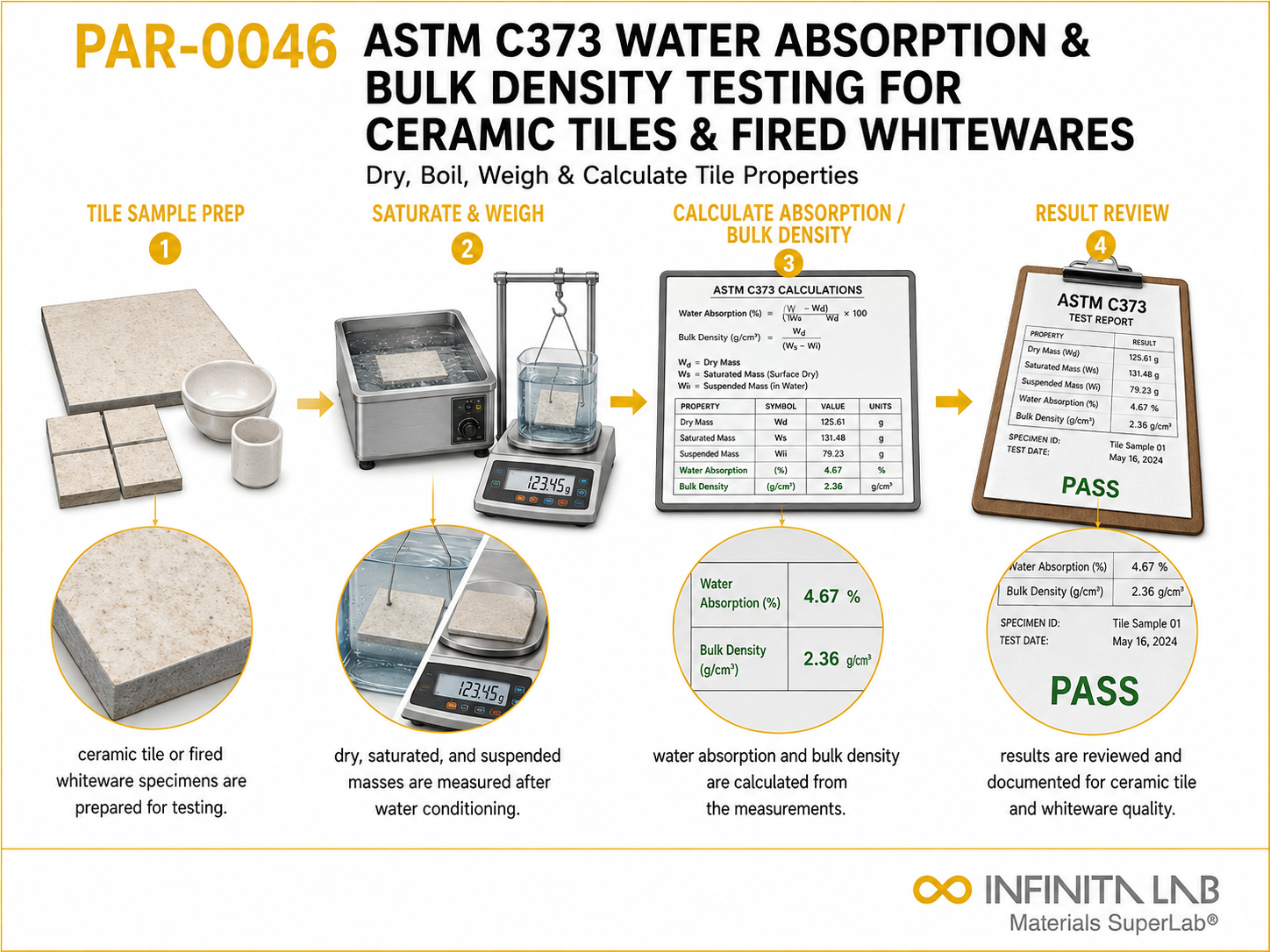
The test relies on a boil-and-weigh procedure grounded in water displacement. A specimen is first dried to a constant mass and weighed to establish its dry weight. It is then boiled in water for a specified duration and allowed to soak further, forcing water into the material’s open, interconnected pore structure until it reaches full saturation. The specimen is next weighed while fully suspended in water to obtain its immersed mass, and finally weighed in air after its surface has been blotted to a saturated surface-dry condition. From these three mass measurements – dry, suspended, and saturated – all four properties are calculated using standardised formulas, without destructive sectioning or specialised imaging equipment.
Water absorption is the property most closely tied to real-world tile performance. It reflects how much open pore space exists within the fired body, which governs a tile’s resistance to freeze-thaw damage, susceptibility to staining, and overall durability in wet or exterior environments. Because of this, results are used to classify ceramic tiles into recognised use categories – impervious, vitreous, semi-vitreous, and non-vitreous – that determine where a tile may be appropriately installed.
For manufacturers, ASTM C373 testing supports material qualification, in-process quality control, and finished-product verification. For specifiers and importers, it provides objective, repeatable data confirming that ceramic and glass tile products meet the density, porosity, and durability requirements in project specifications and classification standards.

Applications and Benefits of ASTM C373 Ceramic Tile Water Absorption Bulk Density Testing
Scope
- ASTM C373 measures four interrelated physical properties of a fired ceramic specimen: water absorption, bulk density, apparent porosity, and apparent specific gravity.
- The method is based on a boil-and-weigh principle in which a dried specimen is boiled and soaked in water to drive moisture into its open pores until saturation is reached.
- Three mass measurements are taken during the procedure: the dry mass after oven drying, the suspended (immersed) mass in water, and the saturated surface-dry mass in air.
- Water absorption is calculated as the percentage increase in mass between the dry and saturated states, expressed relative to the dry mass.
- Bulk density is calculated as the dry mass of the specimen divided by its exterior volume, reported in grams per cubic centimetre.
- Apparent porosity represents the percentage of a specimen’s exterior volume made up of open, water-permeable pores.
- Apparent specific gravity reflects the density of the solid, impervious portion of the fired body, excluding open pore volume.
- The standard covers fired unglazed whiteware products, glazed and unglazed ceramic tiles, and glass tiles used in flooring, wall, and cladding applications.
- Results are commonly used to classify ceramic tile into recognized use categories such as impervious, vitreous, semi-vitreous, and non-vitreous.
- Testing under this method supports manufacturing quality control, product certification, and compliance verification against project or regulatory specifications.
Applications
- Quality control testing during ceramic and porcelain tile manufacturing to verify consistent firing and body density.
- Verification of water absorption limits for floor and wall tile products against project specifications.
- Classification of ceramic tile into impervious, vitreous, semi-vitreous, or non-vitreous categories for installation suitability.
- Evaluation of fired whiteware products, including sanitaryware and technical ceramics, for porosity and density performance.
- Testing of glass tile products used in architectural, decorative, and wet-area applications.
- Comparative material evaluation when qualifying new raw material sources, glazes, or firing processes.
- Support for import compliance and third-party product certification programs for tile and ceramic products.
Benefits
- Provides objective, repeatable data on four key physical properties from a single standardised test procedure.
- Supports accurate classification of tile products for appropriate flooring, wall, or exterior use.
- Helps manufacturers identify firing or formulation inconsistencies that affect density and porosity.
- Assists specifiers and architects in confirming that materials meet freeze-thaw and durability expectations.
- Generates documented results suitable for specification compliance, certification, and customer quality records.
- Enables direct, standardised comparison between different tile products, batches, or suppliers.
Our ASTM C373 Testing Procedure
Sample Preparation
Tile specimens are cleaned, dried, and weighed.
1Water Immersion
Samples are immersed in water (often boiling) for a defined duration.
2Saturation Measurement
Saturated weight is recorded after immersion.
3Data Recording & Evaluation
Water absorption percentage and density are calculated.
4ASTM C373 Test Parameters and Requirements
| Parameter | Details |
|---|---|
| Applicable Materials | Ceramic and glass tiles |
| Water Absorption Range | ~0.1% to 20% |
| Boiling Time | ~5 hours |
| Drying Temperature | ~110°C |
| Bulk Density | ~1.5 to 2.5 g/cm³ |
| Measured Outputs | Water absorption (%), density, porosity |


- Drying Oven – dries specimens to constant mass at a controlled temperature before initial weighing.
- Boiling Apparatus / Water Bath – provides controlled boiling and soaking of specimens to achieve full saturation of open pores.
- Analytical Balance with Suspension Setup – measures dry, suspended (immersed), and saturated masses with the precision required for accurate calculations.
- Wire Suspension Fixture – supports the specimen while fully submerged during the suspended-weight measurement.
- Desiccator – cools dried specimens and maintains a moisture-free environment before weighing.
- Chamois or Absorbent Cloth – removes surface moisture from saturated specimens without drawing water out of the open pores.
- Specimen Preparation Tools – used for cutting, cleaning, and inspecting specimens to standard test dimensions before testing.
Equipment and Instrumentation Used for ASTM C373 Testing
What You Receive: Test Report, Data, and Certification
- Percentage water absorption value for each tested specimen.
- Calculated bulk density expressed in grams per cubic centimetre.
- Calculated apparent porosity expressed as a percentage of exterior volume.
- Calculated apparent specific gravity of the fired ceramic body.
- A detailed test report documenting specimen identification, test conditions, individual mass measurements, and final calculated results.
- Classification guidance indicating how results relate to recognised tile use categories, where applicable.
ASTM C373 Ceramic Tile Water Absorption Bulk Density FAQs
The ASTM C373 test method is used to determine the water absorption, bulk density, apparent porosity, and apparent specific gravity of fired unglazed whiteware products, glazed or unglazed ceramic tiles, and glass tiles.
The ASTM C373 test is important, as it determines most of the important physical data on tiles. This helps manufacturers maintain their products in conformance with the industry's minimum standards regarding durability, performance, and safety. These standards are particularly crucial in the case of tiles used in settings where resistance to moisture and strength are among the major concerns.
The ASTM C373 test is essential to determine the tiles' most critical physical data. This helps manufacturers maintain their products in conformance with the industry's minimum durability, performance, and safety standards. These standards are particularly crucial for tiles used in settings where resistance to moisture and strength are among the major concerns.
ASTMC 373 standard helps manufacturers meet industry standards and consumers' expectations regarding durability, aesthetic appeal, and regulatory obligations.
ASTM C373 evaluates water absorption under controlled laboratory conditions and may not fully represent long-term performance under varying environmental conditions, installation methods, or mechanical stresses affecting tile durability.
Tile density is determined by measuring the tile’s mass and volume, including consideration of its internal pore structure. ASTM C373 evaluates related properties such as bulk density, apparent porosity, and apparent specific gravity.
ASTM C373 uses controlled water saturation and weighing procedures to determine water absorption, bulk density, apparent porosity, and apparent specific gravity of ceramic and glass tiles. Pressed tiles are tested using the vacuum method, while extruded tiles use the boiling-water method.
Tile density indicates how much mass is contained within a given volume of tile. Higher density generally corresponds to a more compact ceramic body, while porosity and water absorption provide additional information about its internal structure.
Why Choose Infinita Lab for Ceramic Tile Water Absorption Bulk Density Testing
When your Ceramic Tile Water Absorption Bulk Density results have to hold up - for compliance, a customer audit, or an engineering decision - ASTM C373 accuracy and an unbiased third-party report matter more than price. Infinita Lab routes your ASTM C373 ceramic tile water absorption bulk density testing to ISO/IEC 17025-accredited U.S. partner labs with hands-on method experience, so you get defensible data, transparent reporting, and turnaround times built around your project deadline - not ours.

Need ASTM C373 Ceramic Tile Water Absorption Bulk Density Testing You Can Rely On?
Send query us at hello@infinitalab.com or call us at (888) 878-3090 to learn more about our services and how we can support you.



Request a Quote
Submit your material details and receive testing procedures, pricing, and turnaround time within 24 hours.
 Quick Turnaround and Hasslefree process
 Confidentiality Guarantee
 Free, No-obligation Consultation
 100% Customer Satisfaction
