


ASTM D4672: Polyurethane Raw Material QC Testing Services
Accredited ASTM D4672 polyurethane raw material QC testing from Infinita Lab, performed to the exact standard requirements - accurate, reproducible results with full documentation for compliance, R&D, and quality control programs.
TRUSTED BY


Get ASTM D4672 compliant results - request your polyurethane raw material QC testing quote
- Overview
- Scope, Applications, and Benefits
- Test Process
- Specifications
- Instrumentation
- Results and Deliverables
What Is ASTM D4672 Polyurethane Raw Material QC?
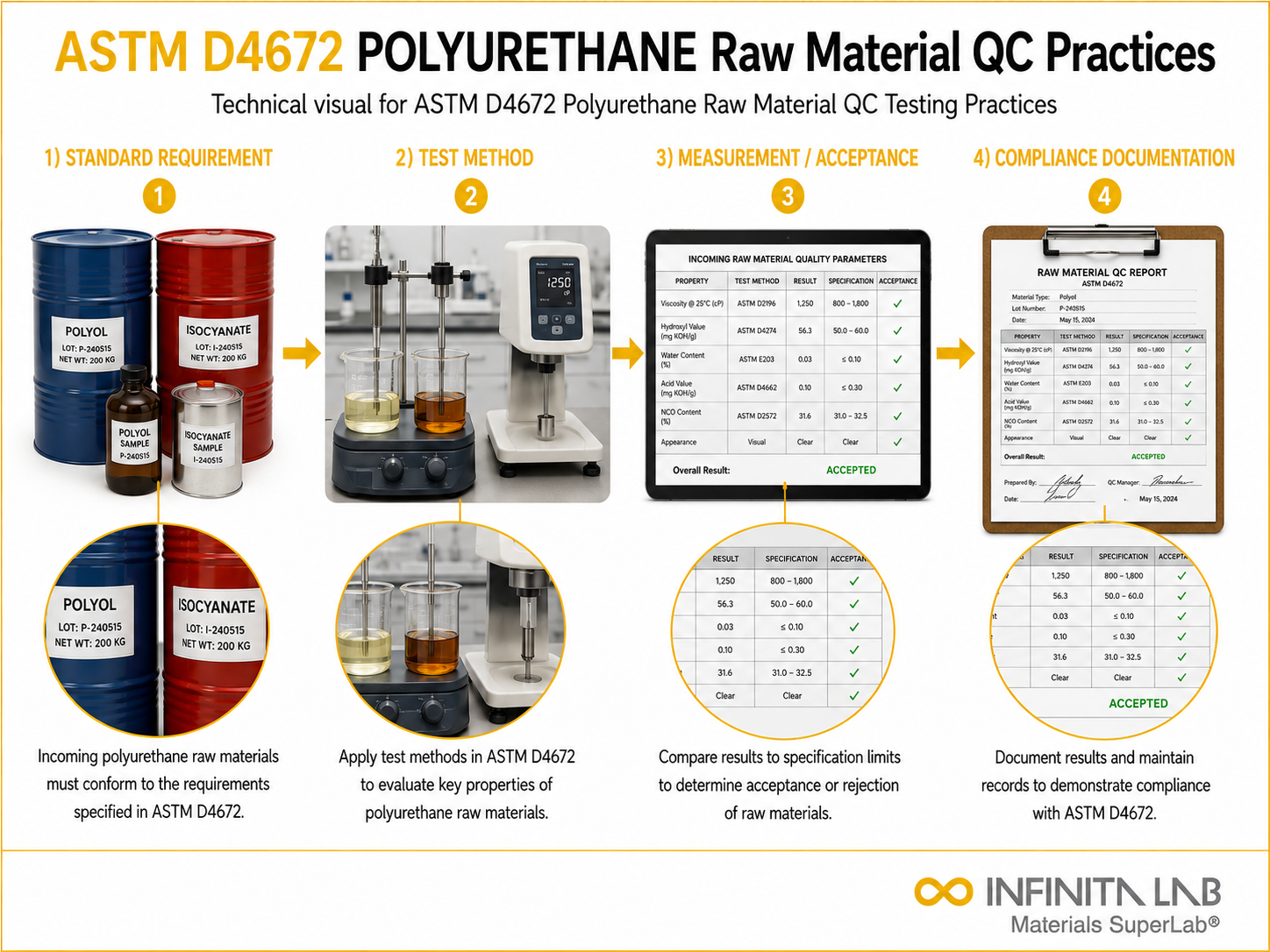
ASTM D4672, “Standard Test Method for Polyurethane Raw Materials: Determination of Water Content of Polyols” (current edition D4672-24, previously issued as D4672-18 and D4672-12), is a standardised analytical procedure published by ASTM International for measuring the water content of polyol raw materials used in polyurethane manufacturing. The method specifies volumetric or coulometric Karl Fischer titration to quantify moisture in polyether and polyester polyols, spanning a working range from trace, sub-100 ppm levels reported for “ultra-dry” speciality polyols to higher percentage-level water contents found in some standard commercial grades. At Infinita Lab, testing performed under ASTM D4672 gives raw material suppliers, polyurethane formulators, and foam, coatings, adhesive, and elastomer manufacturers an accredited, reproducible way to confirm that incoming or in-process polyol lots meet the moisture specifications called out in purchase agreements and internal quality plans.
Water is not an inert contaminant in polyurethane chemistry; it reacts directly with isocyanate groups to generate carbon dioxide gas and urea linkages, competing with the intended polyol-isocyanate reaction that builds the polymer backbone. Because polyurethane formulations are built on precise isocyanate-to-polyol stoichiometry, even small, uncontrolled variations in polyol water content shift that ratio, altering cure kinetics, cell structure, density, and mechanical properties in the finished foam, coating, adhesive, or elastomer. Where water is intentionally used as a chemical blowing agent, its concentration must be known and controlled precisely rather than simply minimised. ASTM D4672 gives manufacturers and their raw material suppliers a common, traceable basis for that control: a defined sampling and titration procedure, calibration against certified water standards, and a reportable result in ppm or weight per cent that can be checked directly against specification limits, tracked from batch to batch, and used to qualify new polyol sources or monitor drying and storage practices before those raw materials reach production.

Applications and Benefits of ASTM D4672 Polyurethane Raw Material QC Testing
Scope
- ASTM D4672 is a standard test method that defines the volumetric and coulometric Karl Fischer titration procedures used to determine the water content of polyurethane raw material polyols.
- The method applies to polyether polyols and polyester polyols used as the polyol component in polyurethane foam, coating, adhesive, sealant, and elastomer formulations.
- It covers a working range from trace moisture levels, including sub-100 ppm results reported for ultra-dry speciality polyols, up to higher percentage-level water contents found in some standard-grade or recycled polyols.
- The procedure specifies sample-handling precautions, including minimising atmospheric moisture pickup during sampling, storage, and titration-vessel transfer, since polyols are hygroscopic and readily absorb ambient humidity.
- The method includes instrument calibration and standards against certified water standards or water-in-methanol standards, ensuring titrant strength and coulometric cell performance are verified before and during a testing run.
- The test method does not itself set pass/fail moisture limits; results are compared against the water content specification limits established in the purchase specification, resin data sheet, or internal quality standard for the specific polyol grade.
- D4672 testing confirms compliance with supplier certificates of analysis, detects moisture absorbed during storage or transport, and verifies the effectiveness of polyol drying or dehydration processes.
- The standard supports both incoming raw material inspection at polyurethane manufacturing sites and outgoing quality control testing at polyol production and distribution facilities.
- D4672 is scoped specifically to polyol raw materials; isocyanate components used in polyurethane systems are evaluated for moisture and other quality parameters under separate ASTM test methods outside the scope of D4672.
- Results generated under D4672 are commonly used alongside other polyol quality parameters, such as hydroxyl number and viscosity, to build a complete raw material quality control profile ahead of production use.
Applications
- Incoming inspection of polyether and polyester polyol shipments at polyurethane foam, coatings, adhesives, and elastomer manufacturing plants.
- Outgoing quality control release testing at polyol production and blending facilities before shipment to customers.
- Qualification of new or alternate polyol suppliers against existing formulation specifications.
- Monitoring of polyol drying, dehydration, or inert-gas blanketing processes intended to reduce moisture content.
- Verification of “ultra-dry” polyol grades used in rigid foam, spray foam, and CASE (coatings, adhesives, sealants, elastomers) applications sensitive to moisture-driven side reactions.
- Investigation of foam defects such as blowholes, voids, or inconsistent density that may trace back to polyol moisture variation.
- Ongoing storage and shelf-life monitoring of polyol inventories to detect moisture pickup over time.
Benefits
- Provides an accredited, industry-recognised method for verifying polyol water content against specification limits.
- Helps prevent CO2-driven foam defects such as blowholes, voids, and irregular cell structure caused by uncontrolled polyol moisture.
- Supports consistent reaction stoichiometry between polyol and isocyanate components, protecting cure time, density, and mechanical properties.
- Detects moisture absorbed during storage, transport, or handling before it affects production.
- Confirms the effectiveness of polyol drying and dehydration steps.
- Gives raw material suppliers and manufacturers a shared, traceable basis for accepting or rejecting polyol lots.
Our ASTM D4672 Testing Procedure
Instrument Preparation
Karl Fischer titrator is standardized with certified water standard.
1Sample Injection
Polyol sample is weighed and injected into the KF titration vessel.
2Titration
Karl Fischer reagent is automatically or manually titrated until the endpoint is reached.
3Calculation
Water content is calculated from the titrant volume or coulombs consumed and the sample weight.
4ASTM D4672 Test Parameters and Requirements
| Parameter | Details |
|---|---|
| Test Principle | Karl Fischer titration (volumetric or coulometric) |
| Sensitivity | ppm to percent water levels |
| Applicable Materials | Polyether and polyester polyols |
| Output Units | ppm (mg/kg) or weight percent (%) |
| Measured Outputs | Water content |


- Karl Fischer Titrator (Volumetric or Coulometric) – performs the core titration that quantifies water content in the polyol sample.
- Certified Water Standards – used to standardise and verify titrant strength or coulometric cell performance before testing.
- Analytical Balance – weighs polyol samples with the precision needed for accurate water content calculations.
- Sealed Titration Vessel – isolates the sample from ambient humidity during titration to prevent moisture contamination of results.
- Dry Solvent and Reagent Delivery System – supplies moisture-free Karl Fischer reagent and working solvent to the titration cell.
- Dry Nitrogen or Desiccant Purge – maintains a low-humidity environment around sample handling and the titration vessel.
- Titration Data Acquisition Software – records endpoint detection and titrant or charge consumption and calculates the final water content result.
Equipment and Instrumentation Used for ASTM D4672 Testing
What You Receive: Test Report, Data, and Certification
- Quantitative water content result for each polyol sample, reported in ppm or weight per cent.
- Raw titration data, including titrant consumption or coulometric charge and endpoint detection records.
- Instrument calibration and standardisation records supporting result traceability.
- Comparison of results against the applicable specification or acceptance limit.
- A formal test report suitable for supplier qualification files, incoming inspection records, or customer certificates of analysis.
- Guidance on retesting or resampling when results fall outside expected ranges or specification limits.
ASTM D4672 Polyurethane Raw Material QC FAQs
ASTM D4672 determines water content in polyols. It evaluates moisture levels that affect reactivity, foaming behavior, and product quality in polyurethane manufacturing and related chemical applications.
Key parameters include sample preparation, titration method such as Karl Fischer, reagent calibration, and temperature control. Controlled conditions ensure accurate measurement of water content in polyol samples.
The test measures water content, typically expressed in percentage or parts per million. Results indicate moisture levels influencing processing, reactivity, and final product properties.
ASTM D4672 applies to polyols used in polyurethane foams, coatings, adhesives, sealants, and elastomers where moisture content significantly affects performance and stability.
ASTM D4672 results depend on proper sample handling and titration accuracy. Exposure to ambient moisture may affect results, requiring careful storage and testing procedures.
A measured polyol sample is titrated with Karl Fischer reagent, which reacts quantitatively with water. The reagent consumption is used to calculate the moisture content, helping control polyurethane raw-material quality.
Why Choose Infinita Lab for Polyurethane Raw Material QC Testing
When your Polyurethane Raw Material QC results have to hold up - for compliance, a customer audit, or an engineering decision - ASTM D4672 accuracy and an unbiased third-party report matter more than price. Infinita Lab routes your ASTM D4672 polyurethane raw material QC testing to ISO/IEC 17025-accredited U.S. partner labs with hands-on method experience, so you get defensible data, transparent reporting, and turnaround times built around your project deadline - not ours.

Looking for an Accredited Partner for ASTM D4672 Polyurethane Raw Material QC Testing?
Send query us at hello@infinitalab.com or call us at (888) 878-3090 to learn more about our services and how we can support you.



Request a Quote
Submit your material details and receive testing procedures, pricing, and turnaround time within 24 hours.
 Quick Turnaround and Hasslefree process
 Confidentiality Guarantee
 Free, No-obligation Consultation
 100% Customer Satisfaction
