


ASTM E903: Solar Absorptance Reflectance Transmittance Testing Services
Accredited ASTM E903 solar absorptance reflectance transmittance testing from Infinita Lab, performed to the exact standard requirements - accurate, reproducible results with full documentation for compliance, R&D, and quality control programs.
TRUSTED BY


Get ASTM E903 compliant results - request your solar absorptance reflectance transmittance testing quote
- Overview
- Scope, Applications, and Benefits
- Test Process
- Specifications
- Instrumentation
- Results and Deliverables
What Is ASTM E903 Solar Absorptance Reflectance Transmittance?
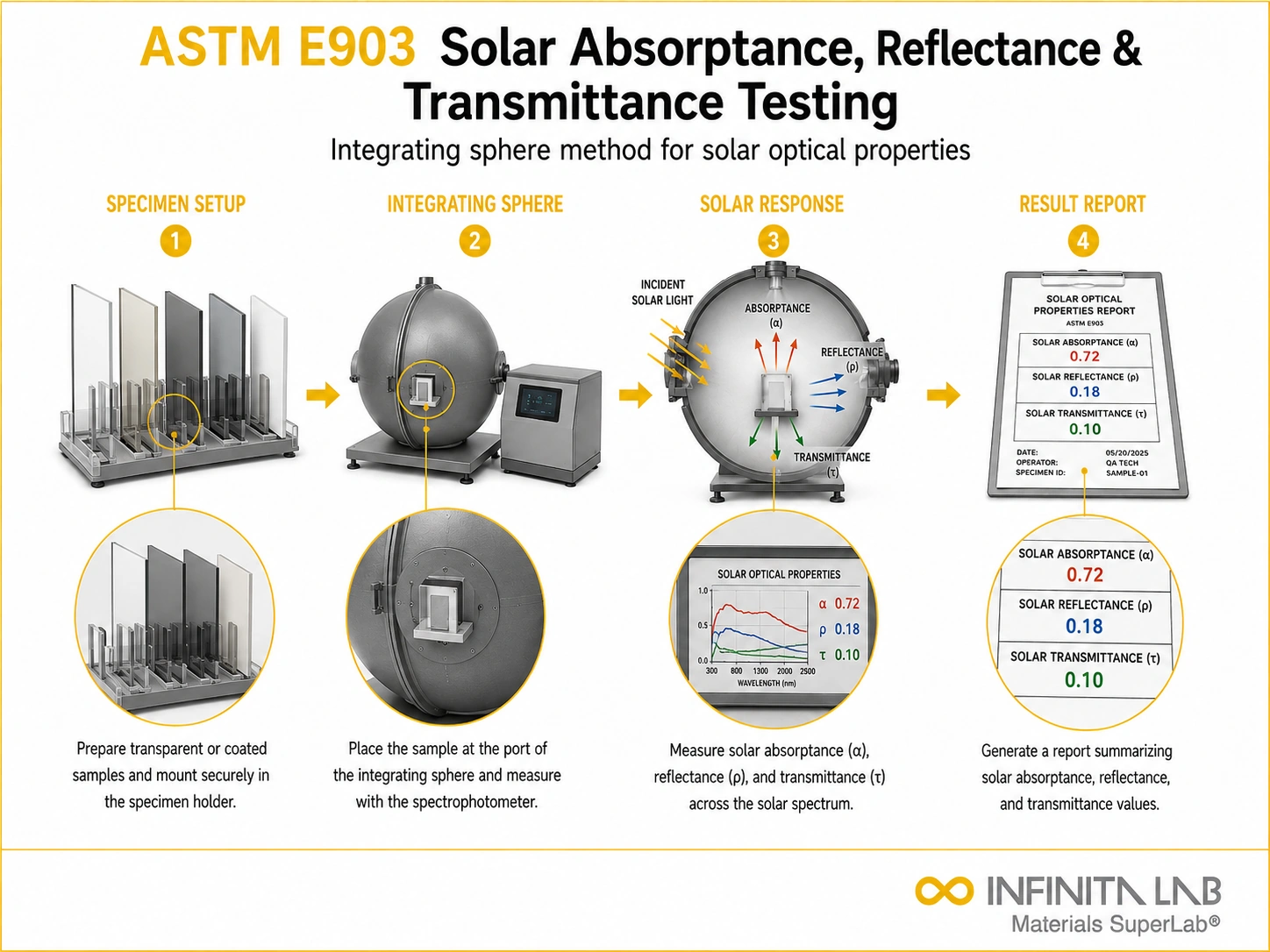
ASTM E903, Standard Test Method for Solar Absorptance, Reflectance, and Transmittance of Materials Using Integrating Spheres, defines a spectrophotometric procedure for quantifying how a material interacts with solar radiation across the ultraviolet, visible, and near-infrared regions of the solar spectrum, approximately 250 to 2500 nanometers. The method uses a spectrophotometer fitted with an integrating sphere accessory to capture the near-normal hemispherical reflectance and transmittance of a specimen at a series of wavelengths spanning this range. Because the interior of the sphere is coated with a highly reflective, diffusing material, light reflected from or transmitted through the sample, whether scattered specularly or diffusely, is collected and homogenised so that a detector can measure the total reflected or transmitted energy regardless of the direction in which it left the specimen. The resulting spectral data are then weighted against a standard solar irradiance distribution to produce single-number solar reflectance and solar transmittance values, and solar absorptance is derived from the energy balance principle, where absorptance equals one minus reflectance minus transmittance.
This test method is widely used because solar optical properties directly govern how much radiant energy a material absorbs, reflects, or transmits, which in turn affects surface temperature, thermal load, and overall energy performance. Roofing manufacturers rely on ASTM E903 data to support cool-roof and solar reflectance certifications, coatings developers use it to compare formulations for heat rejection, and window, glazing, and photovoltaic material producers use it to characterise how much solar energy passes through or is captured by their products. Infinita Lab connects manufacturers, formulators, and researchers to accredited laboratories equipped to perform ASTM E903 testing with calibrated integrating sphere spectrophotometers, delivering accurate, standardised, and defensible solar optical property data for product qualification, energy code compliance, and research and development.

Applications and Benefits of ASTM E903 Solar Absorptance Reflectance Transmittance Testing
Scope
- ASTM E903 measures the spectral and total solar reflectance, transmittance, and absorptance of opaque, translucent, and transparent materials.
- Testing covers the solar spectral range of approximately 250 to 2500 nanometers, encompassing ultraviolet, visible, and near-infrared wavelengths.
- The method relies on the integrating sphere principle, in which a sphere with a highly reflective, diffusing interior coating collects light reflected from or transmitted through a specimen so total energy can be measured independent of scattering direction.
- A spectrophotometer paired with the integrating sphere records near-normal hemispherical reflectance or transmittance at discrete wavelength intervals across the specified range.
- Solar absorptance is calculated from the measured reflectance and transmittance data using the energy balance relationship, where absorptance equals one minus reflectance minus transmittance.
- The method applies to a broad range of materials, including glass, coated and uncoated metals, polymer films, paints and coatings, roofing membranes, and building envelope materials.
- Industries served include roofing and building materials, architectural glazing, protective and decorative coatings, solar energy and photovoltaics, aerospace, and automotive glass and paint.
- Data generated under ASTM E903 supports cool-roof rating programs, energy code compliance, and solar heat gain evaluations that reference related methods used by cool roof rating organisations.
- The test method is used alongside related solar and thermal optical property standards to build a complete profile of a material’s radiative behaviour.
- ASTM E903 results support product development, quality control, regulatory submissions, and marketing claims tied to solar reflectance and thermal performance.
Applications
- Evaluating cool-roof coatings and roofing membranes for solar reflectance and energy-efficiency certification.
- Characterising architectural glazing and window materials for solar heat gain and transmittance performance.
- Assessing reflective and absorptive coatings used in construction, industrial, and consumer products.
- Qualifying solar energy and photovoltaic module materials for optical efficiency.
- Testing automotive glass, glazing, and exterior paint finishes for solar heat management.
- Supporting aerospace and spacecraft thermal control material selection.
- Comparing competing material formulations during research and product development.
Benefits
- Provides accurate, standardised solar optical property data across the full solar spectrum.
- Supports cool-roof, energy code, and green building certification requirements.
- Enables objective comparison between coatings, glazing, and roofing material candidates.
- Delivers data suitable for regulatory submissions and technical marketing claims.
- Identifies opportunities to improve thermal performance through formulation or design changes.
- Reduces development risk by validating solar performance before large-scale production.
Our ASTM E903 Testing Procedure
Sample Preparation
lean and measure the sample dimensions.
1Instrument Calibration
Calibrate the spectrophotometer or solar reflectometer using reference standards.
2Measurement
Measure reflected solar radiation from the sample across the required spectrum.
3Calculation
Compute solar absorptance using the measured reflectance data.
4ASTM E903 Test Parameters and Requirements
| Parameter | Details |
|---|---|
| Purpose | Measurement of solar absorptance beyond the visible range |
| Spectral Range | UV, visible, and near-infrared |
| Light Source | Artificial source (ASTM E424) or natural sunlight |
| Outdoor Method | ASTM E971 for sunlight-based measurements |
| Polarization Check | Sample rotated at different normal angles |
| Test Environment | Controlled laboratory conditions |


- UV-Vis-NIR Spectrophotometer – generates and detects light across the ultraviolet, visible, and near-infrared wavelength range needed for solar spectral measurements.
- Integrating Sphere Accessory – collects and diffuses reflected or transmitted light so total energy can be measured regardless of scattering direction.
- Calibrated Reflectance Standards – reference materials used to calibrate and verify reflectance measurement accuracy.
- Calibrated Transmittance Standards – reference materials used to calibrate and verify transmittance measurement accuracy.
- Specimen Holder and Sphere Port Fixtures – secure and position specimens consistently at the sphere port for reflectance or transmittance scans.
- Broadband Light Source – provides stable illumination spanning the ultraviolet through near-infrared solar spectrum.
- Data Acquisition and Analysis Software – applies solar spectral weighting functions and calculates total solar reflectance, transmittance, and absorptance from spectral scan data.
Equipment and Instrumentation Used for ASTM E903 Testing
What You Receive: Test Report, Data, and Certification
- Detailed test report documenting spectral reflectance and transmittance data across the solar wavelength range.
- Calculated total solar reflectance, total solar transmittance, and total solar absorptance values.
- Specimen identification, conditioning, and instrument calibration records.
- Reference to the ASTM E903 test method and any related standards applied during testing.
- Data suitable for supporting cool-roof, energy code, and product certification submissions.
- Optional consultation on result interpretation and next steps for product development.
Frequently Asked Question
This ASTM E903 test method measures the spectral absorption, reflectance, and transmittance of materials with spectrophotometers that have integrating spheres.
It is usually carried out in the solar spectral wavelength region of 300 to 2500 nm, incorporating most sunlight energy.
ASTM E903 is employed to test the coating and materials exposed to sunlight to understand thermal properties.
Knowledge of such properties helps enhance the material properties necessary for energy efficiency, sustainability, and viability of structures in solar-irradiated regions.
Samples should be typical of the materials in use and have uniform thickness and, hence, surface polish, mainly depending on the planned application.
ASTM E903 measures a material’s spectral reflectance, transmittance, and absorptance using a spectrophotometer equipped with an integrating sphere. The measured spectral data are then used to calculate solar-weighted optical properties.
ASTM E903 is the Standard Test Method for Solar Absorptance, Reflectance, and Transmittance of Materials Using Integrating Spheres. It evaluates the optical properties of materials with specular and diffuse characteristics and is used to determine their solar-weighted absorptance, reflectance, and transmittance.
Why Choose Infinita Lab for Solar Absorptance Reflectance Transmittance Testing
When your Solar Absorptance Reflectance Transmittance results have to hold up - for compliance, a customer audit, or an engineering decision - ASTM E903 accuracy and an unbiased third-party report matter more than price. Infinita Lab routes your ASTM E903 solar absorptance reflectance transmittance testing to ISO/IEC 17025-accredited U.S. partner labs with hands-on method experience, so you get defensible data, transparent reporting, and turnaround times built around your project deadline - not ours.

Need ASTM E903 Solar Absorptance Reflectance Transmittance Testing You Can Rely On?
Send query us at hello@infinitalab.com or call us at (888) 878-3090 to learn more about our services and how we can support you.



Request a Quote
Submit your material details and receive testing procedures, pricing, and turnaround time within 24 hours.
 Quick Turnaround and Hasslefree process
 Confidentiality Guarantee
 Free, No-obligation Consultation
 100% Customer Satisfaction
