


Random Drop Non Packaged Product Testing Services
Military equipment testing and assessment processes must include the military drop test. In particular, the random drop test offers insightful information on how long the equipment will last and how resilient it will be to unexpected spills and falls. The test helps to guarantee that the equipment can endure the rigors of use in tough and unpredictable environments by placing it under conditions similar to those found in real-world situations.
TRUSTED BY


Get compliant results — request your random drop non packaged product testing quote
- Overview
- Scope, Applications, and Benefits
- Test Process
- Specifications
- Instrumentation
- Results and Deliverables
What Is Random Drop Non Packaged Product?
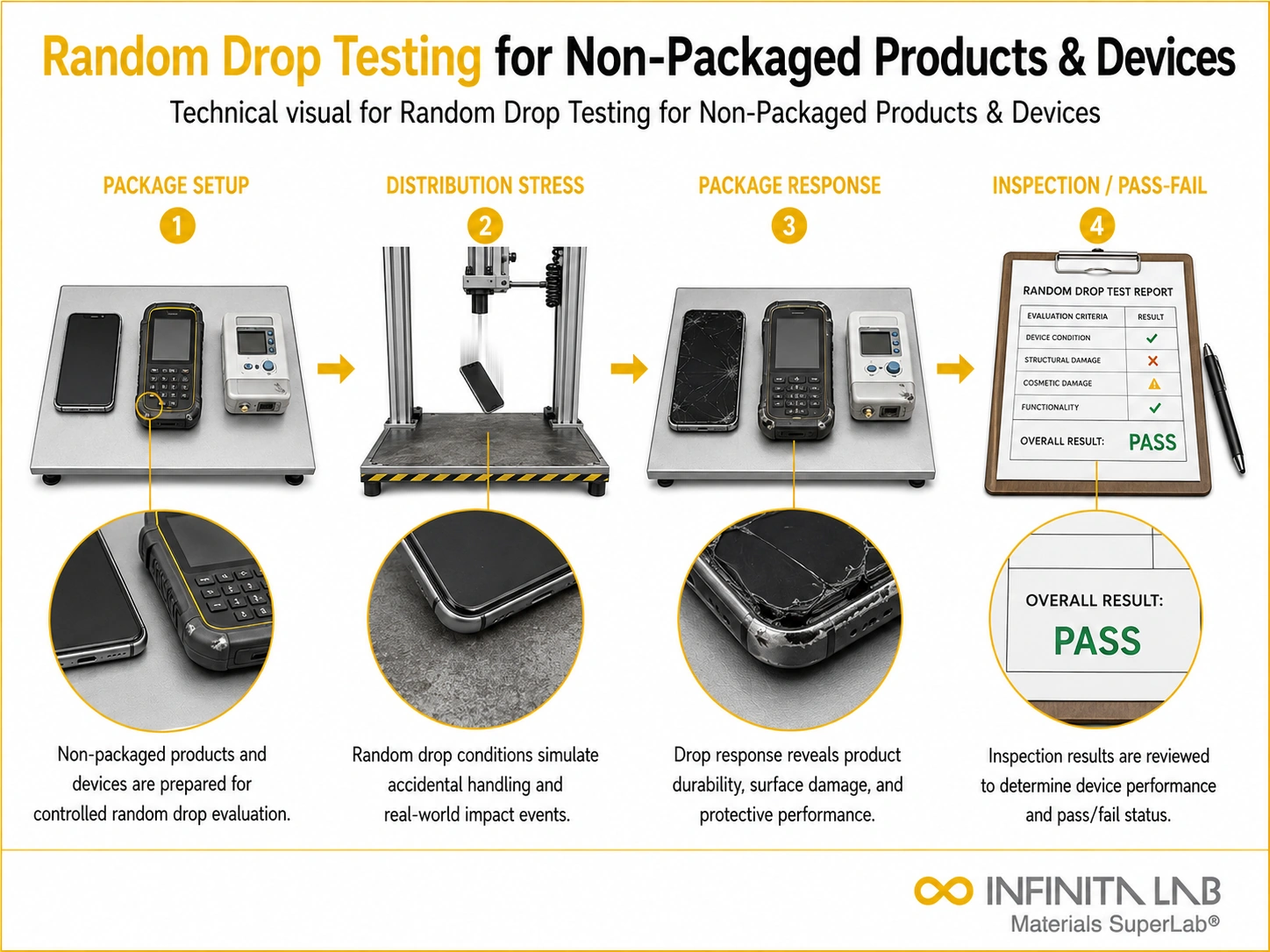
Random drop (non-packaged) testing is used to evaluate the ability of products and components to withstand repeated accidental drops during handling, transportation, and real-world use without protective packaging. It simulates uncontrolled drop events that may occur during manual handling, installation, or field operation.
This test is considered an accelerated method for identifying structural and mechanical weaknesses that may not be detected by vibration or shock testing alone. By subjecting products to multiple drops in different orientations, it helps assess durability, impact resistance, and functional reliability.

Applications and Benefits of Random Drop Non Packaged Product Testing
Scope
Random drop testing evaluates:
- Resistance to repeated drop impacts
- Structural integrity after free-fall events
- Functional performance after drops
- Weak points in design and assembly
- Durability under real handling conditions
Applications
- Consumer electronics and devices
- Automotive and industrial components
- Electrical and electronic equipment
- Military and aerospace hardware
- Portable tools and equipment
Benefits
- Simulates real-world accidental drops
- Identifies structural and mechanical weaknesses
- Improves product durability and design
- Reduces risk of field failures
- Supports reliability validation
Random Drop (Non-Packaged) Test Process
Sample Preparation
Product is tested without packaging and configured in operational condition.
1Drop Execution
Samples are dropped from specified heights in multiple orientations (face, edge, corner).
2Repeated Drops
Multiple drop cycles are performed to simulate real handling conditions.
3Data Analysis
Product is inspected for physical damage and functional performance after each drop.
4Test parameters and requirements
| Parameter | Details |
|---|---|
| Standards | MIL-STD-202, ASTM D999, ASTM D1083 |
| Drop Height | Typically ~0.5 m to 1.5 m (application dependent) |
| Drop Orientation | Face, edge, corner impacts |
| Number of Drops | Multiple cycles (e.g., 10–50 drops) |
| Surface Type | Hard rigid surface (steel/concrete) |
| Measured Outputs | Physical damage, functionality |


- Drop test apparatus or guided drop tester
- Hard impact surface (steel plate/concrete base)
- Orientation fixtures (if required)
- High-speed cameras (optional)
- Measurement tools for deformation/damage
- Data recording system
Equipment and Instrumentation Used for Testing
What You Receive: Test Report, Data, and Certification
- Drop resistance performance data
- Physical damage and deformation analysis
- Functional performance after drops
- Failure mode identification
- Pass/fail evaluation based on criteria
- Test report
Random Drop Non Packaged Product FAQs
Random drop testing evaluates how a product performs when dropped multiple times without packaging, simulating real-world handling and accidental drops during use or transport.
Packaged testing evaluates packaging protection, while non-packaged testing directly assesses the product’s durability and resistance to impact without any protective materials.
Key parameters include drop height, orientation, number of drops, surface type, and product weight, all of which influence impact energy and damage severity.
Standards such as MIL-STD-202, ASTM D999, and ASTM D1083 are commonly used for evaluating drop resistance of non-packaged products.
It helps identify product weaknesses and ensures durability under real handling conditions, reducing failures, returns, and performance issues in field applications.
Why Choose Infinita Lab for Random Drop Non Packaged Product Testing
At the core of this breadth is our network of 2,000+ accredited laboratories across the USA, offering access to over 10,000 testing methods and analytical services. From advanced materials characterization (SEM, TEM, RBS, XPS) to mechanical, chemical, environmental, biological, and standardized ASTM/ISO-compliant testing, we deliver unmatched flexibility, specialization, and scale. You are never limited by geography, facility, or methodology — Infinita Lab connects you to the right expertise and testing solution, every time.

Looking for an Accredited Partner for Random Drop Non Packaged Product Testing?
Send query us at hello@infinitalab.com or call us at (888) 878-3090 to learn more about our services and how we can support you.



Request a Quote
Submit your material details and receive testing procedures, pricing, and turnaround time within 24 hours.
 Quick Turnaround and Hasslefree process
 Confidentiality Guarantee
 Free, No-obligation Consultation
 100% Customer Satisfaction
