


Drop Packaging Testing Services
Drop testing evaluates packaged items to identify mechanical and structural flaws not seen in shock or vibration tests. It assesses the effects of random drops and repeated impacts from shipping, handling, and other field service circumstances. Packaged items are divided into three categories: standard, small, and flat, depending on their volume, weight, and longest dimension. Drop testing standards include ISTA 3A, ASTM D5276 and D5487, MIL-STD 810 Test Method 516, and MIL-STD 202.
TRUSTED BY


Get compliant results — request your drop packaging testing quote
- Overview
- Scope, Applications, and Benefits
- Test Process
- Specifications
- Instrumentation
- Results and Deliverables
What Is Drop Packaging?
Drop testing evaluates the ability of packaged products to withstand impacts during handling, transportation, and storage. It simulates real-world drops to assess the protective performance of packaging systems against mechanical shocks.
This test helps identify potential damage risks to products and ensures packaging integrity. It is widely used across industries to validate packaging design, optimize cushioning materials, and comply with distribution standards.

Applications and Benefits of Drop Packaging Testing
Scope
Drop testing defines procedures to simulate free-fall impacts on packaged goods under controlled conditions. It evaluates how packaging absorbs shock and protects the product from damage during handling events.
The method supports performance validation of packaging systems across different drop orientations and heights.
- Simulation of free-fall drops under controlled conditions
- Evaluation of packaging shock absorption capability
- Assessment of product protection during handling
- Analysis of damage patterns and failure points
- Comparison of packaging designs and materials
- Standardized distribution testing method
Applications
- E-commerce packaging validation
- Consumer electronics packaging testing
- Pharmaceutical and medical product packaging
- Food and beverage packaging evaluation
- Industrial product shipment testing
- Logistics and supply chain optimization
- Packaging design and development
Benefits
- Ensures product safety during transportation
- Reduces damage-related losses and returns
- Improves packaging design efficiency
- Supports compliance with distribution standards
- Enhances customer satisfaction
- Optimizes material usage and cost
Our Testing Procedure
Sample Preparation
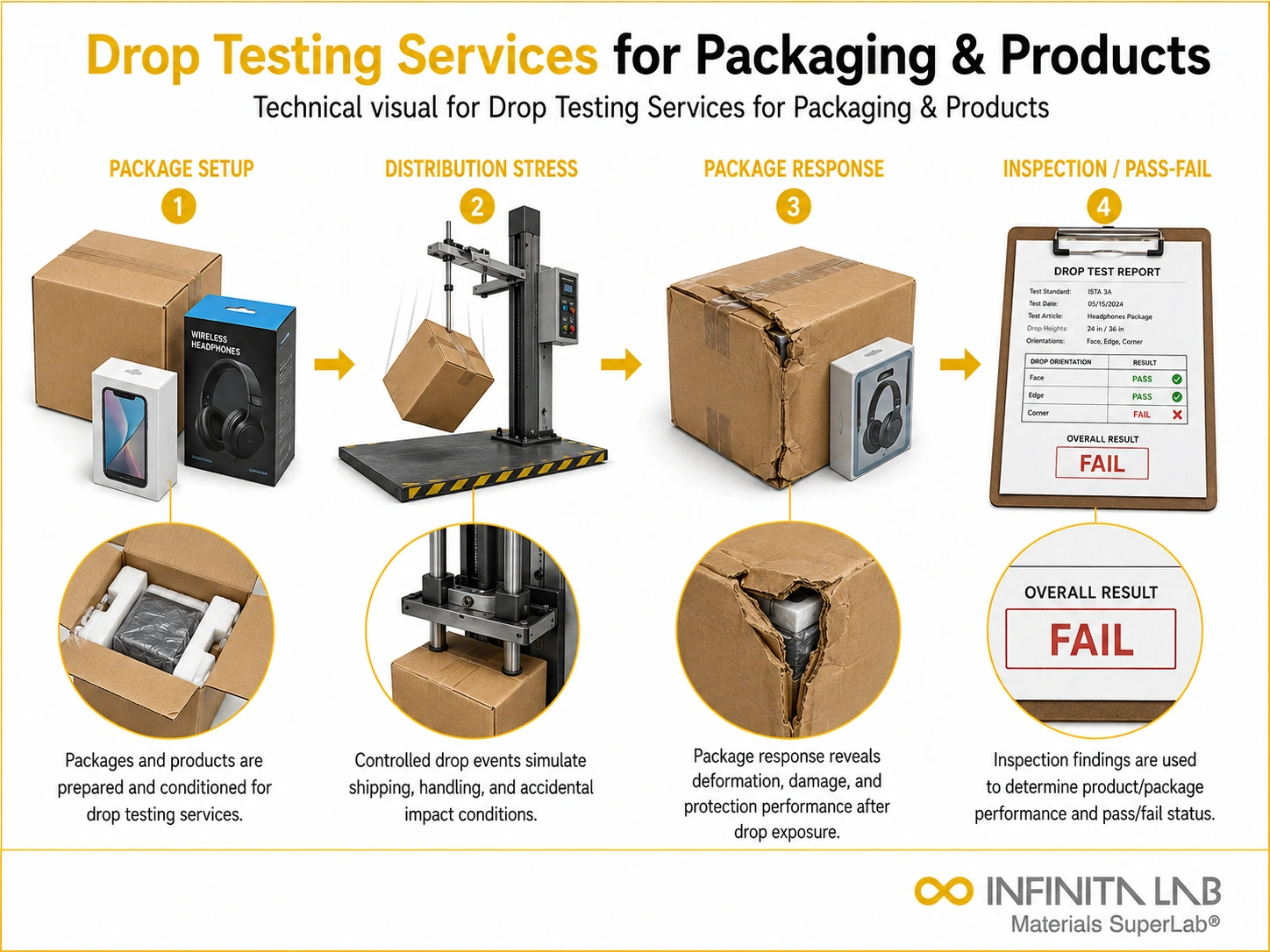
The packaged product is conditioned and sealed as per actual shipping configuration to replicate real handling conditions.
1Test Setup
The sample is positioned in specified orientations such as flat, edge, or corner to simulate different impact scenarios.
2Drop Execution
The package is dropped from defined heights onto a rigid surface using controlled release mechanisms.
3Inspection & Evaluation
The package and product are inspected for damage, deformation, and performance compliance after impact.
4Test parameters and requirements
| Parameter | Details |
|---|---|
| Sample Type | Packaged products |
| Sample Condition | Fully packed and sealed shipping configuration |
| Measurement Method | Free-fall drop under controlled conditions |
| Drop Height | Defined based on product weight and standard requirements |
| Impact Surface | Rigid, flat surface (steel or concrete) |
| Measurement Units | Height (cm/m), weight (kg), damage criteria |


- Drop test machine (free-fall drop tester)
- Impact platform (steel/concrete base)
- Height adjustment system
- Release mechanism for controlled drop
- Measuring scale or height gauge
- Environmental conditioning chamber
- Inspection tools (visual and dimensional)
- Data recording system
Equipment and Instrumentation Used for Testing
What You Receive: Test Report, Data, and Certification
- Pass/fail evaluation of packaging performance
- Damage assessment (product and packaging)
- Identification of failure points
- Impact resistance analysis
- Test report as per applicable standards
- Packaging improvement recommendations
- Compliance documentation
- Quality assurance records
Drop Packaging FAQs
The objective is to simulate real-world handling impacts to assess whether packaging can protect the product from mechanical shock, ensuring integrity and minimizing damage during transportation and distribution cycles.
Drop height directly affects impact energy; higher drops increase kinetic energy, leading to greater stress on packaging and higher risk of product damage.
Different orientations such as flat, edge, and corner drops simulate real handling conditions, as packages rarely fall uniformly, ensuring comprehensive evaluation of packaging performance.
Heavier packages generate higher impact forces, requiring adjusted drop heights and test parameters to accurately simulate real-world risks.
Drop height determines energy, but acceleration defines the shock experienced by the product; packaging effectiveness depends on reducing peak deceleration, which directly correlates with product damage risk.
Why Choose Infinita Lab for Drop Packaging Testing?
At the core of this breadth is our network of 2,000+ accredited laboratories across the USA, offering access to over 10,000 testing methods and analytical services. From advanced materials characterization (SEM, TEM, RBS, XPS) to mechanical, chemical, environmental, biological, and standardized ASTM/ISO-compliant testing, we deliver unmatched flexibility, specialization, and scale. You are never limited by geography, facility, or methodology — Infinita Lab connects you to the right expertise and testing solution, every time.

Looking for an Accredited Partner for Drop Packaging Testing?
Send query us at hello@infinitalab.com or call us at (888) 878-3090 to learn more about our services and how we can support you.



Request a Quote
Submit your material details and receive testing procedures, pricing, and turnaround time within 24 hours.
 Quick Turnaround and Hasslefree process
 Confidentiality Guarantee
 Free, No-obligation Consultation
 100% Customer Satisfaction
