


ASTM D4883: Polyethylene Density Ultrasound Testing Services
The ASTM D4883 test method covers the determination of the density of polyethylene through the utilization of ultrasound equipment. This test method is based on the distinct behaviors of the amorphous and crystalline phases of polyethylene in response to ultrasound.
TRUSTED BY


Get ASTM D4883 compliant results — request your polyethylene density ultrasound testing quote
- Overview
- Scope, Applications, and Benefits
- Test Process
- Specifications
- Instrumentation
- Results and Deliverables
What Is ASTM D4883 Polyethylene Density Ultrasound?
ASTM D4883 defines a standardized method for determining the density of polyethylene using ultrasonic velocity measurement. The density of polyethylene is directly related to its degree of crystallinity, which in turn governs key performance properties such as stiffness, barrier properties, chemical resistance, and tensile strength. Conventional density measurement by liquid displacement can be time-consuming and requires precise temperature control; the ultrasound technique offers a rapid, non-destructive alternative.
The method measures the velocity of ultrasonic waves through a polyethylene specimen. Since the velocity of sound in a material is a function of its density and elastic modulus, and because these properties are well characterized for polyethylene, the density can be accurately calculated from the measured wave velocity using established correlations. This technique is particularly useful for rapid quality control and for in-line or at-line density monitoring during polyethylene production and processing.

Applications and Benefits of ASTM D4883 Polyethylene Density Ultrasound Testing
Scope
ASTM D4883 evaluates:
- Density of polyethylene sheet, film, and molded specimens
- Ultrasonic wave velocity through polyethylene specimens
- Crystallinity estimation from ultrasound density data
- Batch-to-batch density consistency of polyethylene products
- Rapid quality control without specimen destruction
- Comparison with density values from liquid displacement methods
Applications
- HDPE, LDPE, and LLDPE resin quality control
- Polyethylene film and sheet density verification
- Pipe and fitting PE density compliance
- Geomembrane liner density quality control
- In-line and at-line density monitoring
- Recycled polyethylene density characterization
- Research and development in polyolefin crystallinity
Benefits
- Provides rapid, non-destructive density measurement
- Enables at-line quality control in production
- Reduces time compared to density gradient column methods
- Correlates density with crystallinity and mechanical properties
- Supports specification compliance for PE products
- Enables density mapping across a specimen surface
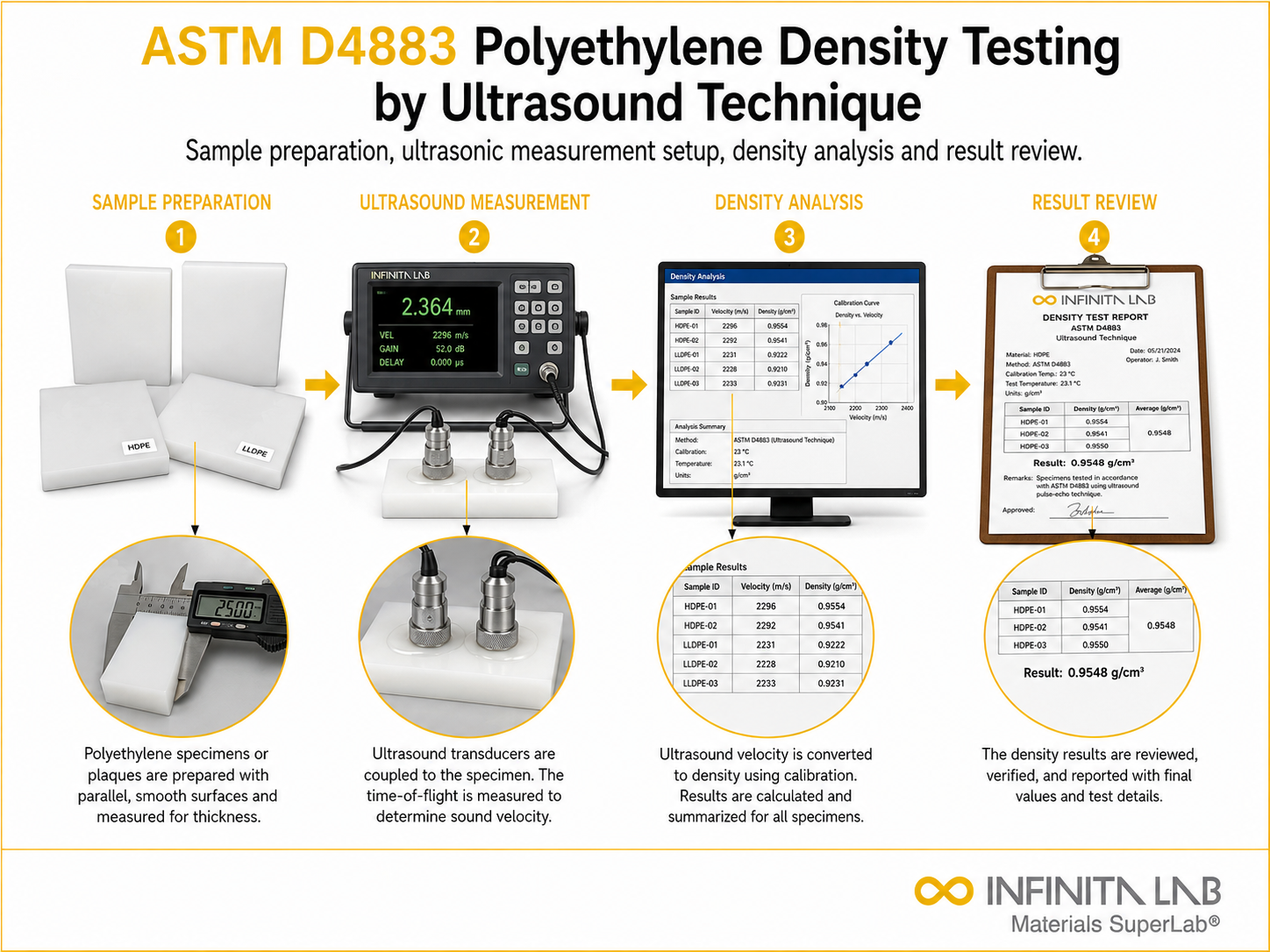
Our ASTM D4883 Testing Procedure
Specimen Preparation
Flat polyethylene specimens are cut and conditioned at the specified temperature.
1Transducer Coupling
Ultrasonic transducer is coupled to the specimen surface with appropriate couplant.
2Velocity Measurement
Time of flight of the ultrasonic pulse through the known specimen thickness is measured.
3Density Calculation
Density is calculated from the measured velocity using the established PE velocity-density correlation.
4ASTM D4883 Test Parameters and Requirements
| Parameter | Details |
|---|---|
| Test Principle | Ultrasonic pulse velocity measurement |
| Applicable Materials | Polyethylene (HDPE, LDPE, LLDPE) specimens |
| Output Units | g/cm³ or kg/m³ |
| Measured Outputs | Density, ultrasonic wave velocity |


- Ultrasonic pulse-echo or through-transmission instrument
- Appropriate ultrasonic transducers
- Coupling agent (gel or oil)
- Micrometer for specimen thickness measurement
- Temperature-controlled conditioning environment
- Data recording and density calculation software
Equipment and Instrumentation Used for ASTM D4883 Testing
What You Receive: Test Report, Data, and Certification
- Density values (g/cm³ or kg/m³)
- Ultrasonic wave velocity measurements
- Crystallinity estimates (derived)
- Specimen thickness records
- Compliance reports
ASTM D4883 Polyethylene Density Ultrasound FAQs
ASTM D4883 determines density of polyethylene using ultrasonic techniques. It evaluates material uniformity and composition, helping ensure quality control and performance in polyethylene products used across industrial and packaging applications.
Key parameters include ultrasonic frequency, sample thickness, temperature, calibration standards, and signal measurement. Controlled conditions ensure accurate determination of polyethylene density using ultrasound methods.
The test measures density of polyethylene, typically expressed in g/cm³. Results indicate material composition, crystallinity, and consistency affecting mechanical and processing properties.
ASTM D4883 applies to polyethylene materials such as films, sheets, and molded products used in packaging, construction, and industrial applications where density influences performance.
ASTM D4883 results depend on calibration and sample uniformity. Variations in material structure or surface condition may affect ultrasonic measurements, requiring additional methods for precise density determination.
Why Choose Infinita Lab for Polyethylene Density Ultrasound Testing?
At the core of this breadth is our network of 2,000+ accredited laboratories across the USA, offering access to over 10,000 testing methods and analytical services. From advanced materials characterization (SEM, TEM, RBS, XPS) to mechanical, chemical, environmental, biological, and standardized ASTM/ISO-compliant testing, we deliver unmatched flexibility, specialization, and scale. You are never limited by geography, facility, or methodology — Infinita Lab connects you to the right expertise and testing solution, every time.

Looking for an Accredited Partner for ASTM D4883 Polyethylene Density Ultrasound Testing?
Send query us at hello@infinitalab.com or call us at (888) 878-3090 to learn more about our services and how we can support you.



Request a Quote
Submit your material details and receive testing procedures, pricing, and turnaround time within 24 hours.
 Quick Turnaround and Hasslefree process
 Confidentiality Guarantee
 Free, No-obligation Consultation
 100% Customer Satisfaction
