

What Is ASTM A503 Forged Crankshaft Ultrasonic?
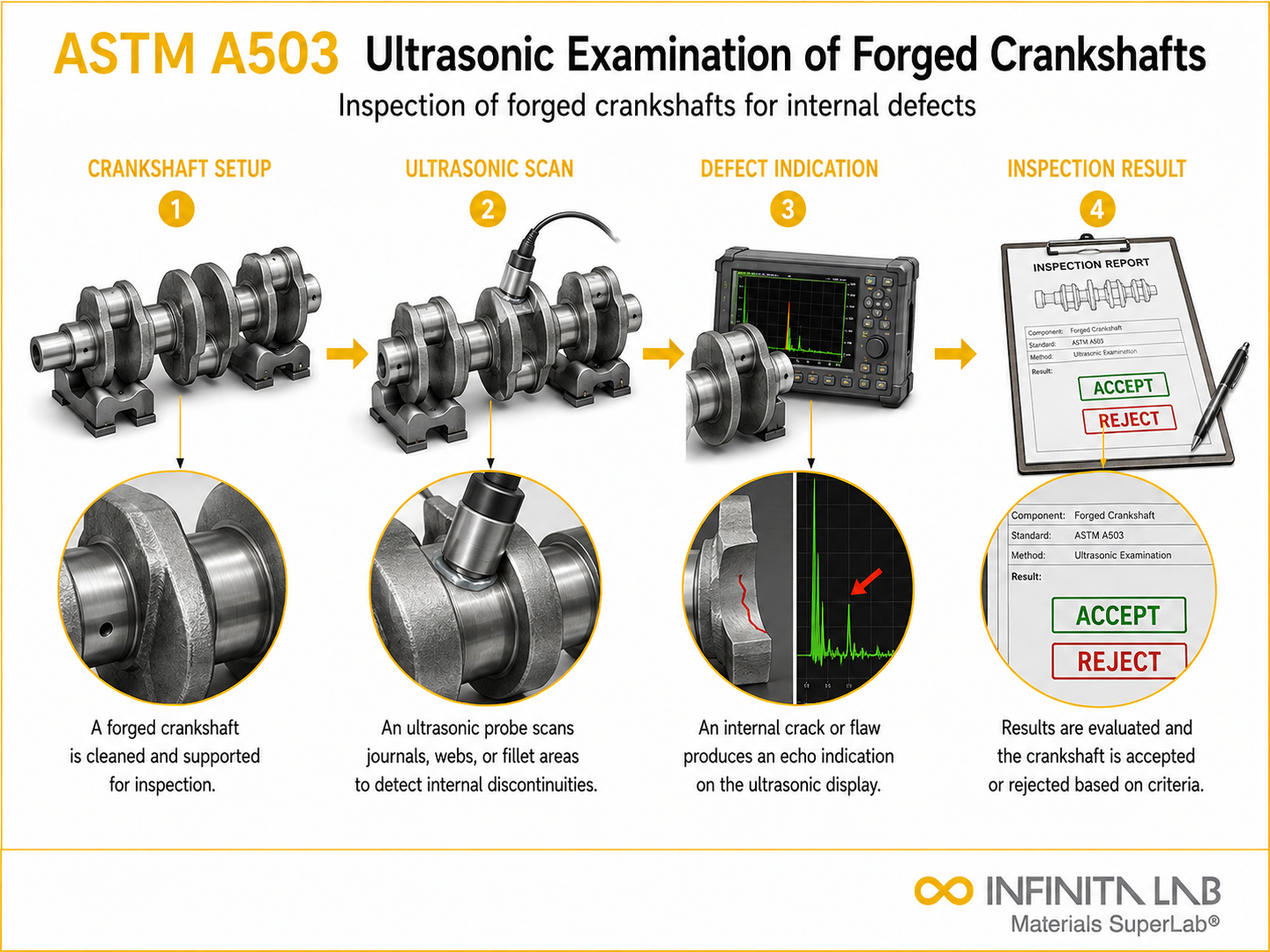
ASTM A503 provides the guidelines for the ultrasonic testing of forged steel crankshafts. The purpose of the test is to identify any defects that might develop within the crankshaft as a result of the forging and heat treatment processes.
The test uses ultrasonic waves that are directed into the crankshaft. The ultrasonic waves reflect off any defects that they encounter within the crankshaft. The reflected waves are then examined to determine the quality of the crankshaft. ASTM A503 provides the guidelines that govern the testing of crankshafts in various machinery.

Applications and Benefits of ASTM A503 Forged Crankshaft Ultrasonic Testing
Scope
ASTM A503 specifies the procedure for conducting ultrasonic tests on forged steel crankshafts intended for heavy industrial applications. It is generally used on large crankshafts used in marine engines, heavy machinery, and power generation equipment, where the integrity of the material used in these parts is of utmost importance. The ultrasonic tests specified in ASTM A503 are intended to identify any potential problems in the performance of the crankshafts under heavy mechanical stresses.
The ASTM A503 standard applies to:
– Forged steel crankshafts used in heavy machinery
– Large industrial crankshafts
– Crankshafts used in marine engines
– Crankshafts used in power generation equipment
Applications
- Quality control in crankshaft manufacturing
- Inspection of forged steel components
- Marine engine crankshaft testing
- Power plant rotating equipment inspection
- Automotive and heavy machinery crankshafts
- Failure analysis of forged components
- Maintenance inspection of critical rotating shafts
- Verification of forging quality
Benefits
- Detects internal defects without damaging the component
- Ensures structural integrity of crankshafts
- Improves reliability of rotating equipment
- Prevents catastrophic mechanical failures
- Supports compliance with engineering specifications
- Enhances manufacturing quality assurance
- Provides standardised ultrasonic inspection procedures
- Reduces operational risks in critical machinery
Our ASTM A503 Testing Procedure
Surface Preparation & Calibration
The crankshaft surface is cleaned and the ultrasonic equipment is calibrated using reference blocks.
1Couplant Application
A suitable couplant is applied to ensure efficient transmission of ultrasonic waves.
2Ultrasonic Scanning
The transducer scans the crankshaft surface to transmit waves and examine the internal structure.
3Signal Detection & Defect Evaluation
Reflected signals are analyzed to identify internal defects based on amplitude and location.
4ASTM A503 Test Parameters and Requirements
| Parameter | Details |
|---|---|
| Inspection Method | Pulse-echo ultrasonic testing |
| Applicable Materials | Forged steel crankshafts |
| Defects Detected | Cracks, voids, inclusions, and internal discontinuities |
| Inspection Coverage | Full or specified sections of crankshaft |
| Couplant Used | Water, oil, or gel-based ultrasonic couplant |
| Output Units | Signal amplitude and location of discontinuities |


- Ultrasonic testing (UT) flaw detector
- Ultrasonic transducers (straight beam or angle beam)
- Calibration reference blocks
- Couplant materials
- Scanning fixtures or manual probes
- Surface preparation tools
- Data acquisition and analysis software
Equipment and Instrumentation Used for ASTM A503 Testing
What You Receive: Test Report, Data, and Certification
- Ultrasonic inspection report
- Identification of internal defects
- Location and size estimation of discontinuities
- Acceptance or rejection evaluation based on specification limits
- Quality assurance documentation
- Reports
ASTM A503 Forged Crankshaft Ultrasonic FAQs
ASTM A503 testing is used to perform ultrasonic examination of forged steel crankshafts to detect internal defects such as cracks, voids, and inclusions that may affect structural integrity and performance.
The test can identify internal discontinuities including cracks, shrinkage cavities, porosity, non-metallic inclusions, and other forging defects within the crankshaft material.
Industries such as marine engine manufacturing, automotive heavy machinery, power generation, and industrial equipment manufacturing commonly use ASTM A503 testing for crankshaft quality assurance.
ASTM A503 uses ultrasonic testing (UT), typically the pulse-echo technique, where high-frequency sound waves are transmitted into the material and reflected signals are analyzed.
ASTM A503 is a non-destructive testing (NDT) method, meaning the crankshaft can be inspected without damaging or altering the component.
Why Choose Infinita Lab for Forged Crankshaft Ultrasonic Testing?
At the core of this breadth is our network of 2,000+ accredited laboratories across the USA, offering access to over 10,000 testing methods and analytical services. From advanced materials characterization (SEM, TEM, RBS, XPS) to mechanical, chemical, environmental, biological, and standardized ASTM/ISO-compliant testing, we deliver unmatched flexibility, specialization, and scale. You are never limited by geography, facility, or methodology — Infinita Lab connects you to the right expertise and testing solution, every time.

Looking for an Accredited Partner for ASTM A503 Forged Crankshaft Ultrasonic Testing?
Send query us at hello@infinitalab.com or call us at (888) 878-3090 to learn more about our services and how we can support you.





