


ASTM D6677: Coating Adhesion Knife Testing Services
This test technique describes how to use a knife to analyze the adherence of coating films to a substrate. ASTM D6677 is used to determine if a coating adheres to a substrate or another coating is often satisfactory. The technique is applicable for both laboratory and field.
TRUSTED BY


Get ASTM D6677 compliant results — request your coating adhesion knife testing quote
- Overview
- Scope, Applications, and Benefits
- Test Process
- Specifications
- Instrumentation
- Results and Deliverables
What Is ASTM D6677 Coating Adhesion Knife?
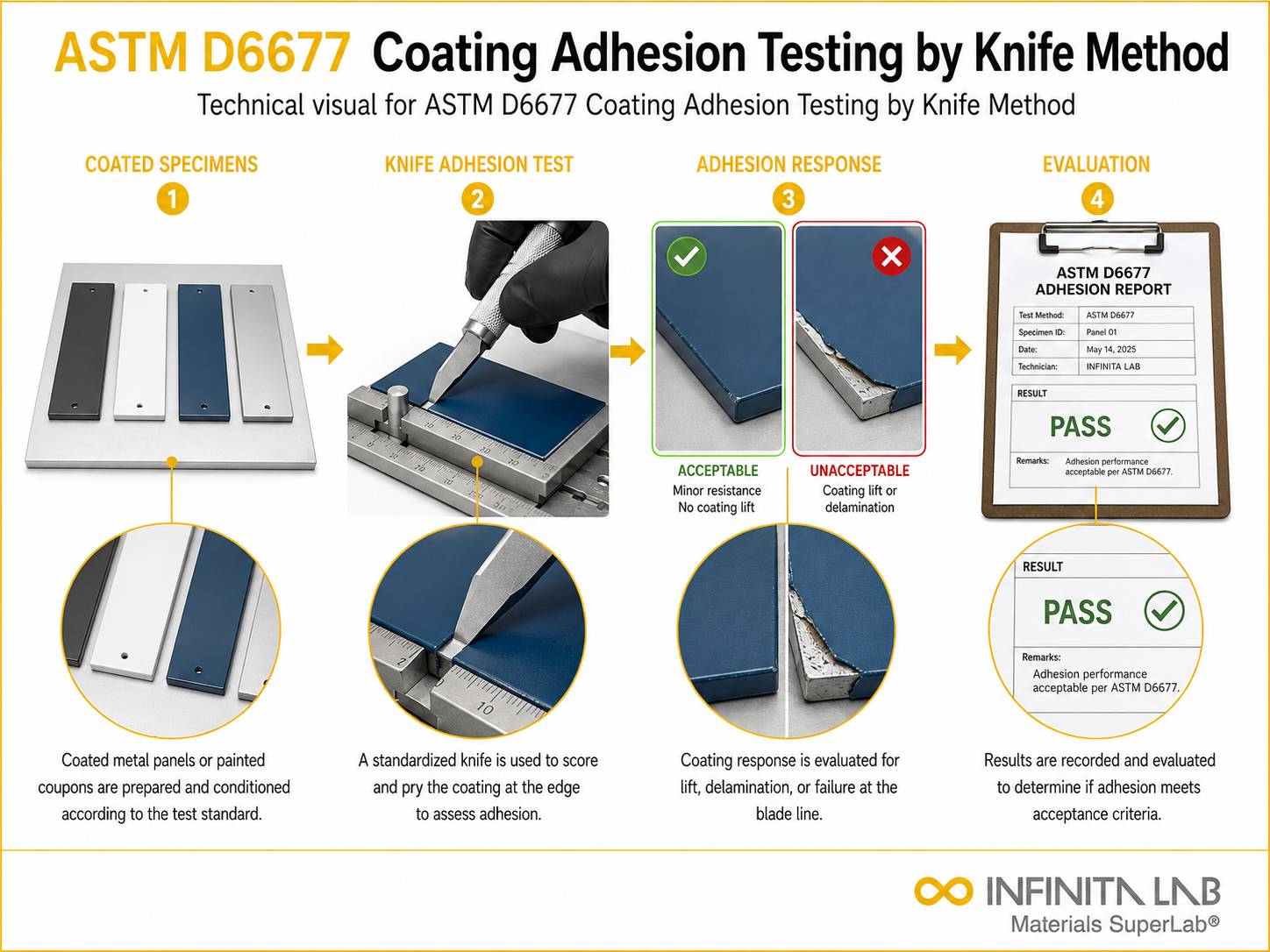
ASTM D6677 is a standardized test that employs a knife to determine the ability of a coating to adhere to a metal surface. The test determines the resistance of the coating to peeling as it is cut and pulled using a knife.
The test is widely applied in the automotive industry, aerospace industry, construction industry, and heavy machinery industry, where the adhesion of the coating to the metal surface is critical.

Applications and Benefits of ASTM D6677 Coating Adhesion Knife Testing
Scope
ASTM D6677 is a standard that applies to paints and coatings on metal surfaces and describes a test procedure using knife penetration to measure the ability of the coating to adhere. The test, carried out under controlled conditions, provides a qualitative indication of the susceptibility of the coating to lifting, peeling, or separation from the substrate.
What it measures:
– Adhesion strength by knife penetration
– Lifting or peeling resistance
– Overall bond integrity between coating and substrate
Purpose:
– Provides a qualitative measure of coating adhesion under controlled cutting conditions
Applications
- Aerospace coating systems
- Industrial equipment coatings
- Structural steel coatings
- Protective marine coatings
- Architectural metal finishes
- Quality control of painted components
- Research and development of coating formulations
Benefits
- Simple and quick adhesion evaluation
- Cost-effective testing method
- Minimal equipment requirement
- Provides immediate qualitative results
- Helps detect poor surface preparation
- Supports coating durability assessment
- Ensures compliance with industry standards
- Improves product reliability and performance
Our ASTM D6677 Testing Procedure
Specimen Preparation
Coating is applied to the metal substrate and allowed to dry or cure according to manufacturer specifications.
1Knife Incision
Two cuts are made through the coating at 30–45° angles using a sharp knife, penetrating fully to the substrate.
2Adhesion Evaluation
Standardized pressure and angle are applied to attempt lifting the coating from the substrate.
3Visual Assessment
The ease of coating removal and surface condition are observed and rated.
4ASTM D6677 Test Parameters and Requirements
| Parameter | Details |
|---|---|
| Applicable Materials | Paints and coatings on metal substrates |
| Cut Angle | 30°–45° |
| Result Type | Qualitative rating scale |
| Adhesion Rating Scale | 0–5 (0 = complete failure, 5 = excellent adhesion) |
| Typical Test Area | Minimum ~10 cm² recommended |
| Output | Adhesion classification rating |


- Sharp standardized knife
- Angle guide (if required)
- Lighting for visual inspection
- Magnification device (optional)
- Specimen holding fixture
Equipment and Instrumentation Used for ASTM D6677 Testing
What You Receive: Test Report, Data, and Certification
- Adhesion rating (0 to 5 scale)
- Visual assessment report
- Surface condition documentation
- Failure mode description (adhesive or cohesive)
- Quality control records
- Comparative adhesion analysis
ASTM D6677 Coating Adhesion Knife FAQs
It is a qualitative test method used to evaluate adhesion of coatings to metal substrates by cutting the coating with a knife and assessing resistance to peeling.
Primarily used for organic coatings applied to metal substrates, especially thick or high build protective coating.
The test measures mixed-mode interlaminar fracture toughness, evaluating resistance to delamination when both opening mode (Mode I) and sliding mode (Mode II) loading are simultaneously applied.
Coating thickness, substrate preparation, curing conditions, and operator technique significantly influence results.
It is a subjective evaluation and operator dependence, absence of quantitative values for adhesion, inapplicability to thin films, destructive test, uncontrolled force of application, sensitivity to surface preparation, edge effects, and poor interlaboratory reproducibility.
Why Choose Infinita Lab for Coating Adhesion Knife Testing
At the core of this breadth is our network of 2,000+ accredited laboratories across the USA, offering access to over 10,000 testing methods and analytical services. From advanced materials characterization (SEM, TEM, RBS, XPS) to mechanical, chemical, environmental, biological, and standardized ASTM/ISO-compliant testing, we deliver unmatched flexibility, specialization, and scale. You are never limited by geography, facility, or methodology — Infinita Lab connects you to the right expertise and testing solution, every time.

Need ASTM D6677 Coating Adhesion Knife Testing You Can Rely On?
Send query us at hello@infinitalab.com or call us at (888) 878-3090 to learn more about our services and how we can support you.



Request a Quote
Submit your material details and receive testing procedures, pricing, and turnaround time within 24 hours.
 Quick Turnaround and Hasslefree process
 Confidentiality Guarantee
 Free, No-obligation Consultation
 100% Customer Satisfaction
