


Thermomechanical Analysis (TMA)
In materials science, a method called thermomechanical analysis (TMA) is used to examine how a material's mechanical and thermal characteristics change with temperature. TMA measures the changes in the dimensions of a sample as it is heated or cooled while applying a constant force, which allows researchers to determine the coefficient of thermal expansion (CTE) and the glass transition temperature (Tg) of a material.
TRUSTED BY


Thermomechanical Analysis (TMA)
- Overview
- Scope, Applications, and Benefits
- Test Process
- Specifications
- Instrumentation
- Results and Deliverables
Thermomechanical Analysis (TMA) Overview
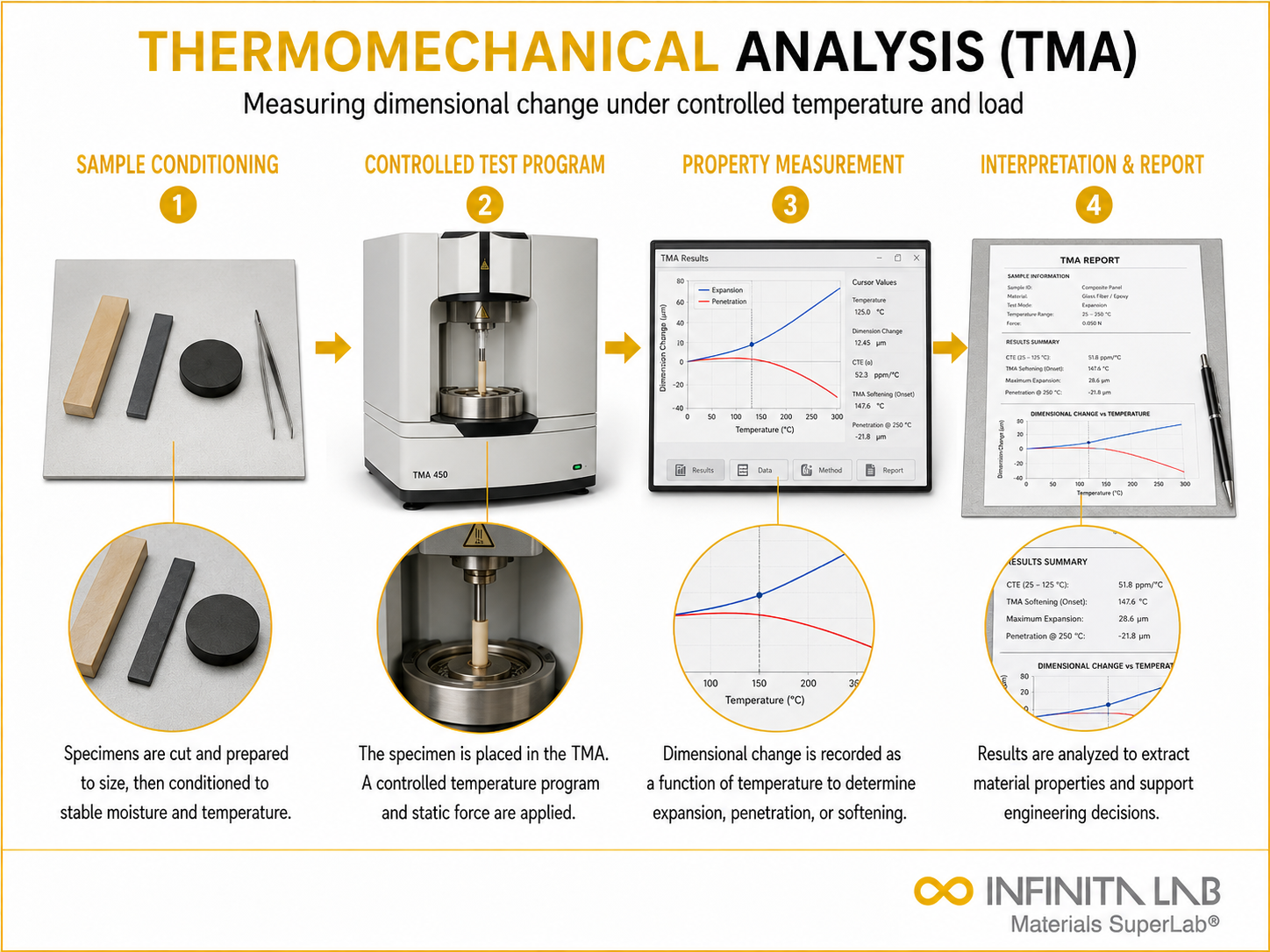
Thermomechanical analysis (TMA) measures the dimensional response of a material to a controlled temperature program. A probe rests on or penetrates the specimen surface under a defined load while the temperature is ramped at a controlled rate. The instrument records probe displacement as a function of temperature, producing a curve that reflects expansion, contraction, softening, glass transition, and phase transitions directly as dimensional changes rather than as heat flow signals. This makes TMA the preferred technique when the quantity of direct engineering interest is how much a material grows, shrinks, or deforms across a temperature range.
The primary measurement is the coefficient of thermal expansion (CTE), derived from the slope of the expansion-temperature curve in the linear region below any transition. For isotropic materials, a single measurement in one direction is sufficient. For anisotropic materials such as fiber-reinforced composites, laminates, and extruded profiles, CTE differs significantly between directions, and TMA measurements along multiple axes are required. The glass transition temperature (Tg) appears in TMA data as a change in slope of the expansion curve – above Tg, the coefficient of expansion increases sharply as the polymer transitions from glassy to rubbery behavior.
TMA is applied across polymers, composites, ceramics, glasses, thin films, adhesives, and electronic packaging materials. In electronics, CTE mismatch between solder, substrate, die, and encapsulant drives thermomechanical fatigue in solder joints and is a primary reliability concern. In structural composites, knowing the CTE in-plane versus through-thickness allows designers to predict thermally induced warpage and residual stress buildup during processing and service. TMA data feeds directly into finite element thermal stress models and is a required input for many material qualification programs.

Thermomechanical Analysis (TMA) Scope, Applications, and Benefits
Scope
TMA applies to solid materials that can be prepared as flat or cylindrical specimens of sufficient dimensional stability to support the probe contact. The technique covers a broad temperature range, typically from -150 degrees Celsius to over 1000 degrees Celsius depending on instrument configuration and specimen type. Key evaluation areas include:
- Coefficient of thermal expansion (CTE) in linear and volumetric measurement modes
- Glass transition temperature (Tg) from slope change in expansion curve
- Softening temperature and penetration onset in polymers and adhesives
- Dimensional stability during thermal cycling between defined temperature limits
- Anisotropic CTE in multiple specimen orientations for composites and laminates
- Shrinkage or expansion during cure, crystallization, or phase transformation
Applications
- Electronic substrate and printed circuit board CTE characterization
- Polymer and adhesive Tg and softening point determination
- Composite laminate CTE measurement in fiber and transverse directions
- Solder joint reliability analysis through CTE mismatch quantification
- Ceramic and glass dimensional stability characterization at elevated temperature
- Thin film and coating expansion behavior on dissimilar substrates
Benefits
- Direct dimensional measurement rather than indirect thermal signal detection
- Simultaneous measurement of CTE and Tg from a single temperature ramp
- Multiple probe modes (expansion, penetration, tension, flexure) cover a broad range of material behaviors
- High sensitivity to small dimensional changes across a wide temperature range
- Data directly usable in finite element thermal stress and warpage models
- Applicable to small specimens from production parts without destructive sectioning
Thermomechanical Analysis (TMA) Process
Specimen Preparation
Specimens are cut or machined to the required dimensions for the probe mode selected.
1Instrument Setup and Calibration
The TMA instrument is calibrated using reference standards of known CTE.
2Thermal Ramp and Data Acquisition
The specimen is loaded into the furnace under the specified probe force and the temperature is ramped at the defined rate.
3Data Analysis and Reporting
CTE is calculated from the slope of the linear expansion region.
4Thermomechanical Analysis (TMA) Technical Specifications
| Parameter | Details |
|---|---|
| Technique | Thermomechanical analysis |
| Measurement Mode | Expansion, penetration, tension, or flexure depending on specimen type |
| Temperature Range | -150 degrees Celsius to +1000 degrees Celsius (instrument and specimen dependent) |
| Typical Ramp Rate | 1 to 10 degrees Celsius per minute |
| Applicable Materials | Polymers, composites, ceramics, glasses, adhesives, metals, thin films |
| Primary Outputs | CTE (ppm/degrees C), Tg (degrees C), softening temperature, dimensional change vs. temperature |


- Thermomechanical analyzer with programmable temperature furnace
- Interchangeable probe heads (expansion, penetration, tension, three-point bend)
- Linear variable differential transformer (LVDT) or equivalent displacement sensor
- Gas purge system for inert or oxidizing atmosphere control
- Certified reference standards for CTE and temperature calibration
- Data analysis software with CTE and Tg calculation routines
Instrumentation Used for Thermomechanical Analysis (TMA)
Thermomechanical Analysis (TMA) Results and Deliverables
- Coefficient of thermal expansion (ppm/degrees C) over specified temperature ranges
- Glass transition temperature (Tg) from slope intersection method
- Softening or penetration onset temperature where applicable
- Dimensional change vs. temperature curve with annotated transitions
- CTE values in multiple orientations for anisotropic specimens
- Quality assurance documentation
Frequently Asked Question
TMA measures dimensional changes in a material as a function of temperature or time. It is commonly used to determine the coefficient of thermal expansion (CTE), softening point, glass transition, and shrinkage behavior.
TMA is suitable for polymers, composites, ceramics, metals, thin films, adhesives, and electronic materials where thermal expansion or dimensional stability is critical.
While DSC measures heat flow associated with thermal transitions, TMA measures the physical expansion, contraction, or deformation of a material under a controlled load during heating or cooling.
Yes. TMA applies a controlled force using a probe, allowing it to assess how materials deform, expand, or soften under conditions that simulate real-world mechanical loading.
Why Choose Infinita Lab for Advanced Materials Testing and Characterization?
At the core of this breadth is our network of 2,000+ accredited laboratories across the USA, offering access to over 10,000 testing methods and analytical services. From advanced materials characterization (SEM, TEM, RBS, XPS) to mechanical, chemical, environmental, biological, and standardized ASTM/ISO-compliant testing, we deliver unmatched flexibility, specialization, and scale. You are never limited by geography, facility, or methodology — Infinita Lab connects you to the right expertise and testing solution, every time.

Looking for a Trusted Partner for Accurate and Reliable Testing Services?
Send query us at hello@infinitalab.com or call us at (888) 878-3090 to learn more about our services and how we can support you.



Request a Quote
Submit your material details and receive testing procedures, pricing, and turnaround time within 24 hours.
 Quick Turnaround and Hasslefree process
 Confidentiality Guarantee
 Free, No-obligation Consultation
 100% Customer Satisfaction
