


ASTM C1525 Thermal Shock Resistance Testing for Advanced Ceramics by Water Quenching
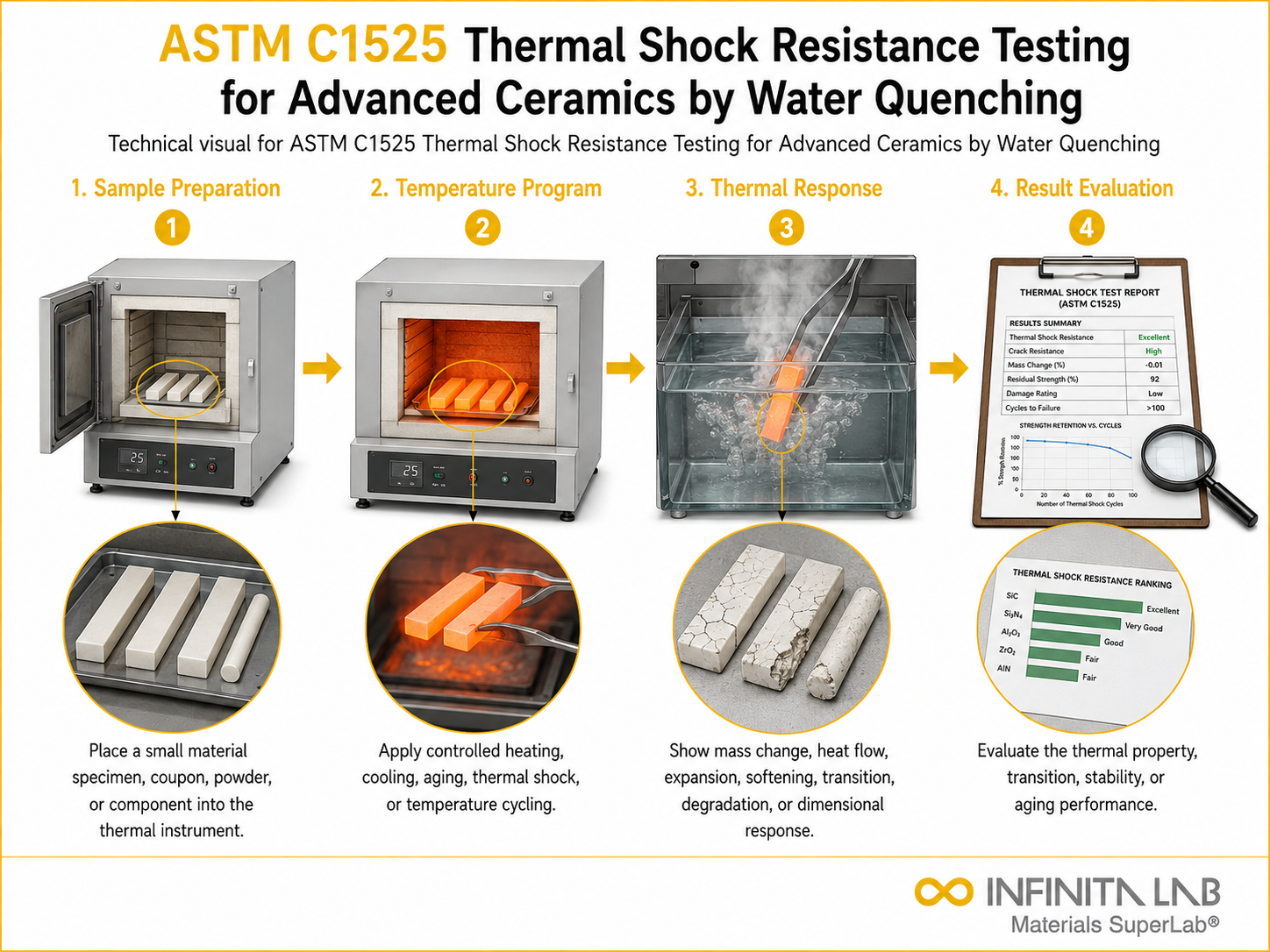
ASTM C1525-18 test method is used to determine Thermal Shock Resistance of Advanced Ceramics by Water Quenching. Thermal shock resistance refers to the material's ability to withstand extreme and rapid changes in temperature.
TRUSTED BY


Precision-driven testing for dimensional accuracy and compliance
- Overview
- Scope, Applications, and Benefits
- Test Process
- Specifications
- Instrumentation
- Results and Deliverables
Overview
ASTM C1525-18 defines a standardized method to evaluate the thermal shock resistance of advanced ceramics using rapid water quenching. It measures the ability of materials to withstand sudden temperature changes without cracking or losing mechanical integrity, which is critical for high-temperature applications.
This test simulates real-world conditions where ceramics experience rapid cooling, such as in engines or thermal systems. By assessing retained strength after quenching, ASTM C1525-18 helps determine material durability, reliability, and suitability for environments involving severe thermal gradients.

Scope, Applications, and Benefits
Scope
ASTM C1525-18 specifies procedures for evaluating thermal shock resistance by heating ceramic specimens and rapidly cooling them in water to assess strength degradation.
- Applicable to monolithic advanced ceramics
- Evaluates resistance to rapid temperature changes
- Uses water quenching as a controlled cooling method
- Measures retained mechanical strength after shock
- Defines specimen preparation and heating conditions
- Supports material comparison and performance evaluation
Applications
- Aerospace and turbine components
- Thermal barrier and insulation systems
- Engine and exhaust components
- High-temperature industrial ceramics
- Energy and power generation systems
- Research and development of ceramic materials
Benefits
- Determines resistance to thermal shock damage
- Helps prevent sudden material failure
- Supports material selection for extreme conditions
- Improves product reliability and durability
- Provides standardized and repeatable testing
- Assists in quality control and performance validation
Test Process
Specimen Preparation
Prepare ceramic specimens with specified dimensions and surface finish.
1Heating Stage
Heat specimens to a predetermined high temperature under controlled conditions.
2Water Quenching
Rapidly immerse heated specimens into water to induce thermal shock.
3Strength Evaluation
Measure retained strength or inspect for damage after quenching.
4Technical Specifications
| Parameter | Details |
|---|---|
| Material Type | Monolithic advanced ceramics |
| Temperature Range | Elevated heating temperature as specified |
| Cooling Medium | Water for rapid quenching |
| Specimen Geometry | Standardized shapes and dimensions |
| Measurement Parameter | Retained strength after quenching |
| Heating Control | Uniform and controlled temperature exposure |
| Failure Evaluation | Crack formation or strength reduction |
| Output Result | Thermal shock resistance performance |


Instrumentation Used for Testing
- High-temperature furnace
- Water quenching tank
- Universal testing machine (UTM)
- Temperature measurement devices (thermocouples)
- Specimen handling tools
- Data acquisition system
Results and Deliverables
- Retained strength values after quenching
- Thermal shock resistance assessment
- Crack and damage analysis
- Temperature vs performance data
- Comparative material evaluation
- Detailed test report with observations
Thermal shock resistance is the ability of a material to resist damage when exposed to rapid temperature changes. It is a critical property for ceramics used in high-temperature and fluctuating thermal environments.
Fused silica (synthetic quartz or silicon oxide, SiO2), cordierite, and silicon nitrides (Si3N4) have very low thermal expansion coefficients, making them relatively resistant to thermal shock
Aluminum Nitride (AlN) provides the highest thermal conductivity, but the level depends on the grade. Precision Ceramics PCAN 3000 is the highest with 230 W/M/K. The industry standard tends to be 170-180 W/M/K, with lesser grades down to 150 W/M/K.
Thermal shock exposes devices to rapid temperature changes that are more significant than 15°C/minute. Temperature cycle testing uses a transition rate of less than 15°C/minute and is usually between 1 to 10°C/minute, from our experience.
To maintain the mechanical properties associated with a crystalline structure or phase distribution that slow cooling would lose, one usually quenches a metal object by rapidly cooling it, such as by immersing it in oil or water, from the high temperature at which it was shaped.
Why Choose Infinita Lab for Advanced Materials Testing and Characterization?
At the core of this breadth is our network of 2,000+ accredited laboratories across the USA, offering access to over 10,000 testing methods and analytical services. From advanced materials characterization (SEM, TEM, RBS, XPS) to mechanical, chemical, environmental, biological, and standardized ASTM/ISO-compliant testing, we deliver unmatched flexibility, specialization, and scale. You are never limited by geography, facility, or methodology — Infinita Lab connects you to the right expertise and testing solution, every time.

Looking for a Trusted Partner for Accurate and Reliable Testing Services?
Send query us at hello@infinitalab.com or call us at (888) 878-3090 to learn more about our services and how we can support you.



Request a Quote
Submit your material details and receive testing procedures, pricing, and turnaround time within 24 hours.
 Quick Turnaround and Hasslefree process
 Confidentiality Guarantee
 Free, No-obligation Consultation
 100% Customer Satisfaction
