


ASTM C1607: Ceramicware Microwave Suitability Testing Services
ASTM C1607 estimates the fracture toughness of ceramic glassware to determine their suitability for use in microwaves. Critical mechanical properties like hardness, toughness, and elastic modulus can be measured very precisely by this method. The ceramic glassware is also assessed for thermal shock resistance.
TRUSTED BY


Get ASTM C1607 compliant results — request your ceramicware microwave suitability testing quote
- Overview
- Scope, Applications, and Benefits
- Test Process
- Specifications
- Instrumentation
- Results and Deliverables
What Is ASTM C1607 Ceramicware Microwave Suitability?
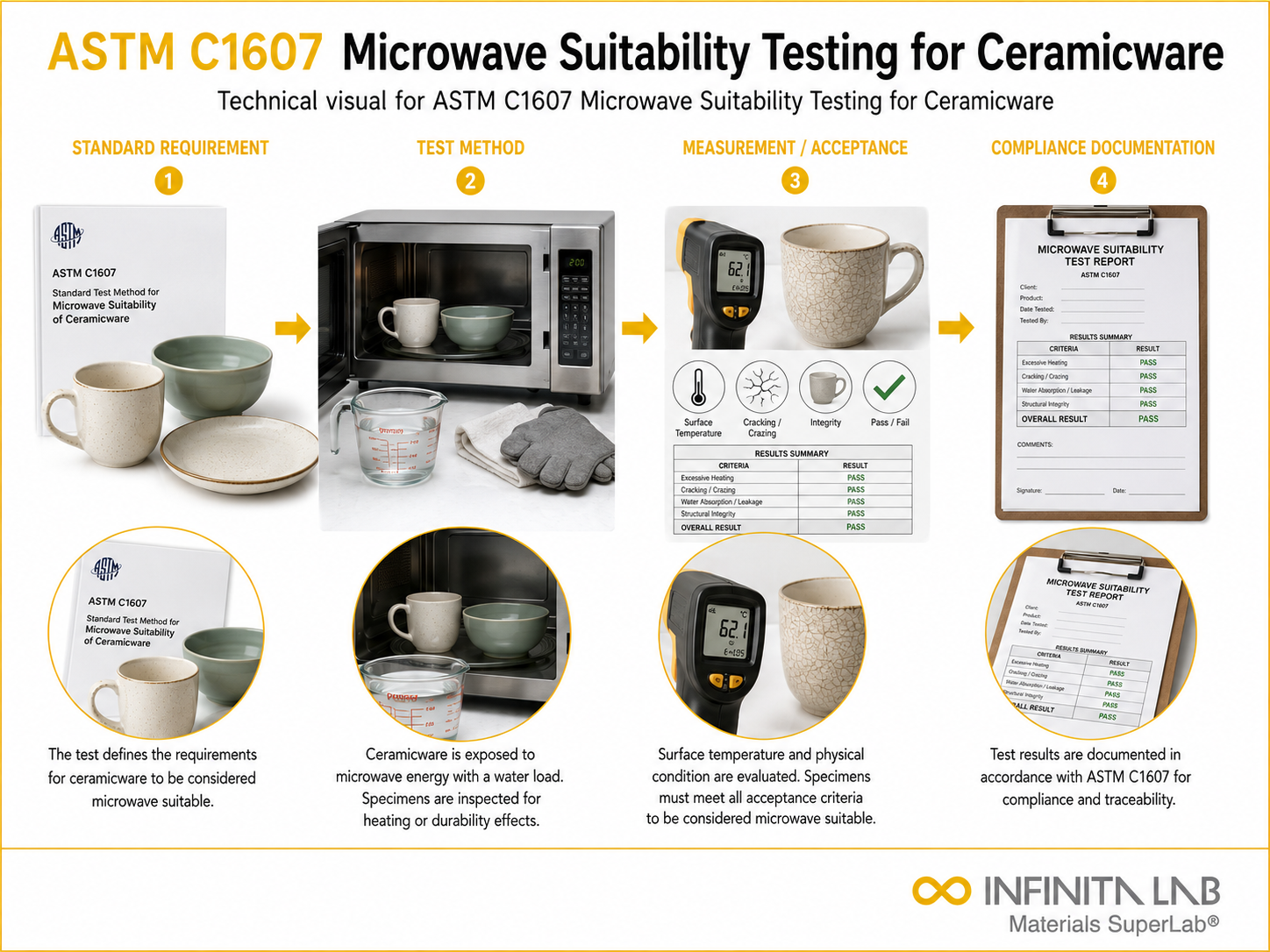
ASTM C1607 defines a standardized method to evaluate the suitability of ceramicware for microwave use by assessing its thermal response during microwave exposure. It determines whether ceramic items heat excessively, which could pose safety risks or indicate poor material performance.
This test is essential for ensuring consumer safety and product reliability, as uneven or excessive heating can lead to burns or material damage. ASTM C1607 helps manufacturers verify microwave compatibility, improve product design, and ensure compliance with safety expectations for household ceramicware.

Applications and Benefits of ASTM C1607 Ceramicware Microwave Suitability Testing
Scope
ASTM C1607 outlines procedures for evaluating ceramicware performance under microwave heating conditions, focusing on temperature rise and safety during use.
- Applicable to ceramic plates, bowls, mugs, and similar items
- Evaluates temperature rise during microwave exposure
- Assesses suitability for repeated microwave use
- Includes standardized heating conditions and duration
- Ensures safe handling and performance criteria
- Supports product quality and compliance verification
Applications
- Household ceramicware such as plates and bowls
- Microwave-safe product validation
- Consumer safety testing
- Quality control in ceramic manufacturing
- Product design and development
- Retail and compliance testing
Benefits
- Ensures safe use of ceramicware in microwaves
- Identifies products that overheat during use
- Enhances consumer safety and confidence
- Supports compliance with safety standards
- Improves product quality and design
- Provides standardized and repeatable testing
Our ASTM C1607 Testing Procedure
Sample Preparation
Clean and condition ceramicware to ensure it is free from contaminants.
1Microwave Exposure
Place the sample in a microwave oven and heat under specified conditions.
2Temperature Measurement
Measure the temperature rise of the ceramicware immediately after heating.
3Suitability Assessment
Evaluate results against criteria to determine microwave safety.
4ASTM C1607 Test Parameters and Requirements
| Parameter | Details |
|---|---|
| Material Type | Ceramicware (plates, bowls, mugs) |
| Heating Medium | Microwave radiation |
| Measurement Parameter | Surface temperature rise |
| Test Duration | Specified heating time |
| Sample Condition | Clean and dry before testing |
| Evaluation Criteria | Acceptable temperature limits |
| Test Environment | Standard microwave conditions |
| Output Result | Microwave suitability classification |


- Microwave oven (standardized)
- Infrared thermometer or thermocouples
- Timer
- Heat-resistant gloves
- Data recording system
- Sample handling tools
Equipment and Instrumentation Used for ASTM C1607 Testing
What You Receive: Test Report, Data, and Certification
- Temperature rise data of ceramicware
- Microwave suitability assessment (safe/unsafe)
- Identification of overheating issues
- Product performance evaluation
- Compliance verification with safety criteria
- Detailed test report with observations
ASTM C1607 Ceramicware Microwave Suitability FAQs
ASTM C1607 is used to evaluate whether ceramicware is safe for microwave use by measuring temperature rise during heating. It ensures that products do not overheat and remain safe for handling and regular use in microwave ovens.
Microwave suitability testing is important because some ceramic materials can absorb microwave energy and become excessively hot. This can cause burns, damage the product, or create unsafe conditions for users during normal kitchen use.
If the ceramicware shows excessive temperature rise compared to acceptable limits, it may be considered unsafe. Overheating indicates that the material absorbs too much microwave energy.
Glaze composition can affect microwave absorption. Certain glazes may contain materials that heat up more, influencing the overall temperature rise of the ceramicware.
It ensures that ceramicware does not become dangerously hot during microwave use, reducing the risk of burns and accidents in everyday use.
Why Choose Infinita Lab for Ceramicware Microwave Suitability Testing?
At the core of this breadth is our network of 2,000+ accredited laboratories across the USA, offering access to over 10,000 testing methods and analytical services. From advanced materials characterization (SEM, TEM, RBS, XPS) to mechanical, chemical, environmental, biological, and standardized ASTM/ISO-compliant testing, we deliver unmatched flexibility, specialization, and scale. You are never limited by geography, facility, or methodology — Infinita Lab connects you to the right expertise and testing solution, every time.

Need ASTM C1607 Ceramicware Microwave Suitability Testing You Can Rely On?
Send query us at hello@infinitalab.com or call us at (888) 878-3090 to learn more about our services and how we can support you.



Request a Quote
Submit your material details and receive testing procedures, pricing, and turnaround time within 24 hours.
 Quick Turnaround and Hasslefree process
 Confidentiality Guarantee
 Free, No-obligation Consultation
 100% Customer Satisfaction
