


Ferrite Content Measurement Testing Services
A ferrite-scope test is a non-destructive method to measure the ferrite content in stainless steel welds and duplex steel. This test uses digital technology to determine the ferrite value and can help to prevent steel failure or damage. Reports are generated to meet technical specifications and customer requirements. The ferrite number (FN) or ferrite percentage (%) is used to determine the success of the test.
TRUSTED BY


Get compliant results — request your ferrite content measurement testing quote
- Overview
- Scope, Applications, and Benefits
- Test Process
- Specifications
- Instrumentation
- Results and Deliverables
What Is Ferrite Content Measurement?
Ferrite content measurement is a non-destructive test used to quantify the amount of ferrite phase present in austenitic and duplex stainless steel welds and castings. Ferrite in these materials is not a defect -in the right amount, it plays an important role in preventing hot cracking during welding and improving resistance to stress corrosion cracking in service. Too little ferrite and the weld is susceptible to solidification cracking. Too much, and the material becomes brittle at elevated temperatures through sigma phase formation or embrittlement at 885-degree F. Getting the ferrite level into the specified range is a real engineering requirement with real consequences on both ends.
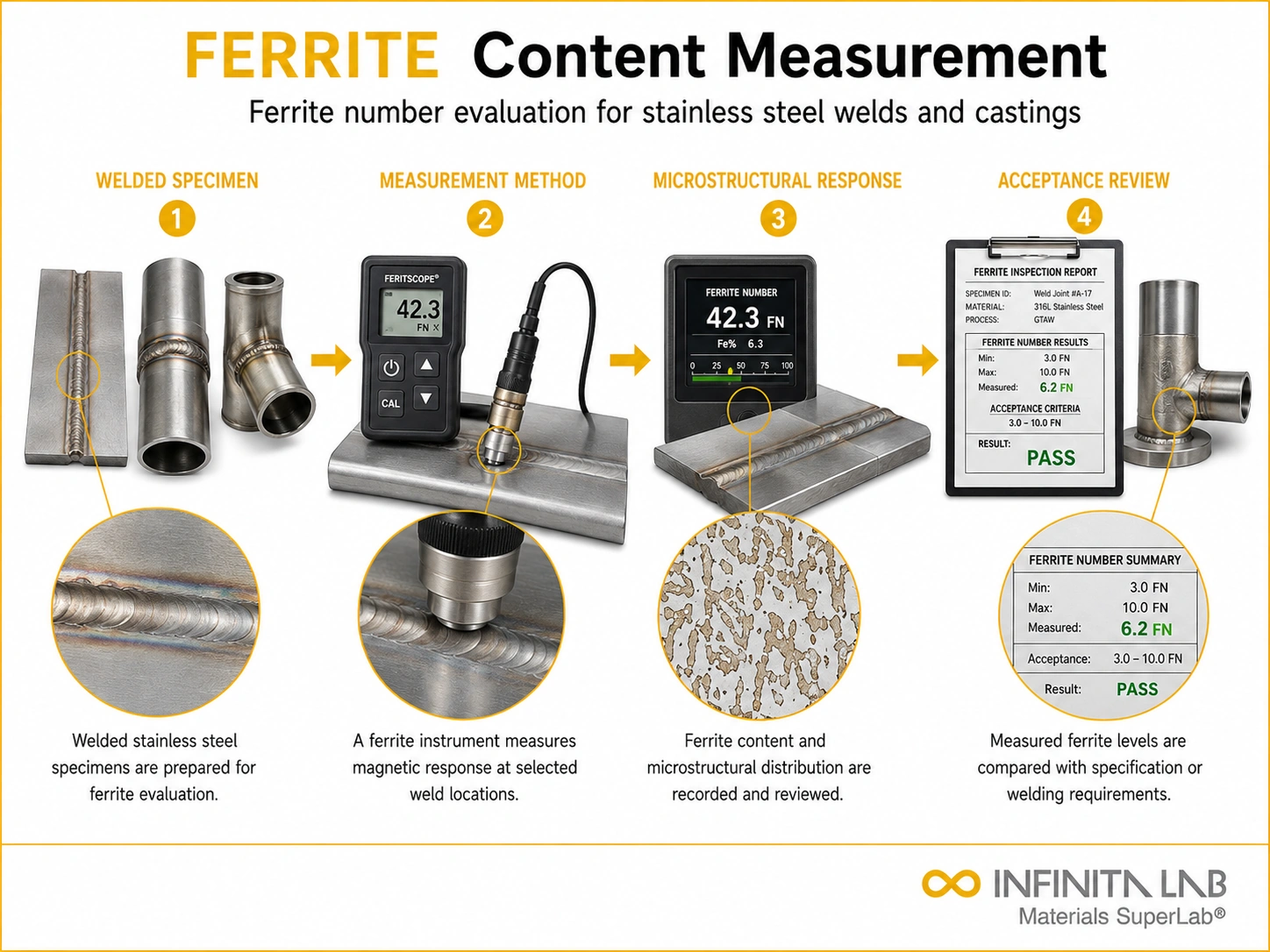
Measurement is performed using a ferritescope -a digital instrument that works on the magnetic induction principle. Because ferrite is ferromagnetic and the austenite matrix is not, the instrument can quantify the ferrite content based on the material’s magnetic response to the probe. Results are reported in two units: Ferrite Number (FN), the industry-standard unit defined by AWS A4.2 and referenced by most weld procedure specifications and codes, and ferrite percent (%), which approximates FN at lower ferrite levels but diverges at higher values. The distinction matters for high-ferrite duplex grades.
The governing standards for this measurement are AWS A4.2 for instrument calibration using primary and secondary standards, and ASTM A800/A800M for castings. ISO 8249 is the international equivalent for welds. For duplex stainless steels, ASTM E562 point-counting metallography or image analysis is sometimes used as a complementary or reference method when precise phase-fraction determination is required.

Applications and Benefits of Ferrite Content Measurement Testing
Scope
Ferrite content measurement applies to austenitic stainless steel welds, duplex stainless steel welds, base metal, and stainless steel castings where ferrite phase content is a specified requirement. Measurement is performed using the magnetic induction method with a calibrated ferritescope per AWS A4.2 calibration procedure, with primary reference standards. Results are reported as Ferrite Number (FN) and, where required, as ferrite percent. For duplex stainless steels with high ferrite levels (typically 40 to 60 percent), metallographic image analysis or point counting per ASTM E562 provides a more accurate determination of the ferrite fraction than the magnetic method alone. Testing can be performed on weld coupons, production welds, pipe and vessel components, and cast products. Relevant standards include AWS A4.2, ASTM A800/A800M, ISO 8249, ASTM E562, and WRC-1992 diagram calculations for weld metal ferrite prediction from composition.
Applications
- Weld procedure qualification (WPS/PQR) ferrite verification per ASME, AWS, and project specifications
- Production weld inspection for austenitic stainless steel piping, vessels, and structural welds
- Duplex stainless steel weld and heat-affected zone ferrite balance verification
- Stainless steel casting ferrite content determination per ASTM A800/A800M
- Incoming material verification for stainless steel weld wire, rod, and filler metal lots
- Cryogenic service weld qualification where ferrite limits are specified to avoid toughness issues
- Corrosive service weld qualification for oil, gas, and chemical process applications
- Failure investigation support where ferrite content is suspected as a contributing factor
Benefits
- Non-destructive measurement -no material removal or preparation required for field or in-process testing
- Fast and repeatable -multiple readings per location provide statistical confidence in the result.
- Portable instruments allow measurements directly on production welds or in-service components.
- Calibrated per AWS A4.2 using primary standards traceable to the Welding Research Council reference collection
- Covers both FN and ferrite percent outputs to meet different specification requirements
- Applicable to austenitic and duplex grades across the full range of typical service ferrite levels
- Metallographic image analysis option available for high-ferrite duplex grades, where magnetic method accuracy is limited
Our Testing Procedure
Instrument Calibration
The ferritescope is calibrated using primary reference standards traceable to the Welding Research Council (WRC)
1Surface Preparation and Probe Positioning
The measurement surface is cleaned of scale, spatter, paint, or coatings that could affect the magnetic response.
2Measurement and Data Collection
Multiple readings are taken at each specified location to account for local variation in ferrite distribution.
3Reporting and Interpretation
Ferrite Number (FN) and ferrite percent are reported for each measurement location.
4Test parameters and requirements
| Parameter | Details |
|---|---|
| Measurement Method | Magnetic induction (ferritescope) per AWS A4.2 |
| Calibration Standard | AWS A4.2 using primary WRC reference standards and secondary calibration blocks |
| Applicable Materials | Austenitic stainless steel welds, duplex stainless steel welds, and base metal, stainless steel castings |
| Output Units | Ferrite Number (FN) and ferrite percent (%) |
| Related Standards | AWS A4.2, ASTM A800/A800M, ISO 8249, ASTM E562 (metallographic image analysis) |
| Complementary Method | ASTM E562 point counting or image analysis for high-ferrite duplex grades |


- Calibrated digital ferritescope (magnetic induction type)
- Primary WRC reference standards for AWS A4.2 calibration
- Secondary calibration reference blocks for pre- and post-session verification
- Surface preparation tools (wire brush, grinding disc) for scale and coating removal, where needed
- Optical metallurgical microscope with image analysis software for ASTM E562 point counting
- Metallographic preparation equipment (mounting, grinding, polishing, etching) for image analysis specimens
Equipment and Instrumentation Used for Testing
What You Receive: Test Report, Data, and Certification
- Ferrite Number (FN) at each measurement location with individual readings and averages
- Ferrite percent (%) where required by the specification
- Measurement location map or description identifying where each reading was taken
- Comparison of results against specified minimum and maximum ferrite limits
- Calibration records showing instrument verification before and after the measurement session
- Metallographic image analysis results (ferrite area percent) for duplex grades where applicable
- Material identification, weld procedure reference, and heat or lot number for full traceability
- Test report formatted for weld procedure qualification records, production inspection records, or material certification
Ferrite Content Measurement FAQs
Ferrite content directly affects mechanical strength, corrosion resistance, and weldability. Monitoring it ensures the material maintains the required balance between austenite and ferrite phases for safe performance.
It is widely used in chemical processing, oil & gas, power generation, and marine industries where stainless steel welds must meet strict safety and corrosion resistance standards.
Ferrite content is commonly measured using magnetic induction instruments such as ferrite meters, or by metallographic analysis under controlled laboratory conditions.
Too much ferrite can reduce toughness and corrosion resistance, while too little ferrite can increase susceptibility to hot cracking during welding and reduce structural reliability.
Yes. Ferrite distribution can be non-uniform across weld zones due to cooling rate differences, filler material composition, and welding parameters, making localized measurement important.
Why Choose Infinita Lab for Ferrite Content Measurement Testing?
At the core of this breadth is our network of 2,000+ accredited laboratories across the USA, offering access to over 10,000 testing methods and analytical services. From advanced materials characterization (SEM, TEM, RBS, XPS) to mechanical, chemical, environmental, biological, and standardized ASTM/ISO-compliant testing, we deliver unmatched flexibility, specialization, and scale. You are never limited by geography, facility, or methodology — Infinita Lab connects you to the right expertise and testing solution, every time.

Looking for an Accredited Partner for Ferrite Content Measurement Testing?
Send query us at hello@infinitalab.com or call us at (888) 878-3090 to learn more about our services and how we can support you.



Request a Quote
Submit your material details and receive testing procedures, pricing, and turnaround time within 24 hours.
 Quick Turnaround and Hasslefree process
 Confidentiality Guarantee
 Free, No-obligation Consultation
 100% Customer Satisfaction
