


Dye Penetrant Testing (PT) Services for Surface Crack Detection
Surface-breaking faults are frequently found using dye penetrant inspection (DPI). Locating surface breaking faults including cracks, porosity, laps, seams, and other surface discontinuities is possible with the help of this non-destructive testing approach; it is also known as liquid penetrant inspection (LPI).
TRUSTED BY


Precision Testing Solutions for Accurate, Reliable, and Standards-Compliant Results
- Overview
- Scope, Applications, and Benefits
- Test Process
- Specifications
- Instrumentation
- Results and Deliverables
Liquid Dye Penetrant Testing Overview
Liquid Dye Penetrant Testing (LPT) is a widely used non-destructive testing method for detecting surface-breaking defects in non-porous materials. It works by applying a liquid penetrant that seeps into cracks or discontinuities, making them visible after excess penetrant removal and developer application.
This method is suitable for metals, plastics, ceramics, and other non-porous materials. It is highly sensitive to fine surface defects such as cracks, porosity, and laps. LPT is commonly used in manufacturing, maintenance, and quality control to ensure structural integrity and product reliability without damaging the component.

Scope, Applications, and Benefits
Scope
Liquid Dye Penetrant Testing is applied to identify surface discontinuities in materials by utilizing capillary action to reveal defects that are not visible to the naked eye.
- Applicable to metals, plastics, ceramics, and non-porous materials
- Detects surface-breaking defects such as cracks, porosity, seams, and laps
- Suitable for complex shapes and large surface areas
- Works on ferrous and non-ferrous materials
- Requires clean, smooth, and non-porous surfaces
- Used in manufacturing, maintenance, and inspection processes
- Supports quality assurance and defect detection
- Applicable in aerospace, automotive, and heavy engineering industries
- Enables inspection without damaging the component
Applications
- Weld inspection for surface cracks
- Aerospace component inspection
- Automotive part quality control
- Casting and forging defect detection
- Maintenance and repair inspections
Benefits
- High sensitivity to small surface defects
- Simple and cost-effective method
- Applicable to a wide range of materials
- Non-destructive and easy to perform
- Suitable for complex geometries
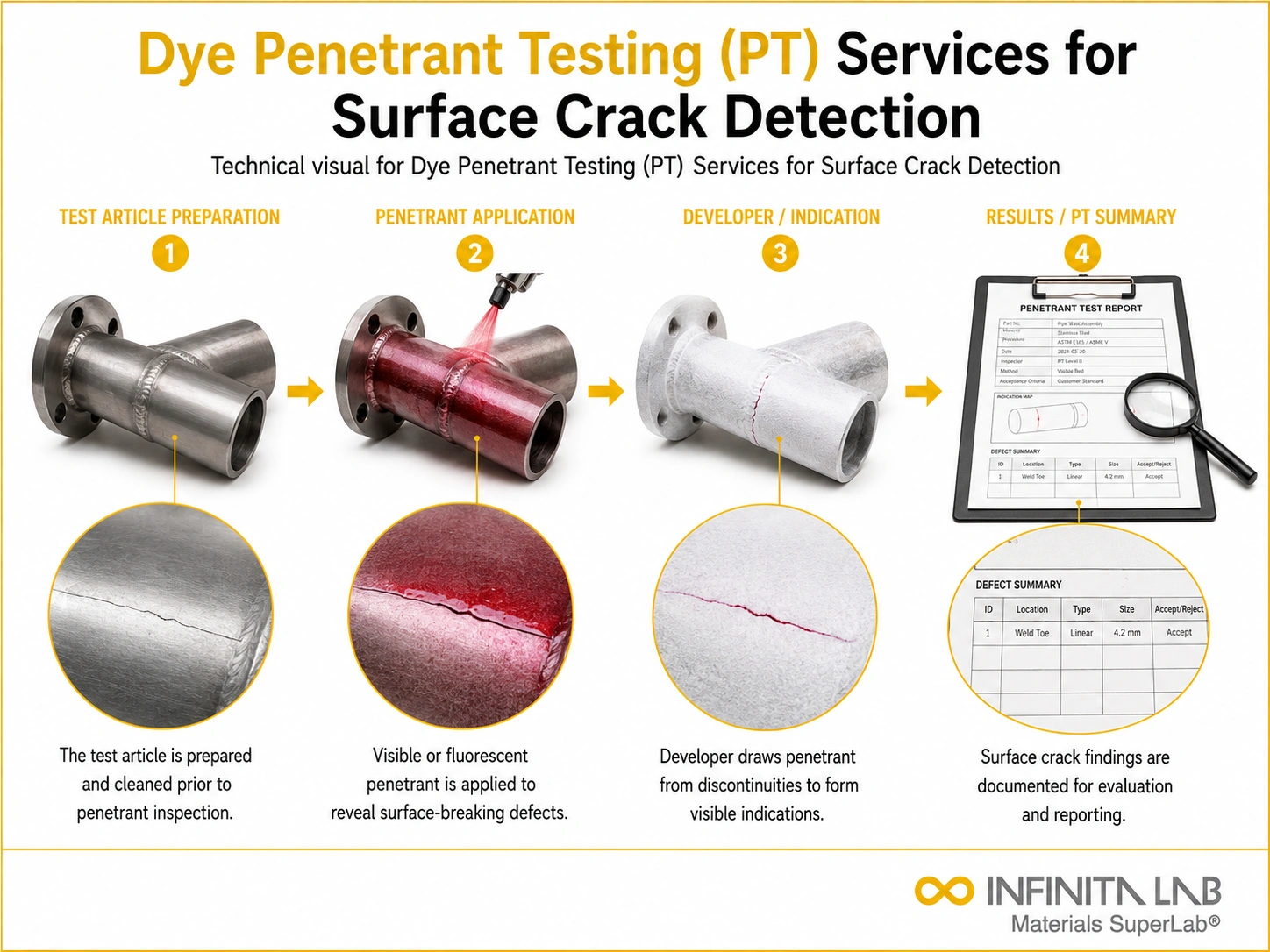
Liquid Dye Penetrant Testing-Test Process
Surface Cleaning
Sample surface is cleaned to remove contaminants and ensure proper penetrant action.
1Penetrant Application
Liquid dye penetrant is applied and allowed to seep into surface defects.
2Excess Removal & Developer
Excess penetrant is removed and developer is applied to draw out trapped dye.
3Inspection
Indications are visually inspected under appropriate lighting conditions.
4Liquid Dye Penetrant Testing- Technical Specifications
| Parameter | Details |
|---|---|
| Method | Capillary action-based surface defect detection |
| Measurement Type | Detection of surface-breaking discontinuities |
| Sample Type | Non-porous materials (metals, plastics, ceramics) |
| Loading Type | Application of liquid penetrant and developer |
| Units | Qualitative indication |
| Penetrant Type | Visible dye or fluorescent penetrant |


Instrumentation Used for Testing
- Dye penetrant (visible or fluorescent)
- Cleaner/remover solution
- Developer (dry, wet, or solvent-based)
- UV lamp (for fluorescent testing)
- Inspection booth or lighting setup
Results and Deliverables
- Visual indication of surface defects
- Defect location and type identification
- Inspection report with observations
- Pass/fail evaluation based on standards
- Photographic documentation
Frequently Asked Questions
Capillary action allows the liquid penetrant to enter narrow surface openings against gravity. The penetrant fills discontinuities such as micro-cracks, and during development, it is drawn back to the surface, making otherwise invisible defects clearly detectable.
Contaminants such as oil, dirt, or oxide layers can block penetrant entry into defects. Proper cleaning ensures open discontinuities, allowing accurate penetration and reliable detection of surface flaws.
Sensitivity depends on penetrant formulation, dwell time, developer type, and inspection conditions. Higher sensitivity systems detect finer defects but require stricter process control.
Fluorescent penetrants require UV light and offer higher sensitivity, while visible dyes are inspected under white light and are easier to use in field conditions.
Dwell time is the period during which penetrant remains on the surface to enter defects. Insufficient dwell time may result in incomplete penetration, reducing detection accuracy.
Why Choose Infinita Lab for Advanced Materials Testing and Characterization?
At the core of this breadth is our network of 2,000+ accredited laboratories across the USA, offering access to over 10,000 testing methods and analytical services. From advanced materials characterization (SEM, TEM, RBS, XPS) to mechanical, chemical, environmental, biological, and standardized ASTM/ISO-compliant testing, we deliver unmatched flexibility, specialization, and scale. You are never limited by geography, facility, or methodology — Infinita Lab connects you to the right expertise and testing solution, every time.

Looking for a Trusted Partner for Accurate and Reliable Testing Services?
Send query us at hello@infinitlab.com or call us at (888) 878-3090 to learn more about our services and how we can support you.



Request a Quote
Submit your material details and receive testing procedures, pricing, and turnaround time within 24 hours.
 Quick Turnaround and Hasslefree process
 Confidentiality Guarantee
 Free, No-obligation Consultation
 100% Customer Satisfaction
