


ASTM E647: Fatigue Crack Growth Rate Testing Services
The determination of fatigue crack growth rates from near-threshold to maximum controlled instability is covered by this test procedure. This test is essentially dependent on the magnitude of the fatigue crack growth rate that is measured during the procedure.
TRUSTED BY


Get ASTM E647 compliant results — request your fatigue crack growth rate testing quote
- Overview
- Scope, Applications, and Benefits
- Test Process
- Specifications
- Instrumentation
- Results and Deliverables
What Is ASTM E647 Fatigue Crack Growth Rate?
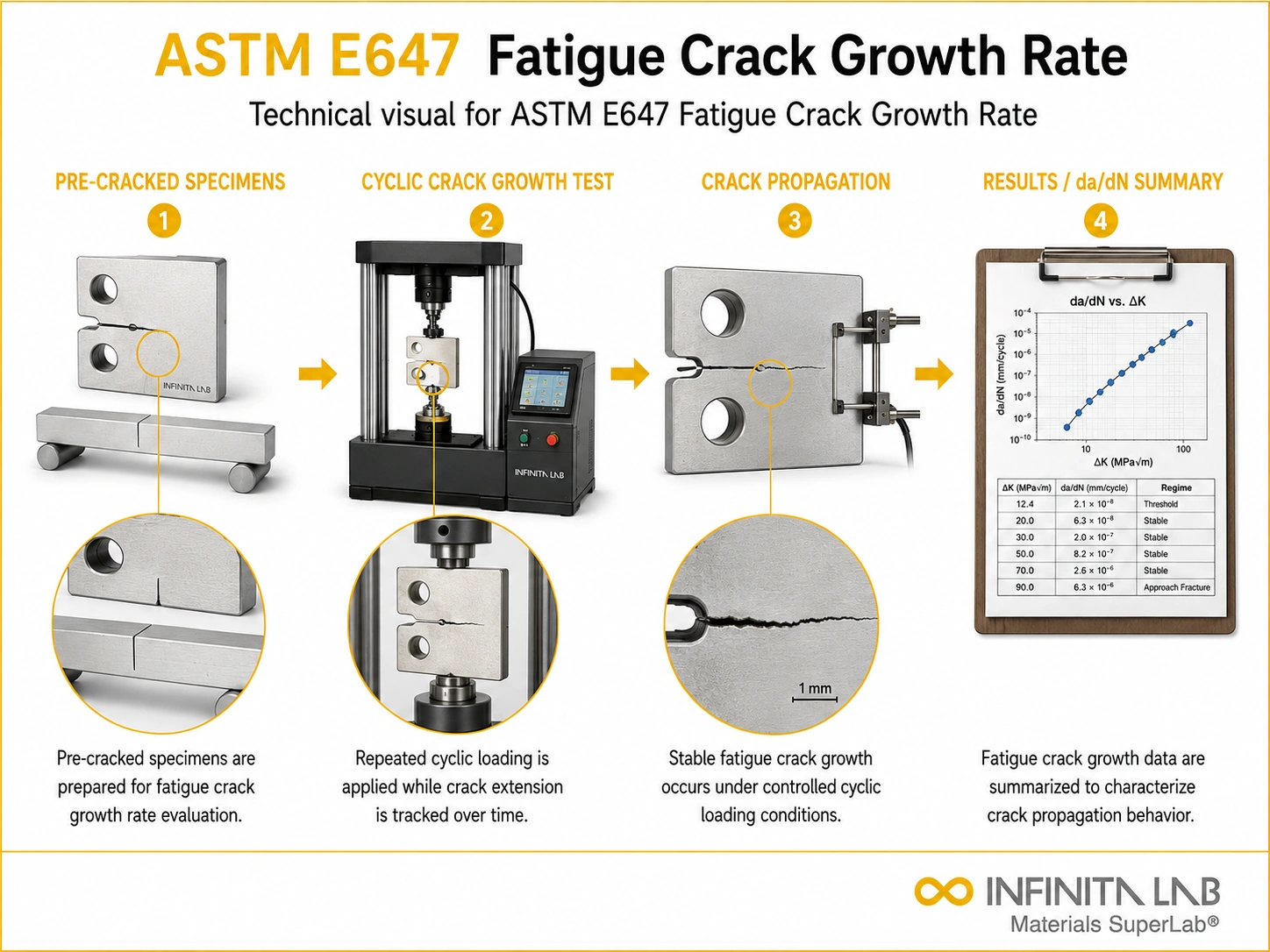
ASTM E647 is the standard test method for measuring fatigue crack growth rates in metallic materials. The result is a da/dN versus delta-K curve -crack growth rate in millimeters or inches per cycle plotted against the cyclic stress intensity factor range -and it is one of the most fundamental datasets in fracture mechanics. It tells you how fast a crack will grow under a given cyclic loading condition, which is the input you need to predict how long a component with a known or assumed flaw size will survive in service before that flaw grows to a critical dimension.
Testing is performed on pre-cracked specimens -most commonly compact tension (CT) or middle-tension (MT) specimens -loaded cyclically under stress-intensity control. Crack length is continuously monitored using either the compliance method, in which crack opening displacement is measured and related to crack length via calibration functions, or the electrical potential drop (EPD) method, in which crack length is inferred from changes in electrical resistance across the specimen. The stress intensity factor range is calculated from the applied load and current crack length at each measurement point, and da/dN is calculated from the rate of crack advance per cycle.
The standard covers the full da/dN versus delta-K curve from near-threshold behavior at the lower end, through the Paris regime linear midrange, up to rapid crack growth approaching fracture instability at the upper end. Near-threshold testing requires special load-shedding procedures to avoid crack closure effects, and the standard includes specific guidance on K-gradient and load-shedding protocols for that region.

Applications and Benefits of ASTM E647 Fatigue Crack Growth Rate Testing
Scope
ASTM E647 covers the determination of fatigue crack growth rates from near-threshold delta-K values up to Kmax-controlled instability in metallic materials. Specimen geometries covered include compact tension (CT), middle-tension (MT), and other geometries for which valid stress-intensity-factor solutions exist. Crack length measurement methods include elastic compliance (using clip-on or back-face strain gauge COD gauges) and electrical potential drop (DC or AC EPD). Load control is applied using sinusoidal or other defined waveforms at a specified load ratio R and frequency. Near-threshold testing is conducted using K-decreasing (load-shedding) procedures with a defined normalized K-gradient to avoid crack-closure artifacts. The standard addresses validity requirements for specimen thickness relative to plastic zone size and provides procedures for computing da/dN from crack length versus cycles data using the secant and incremental polynomial methods. Results are expressed in SI or inch-pound units.
Applications
- Damage tolerance assessment for aerospace structural components under FAA and EASA regulatory frameworks
- Fracture mechanics-based life prediction for rotating machinery, pressure vessels, and pipelines
- Material screening and selection based on crack growth resistance for structural applications
- Effect of environment on crack growth -testing in air, salt water, hydrogen, and other aggressive media
- Load ratio (R-ratio) effects on crack growth rate and near-threshold behavior
- Weld metal and heat-affected zone fatigue crack growth characterization
- Residual stress effect evaluation on crack growth rates through overload and underload testing
- Input data generation for commercial fracture mechanics software (NASGRO, AFGROW, FRANC3D)
- Nuclear pressure boundary and reactor internals fatigue crack growth evaluation
Benefits
- Provides quantitative da/dN versus delta-K data that feeds directly into fracture mechanics life calculations
- Covers the full crack growth curve from near-threshold to rapid growth in a single standard
- Two crack measurement methods -compliance and EPD -give flexibility based on specimen type and lab capability
- Near-threshold K-gradient procedures produce threshold values with controlled crack closure.
- Widely accepted by aerospace, nuclear, and pressure equipment regulators as the reference crack growth test method.
- Results applicable to damage-tolerant design, inspection interval setting, and retirement life decisions
- Can be combined with environmental chambers for corrosion fatigue crack growth testing
Our ASTM E647 Testing Procedure
Specimen Preparation and Pre-Cracking
CT or MT specimens are machined to the required dimensions with a machined notch at the crack starter location.
1Instrument Setup and Crack Measurement Calibration
The crack opening displacement (COD) gauge or EPD leads are attached to the specimen.
2Cyclic Loading and Crack Growth Data Acquisition
Cyclic loading is applied at the specified load range, load ratio R, frequency, and waveform.
3Data Reduction and Reporting
Crack length versus cycles data is reduced to da/dN versus delta-K using the secant or incremental polynomial method as specified.
4ASTM E647 Test Parameters and Requirements
| Parameter | Details |
|---|---|
| Standard | ASTM E647-23 |
| ASTM Committee | E08 – Fatigue and Fracture |
| Specimen Types | Compact tension (CT), middle-tension (MT), and other geometries with valid K solutions |
| Crack Measurement Methods | Elastic compliance (COD gauge, back-face strain gauge), electrical potential drop (DC or AC EPD) |
| Loading Modes | Load control, sinusoidal or other defined waveform, specified R ratio |
| Near-Threshold Method | K-decreasing (load shedding) with a defined normalized K-gradient |


- Servo-hydraulic fatigue testing machine with load and displacement control
- Calibrated load cell covering the specimen load range
- Clip-on or back-face strain gauge crack opening displacement (COD) gauge
- DC or AC electrical potential drop (EPD) system for crack length monitoring
- An optical microscope or a traveling microscope for crack length verification
- Data acquisition system for continuous recording of load, displacement, and crack length. An environmental chamber for elevated temperature or corrosive environment testing, where required
- Fracture mechanics software for da/dN data reduction and Paris law curve fitting
Equipment and Instrumentation Used for ASTM E647 Testing
What You Receive: Test Report, Data, and Certification
- da/dN versus delta-K curve covering the specified crack growth rate range
- Paris law constants C and m from linear regression fit to the midrange data
- Near-threshold delta-K value where applicable
- Kmax and the corresponding crack growth rate at the upper end of the test
- Crack length versus cycles raw data with all measurement points
- Load ratio R, specimen geometry, and K-solution used for stress intensity calculation
- Compliance or EPD calibration verification and crack length measurement details
- Full test report with all data, plots, and specimen identification formatted for fracture mechanics analysis, design, or material qualification use
ASTM E647 Fatigue Crack Growth Rate FAQs
ASTM E647 determines fatigue crack growth rate (da/dN) as a function of stress intensity factor range (ΔK). It is used to quantify how quickly cracks propagate under cyclic loading.
It helps predict remaining fatigue life and assess damage tolerance in structural materials. This is critical for aerospace, automotive, and pressure-containing components where crack propagation governs failure.
Common specimens include compact tension (CT) and single-edge notch bend (SENB) geometries. These are pre-cracked to ensure controlled and repeatable crack growth measurements.
Crack extension is typically tracked using compliance methods, optical measurement, or potential drop techniques. The crack length is correlated with load cycles to generate da/dN vs ΔK curves.
Material microstructure, load ratio (R-ratio), environment (corrosion, humidity), frequency, and residual stresses can significantly affect crack growth behavior and test outcomes.
Why Choose Infinita Lab for Fatigue Crack Growth Rate Testing
At the core of this breadth is our network of 2,000+ accredited laboratories across the USA, offering access to over 10,000 testing methods and analytical services. From advanced materials characterization (SEM, TEM, RBS, XPS) to mechanical, chemical, environmental, biological, and standardized ASTM/ISO-compliant testing, we deliver unmatched flexibility, specialization, and scale. You are never limited by geography, facility, or methodology — Infinita Lab connects you to the right expertise and testing solution, every time.

Need ASTM E647 Fatigue Crack Growth Rate Testing You Can Rely On?
Send query us at hello@infinitalab.com or call us at (888) 878-3090 to learn more about our services and how we can support you.



Request a Quote
Submit your material details and receive testing procedures, pricing, and turnaround time within 24 hours.
 Quick Turnaround and Hasslefree process
 Confidentiality Guarantee
 Free, No-obligation Consultation
 100% Customer Satisfaction
