


ASTM E2714 Creep-Fatigue Testing
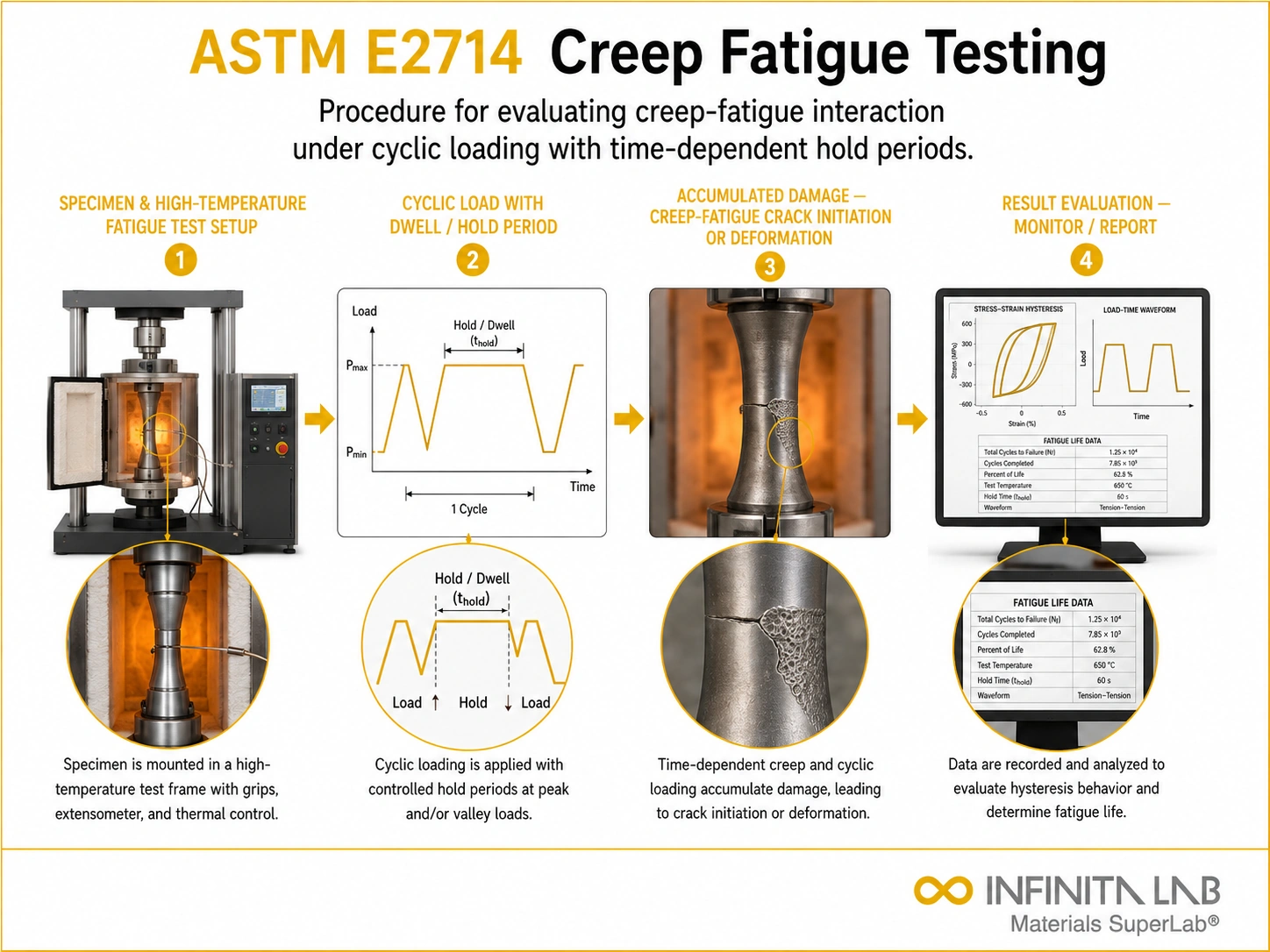
ASTM E2714 test method explains the mechanical properties of homogeneous materials by creep-fatigue deformation or cracks formation under isothermal conditions. The strain values are considered, and the cyclic measurements are taken while maintaining the temperature and quality of the material. The final results are expressed in SI units.
TRUSTED BY


ASTM E2714 Creep-Fatigue Testing
- Overview
- Scope, Applications, and Benefits
- Test Process
- Specifications
- Instrumentation
- Results and Deliverables
ASTM E2714 Creep-Fatigue Testing Overview
ASTM E2714 is the standard test method for creep-fatigue testing of metallic materials under isothermal conditions. Most high-temperature structural components -turbine blades, exhaust manifolds, pressure vessel nozzles, reactor internals -do not experience either pure fatigue or pure creep in service. They experience both, simultaneously or sequentially, as cyclic mechanical loading is combined with sustained high-temperature exposure between or during load cycles. ASTM E2714 is designed specifically to characterize material behavior under those combined conditions.
The test is conducted on cylindrical specimens under strain-controlled axial loading at a constant, precisely maintained temperature. What distinguishes it from conventional fatigue testing is the inclusion of hold times -periods within each cycle during which the strain is held constant at the tensile peak, the compressive peak, or both. During those holds, the material relaxes through creep, and the stress response drops. The accumulation of creep damage during hold times interacts with fatigue damage from the cycling itself, and the combined damage drives crack initiation and eventual failure significantly faster than either mechanism acting alone.
The data generated -cyclic stress-strain response, stress relaxation during holds, hardening or softening trends, and the number of cycles to crack initiation and failure -feed directly into creep-fatigue life assessment models used by designers working to ASME, RCC-MRx, and similar elevated-temperature design codes.

ASTM E2714 Creep-Fatigue Testing Scope, Applications, and Benefits
Scope
ASTM E2714 covers the determination of creep-fatigue behavior of homogeneous metallic materials under isothermal, strain-controlled, axial loading conditions. The standard addresses the measurement of cyclic deformation behavior, including hysteresis loops, cyclic hardening and softening, mean-stress relaxation, and stress relaxation during hold periods. It covers tests with tensile holds, compressive holds, or holds at both peaks within each cycle. Temperature is maintained within ±2 °C of the specified test temperature throughout the test. Testing is performed on cylindrical specimens with a uniform gage section. Changes in the cyclic stress response identify crack initiation, and testing continues until failure is defined or a predetermined cycle count is reached. Results are expressed in SI units. The standard falls under the jurisdiction of ASTM Committee E08 on Fatigue and Fracture.
Applications
- High-temperature turbine blade and disk alloy characterization for aerospace engines
- Steam turbine and boiler component material qualification for power generation
- Nuclear reactor structural material evaluation for elevated temperature service
- Exhaust system and turbocharger component material selection for automotive applications
- Petrochemical reactor and heat exchanger component creep-fatigue life assessment
- Development and validation of creep-fatigue life prediction models
- Material data generation for ASME Boiler and Pressure Vessel Code elevated temperature design
- Research on damage mechanics and the interaction between creep and fatigue in advanced alloys
Benefits
- Directly simulates the combined damage mechanism experienced by components in high-temperature cyclic service.
- Hold time variables can be adjusted to match actual service duty cycles
- Provides cycle-by-cycle stress-strain data that captures hardening, softening, and relaxation behavior
- Identifies the crack initiation point from the cyclic stress response without requiring additional instrumentation
- Generates data in the format required by elevated temperature design codes
- Applicable to nickel superalloys, austenitic stainless steels, ferritic steels, titanium alloys, and other high-temperature structural metals
- Results support both material selection decisions and remaining life assessments for in-service components
ASTM E2714 Creep-Fatigue Testing Process
Specimen Preparation and Setup
Cylindrical specimens with a uniform gage section are machined to the dimensional requirements of the standard.
1Temperature Stabilization and Pre-conditioning
The furnace or induction heating system brings the specimen to the specified test temperature.
2Creep-Fatigue Cycling with Hold Times
Strain-controlled cycling is applied at the specified strain range, strain rate, and waveform.
3Crack Initiation Detection and Post-Test Evaluation
Crack initiation is identified from a defined percentage drop in the tensile peak stress relative to the half-life reference value.
4ASTM E2714 Creep-Fatigue Testing Technical Specifications
| Parameter | Details |
|---|---|
| Standard | ASTM E2714-22 |
| ASTM Committee | E08 – Fatigue and Fracture |
| Test Mode | Strain-controlled, axial loading under isothermal conditions |
| Hold Period Types | Tensile peak hold, compressive peak hold, or both |
| Temperature Control | Maintained within +/- 2 degrees C of the specified test temperature |
| Applicable Materials | Metallic materials -nickel alloys, stainless steels, ferritic steels, titanium alloys |
| Crack Initiation Criterion | Defined percentage drop in tensile peak stress from half-life reference |


Instrumentation Used for ASTM E2714 Creep-Fatigue Testing
- Servo-hydraulic or servo-electric axial fatigue testing machine with strain control capability
- High-resolution extensometer for direct gage section strain measurement
- High-temperature furnace or induction heating system
- Thermocouples for temperature monitoring and closed-loop temperature control
- Data acquisition system for continuous cycle-by-cycle recording of load, strain, and temperature
- Optical or contact crack detection system for initiation monitoring
- Precision load cell calibrated for the expected force range
ASTM E2714 Creep-Fatigue Testing Results and Deliverables
- Cyclic stress-strain hysteresis loops at selected cycle intervals throughout the test
- Peak tensile and compressive stress as a function of cycle number (cyclic hardening/softening curves)
- Stress relaxation data during hold periods for each recorded cycle
- Number of cycles to crack initiation (Ni) and to failure (Nf)
- Stress range, strain range, and mean stress at half-life
- Inelastic strain range and elastic strain range components
- Post-test fractographic images and failure mode classification
- Full test report with all cycle data, waveform parameters, temperature records, and specimen details formatted for materials database entry or design code application
Frequently Asked Questions
It assesses the relationship between creep and fatigue damage, deformation, and the initiation of cracks in solid materials in general.
Tests are performed while maintaining a temperature within ±2°C of the specified temperature.
It includes a tension-compression fatigue machine, an extension gauge, and a crack observation apparatus.
Cyclic stress-strain and deformation, hardening/softening, and crack-forming cycles.
It helps create and control the quality of the materials, as well as choosing materials that are strong enough and without defects.
Why Choose Infinita Lab for Advanced Materials Testing and Characterization?
At the core of this breadth is our network of 2,000+ accredited laboratories across the USA, offering access to over 10,000 testing methods and analytical services. From advanced materials characterization (SEM, TEM, RBS, XPS) to mechanical, chemical, environmental, biological, and standardized ASTM/ISO-compliant testing, we deliver unmatched flexibility, specialization, and scale. You are never limited by geography, facility, or methodology — Infinita Lab connects you to the right expertise and testing solution, every time.

Looking for a Trusted Partner for Accurate and Reliable Testing Services?
Send query us at hello@infinitlab.com or call us at (888) 878-3090 to learn more about our services and how we can support you.



Request a Quote
Submit your material details and receive testing procedures, pricing, and turnaround time within 24 hours.
 Quick Turnaround and Hasslefree process
 Confidentiality Guarantee
 Free, No-obligation Consultation
 100% Customer Satisfaction
